
January 3, 2006
Reading the "Augmented" Digital Text: AR Volcano
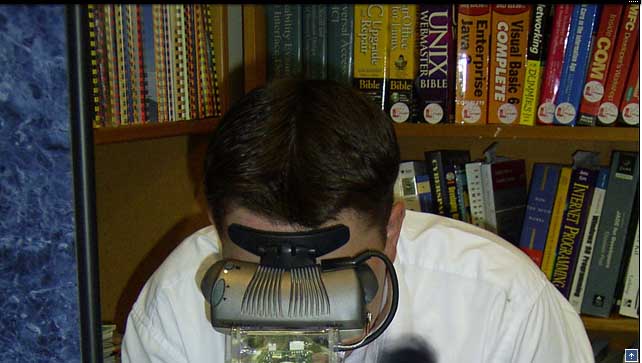
When we talk about "digital textbooks" here at Next/Text, we're usually referring to textbooks that have moved from the printed page to the computer screen. But there are other types of digital texts -- and digital learning environments -- that move beyond the boundaries of the screen to rethink our assumptions of what books might be. One example is the use of augmented reality to create texts which resemble books in their basic physical form, but have features that dramatically alter the experience of reading and learning.
Over the past five years, HCI engineer Mark Billinghurst (formerly based at the University of Washington and now director of the Human Interface Technology Lab at the University of New Zealand) has been working on a series of "magic books" which use AR technology to project three-dimensional animations off of each page, allowing the user to learn about a topic by watching a series of scenarios and demonstrations at their own pace. AR Volcano, created with the assistance of Eric Woods, Graham Aldridge, uses AR to teach students about the science of volcanoes, including details on tectonic plates, subduction, rifts, 'the ring of fire,' volcano formation, and eruptions. I'm going to discuss this project here, with the caveat that I haven't used it: I've only read through articles and documentation and watched a few demonstration videos.
What is augmented reality? While most digitally literate folks might be familiar with virtual reality, augmented reality has generally gotten less attention. An article from from the April 2002 issue of Scientific American neatly outlines the differences between the two media:
Augmented reality (AR) refers to computer displays that add virtual information to a user's sensory perceptions. Much AR research focuses on "see-through" devices, usually worn on the head, that overlay graphics and text on the user's view of his or her surroundings. (Virtual information can also be in other sensory forms, such as sound or touch, but this article will concentrate on visual enhancements.) AR systems track the position and orientation of the user's head so that the overlaid material can be aligned with the user's view of the world. Through this process, known as registration, graphics software can place a three-dimensional image of a teacup, for example, on top of a real saucer and keep the virtual cup fixed in that position as the user moves about the room. AR systems employ some of the same hardware technologies used in virtual-reality research, but there's a crucial difference: whereas virtual reality brashly aims to replace the real world, augmented reality respectfully supplements it.
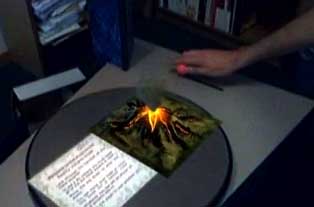
The image above illustrates how Billinghurst's AR Volcano supplements the reality of the "book" that the user encounters. Without goggles, someone approaching AR Volcano would only see what looked like a conventional paper book propped (albeit one which is only six pages long) on a podium. With the goggle, the computer software recognizes special patterns embedded in the book and replaces them with photo-realistic 3D objects. In this photo, a volcanic eruption takes place over the course of several minutes. The image will appear no matter where the user positions themselves around the book, and a new image can be seen by simply turning the page.
AR Volcano has a significant feature that sets it apart from Billinghurst's previous magic books and makes the technology much more suitable for creating learning environments. In earlier books -- such as the Black Magic Book, which tells the story of the America's Cup Race -- the user was positioned as a passive spectator in an enhanced "reading" environment. AR Volcano, however, provides an interactive slider that allows the user to control volcano formation and eruption as well as the movement of tectonic plates. In the image above, the slider (a physical slider attached to the book podium), is adjusted so that the volcano is erupting at a rapid pace; in the image below, the slider is adjusted downwards so that the movement of tectonic plates on the earth's surface occurs more gradually. The audio narrative also adjusts, so that it keeps pace with the user's movement through the pages of the book.
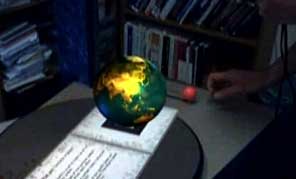
Another useful feature, common to all "magic books," is a zoom function connected to the user's experience of physical space -- simply put, as a user moves physically closer to the book the image grows larger, mirroring the experience of approaching an object in the real world. The photo below is taken from the vantage point of someone who has moved closer to the 3-D visualization of the earth's various layers in order to examine it more closely. Notice that the three-dimensional globe is overlaid with a two-dimensional text label which color-keys the layers indicated by the cross-section.
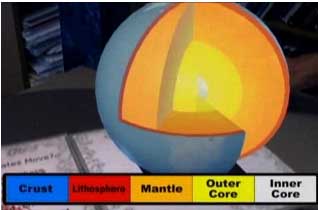
Since it reflects a user's bodily experience, the physical zoom enhances the reality effect of AR books; ideally, the technology will evolve to the point where the augmentations will become less cartoonish and more natural, even "transparent" to the user. The improvement of what AR designers call the "immersion effect" is the focus of another project at Billinghurst's HIT lab, AR Relight, which attempts to improve shadow casting in 3D models.
Making AR more believable is only one of the challenges faced by researchers like Billinghurst; another is integrating interactive functions into a text in a manner that would make it more portable and booklike than AR Volcano; while the Black Magic Book resembles a conventional spiral bound volume, AR Volcano depends on its computerized podium. Since portability is one of the hallmark features of textbooks -- including digital ones, if one has a laptop -- the technology has a ways to go before it can emulate the combination of interactivity and portability of the Young Ladies' Illustrated Primer imagined by Neal Stephenson in his novel The Diamond Age, a book which uses the wonders of nanotechnology to generate three dimensional, interactively narrated animations to guide the protagonist through the challenges of her girlhood.
AR researchers probably won't need to wait for functional nanotechnology to make viable AR books that could be used in teaching contexts; medical books, for example, in which 3D visualizations emerge from the pages. Alternately, educational uses of AR might move away the book metaphor as a means of navigation: for example, a project called MARIE at the University of Sussex uses AR technology to allow students taking online courses to view and interact with three-dimensional objects that the instructor is describing. But AR has made its impact as a way of imagining a form of digital textuality that is not physically wedded a computer screen -- or, for that matter, to immersion in an entirely simulated world.
For those who are interested in experimenting with the technology themselves, Billinghurst and his group have released an AR toolkit, which they describe as "a collection of libraries, utilities applications, and documentation and sample code aimed at creators of augmented reality applications." The libraries allow users to capture images from video sources, process those images to optically track markers in the images, composite computer-generated content with the real-world images, and finally display the result using the graphics language OpenGL.
Posted by lisa lynch at 2:35 PM
November 20, 2005
The Book as Landscape: Hypermedia Berlin
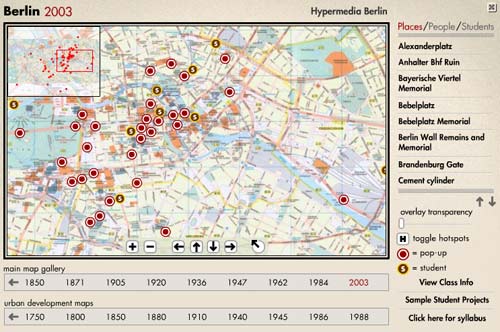
"Hypermedia Berlin represents an extraordinary achievement in accessible urban representation. Great cities like Berlin are densely layered and almost inconceivably complex palimpsests. Attempts to represent that historically-layered complexity have, for generations (since the rise of urban research), foundered on the rock of the printed page.
- Peer Response by: Philip Ethington, University of Southern California, 9.14.05
The page itself, one of the most fundamental components of the book, is undergoing a material and conceptual transformation as the static, flat, delimited space of the paper page gives way to the animated, interactive, unlimited, deep space of the digital book. "Hypermedia Berlin" - which grew out of a collaboration between the Stanford Humanities Laboratory (SHL) and UCLA's Center for Digital Humanities (CDH) - represents an excellent example of the formal innovation made possible by digital media. This project crafts an entirely new kind of page out of a gallery of highly detailed, interlinked, illustrated and annotated map interfaces, which can be navigated with an easy-to-use zoom feature. In other words, the page itself has been re-oriented to "landscape." This alternative book form organizes its content topographically and chronologically; encouraging readers to interact with and consider its subject differently. History, the map interface tells us, is tied as strongly to place as it is to time.
Presently, the site offers 25 navigable maps, "each map, corresponding to a key date in Berlin's nearly 800 hundred year history, consists of an array of virtual reality "hotspots," popup information screens, and critical essays documenting and analyzing significant regions, architectural structures, events, people, and cultural products from that moment in Berlin's history." Using the zoom function, students and scholars can study the maps in detail. The overlay function, which makes maps semi-transparent so that one can be placed on top of the other, allows the reader to analyze changes in Berlin's landscape.
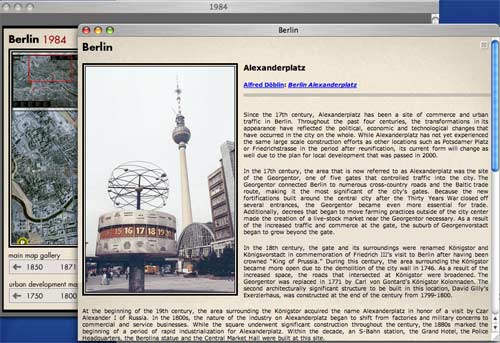
"Hypermedia Berlin" can be used as a multimedia teaching tool as well as a project-based learning environment. For an animated walk-through, visit the "Hypermedia Berlin" project page on the Vectors website.
Over the next two or three years, principle investigators Todd Presner and John Maciuika plan to work with developers to foster new growth for the site. They are connecting the site to a searchable archive of images, hypertext resources and primary sources on Berlin. And they are developing a content management system that will provide a multi-tiered authoring platform. This system will accommodate peer-reviewed contributions and open contributions. The open contribution platform will function like a blog, but posts will be date and location stamped to correspond to a site on the map. For example, a blog post could be connected to a location recently visited, a former residence, or the residence of a relative or ancestor. By providing such a platform, Presner hopes to create a "community memory of place," a memory that will continue accruing over time, as students, scholars and enthusiasts "build" their stories into the landscape.
"Hypermedia Berlin" presents an intriguing possibility. If it is able to harness the power of the network to attract a sufficiently large cache of stories and images and if it can continue receiving an unlimited and ever-growing flow of contributions, then it will succeed in reflecting (in the virtual space) the evolution and complexity of the city itself. An exciting prospect.
Posted by kim white at 5:02 PM
November 17, 2005
Biofutures: Owning Body Parts and Information
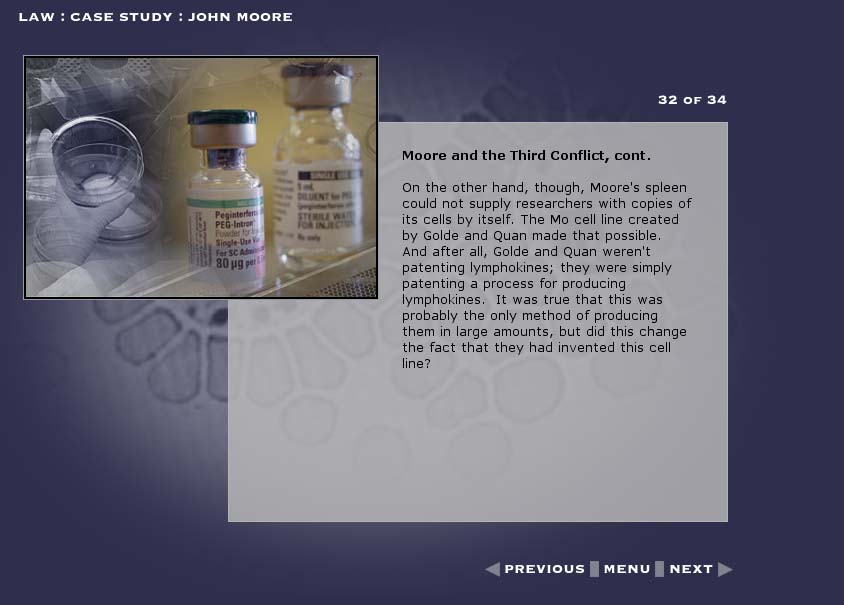
Biofutures, a DVD-ROM about biotechnology and culture currently under development, grew out of conversations between three humanities scholars who shared a common interest in emerging forms of biotechnology. Rob Mitchell, an English Professor at Duke University affiliated with the Duke Institute for Genome Science and Policy and Phillip Thurtle, a molecular biologist turned anthropologist who now teaches at the University of Washington, had both encountered - translation problems - when trying to teach humanities students about biotechnology.
The two professors realized that if they were going to clearly communicate the social, cultural and legal issues that lay behind the case studies they tried to present, they had to find a simple way to get the science across. Aware that a conventional textbook or course pack would only bury their students in a tangle of sometimes overwhelmingly technical information, they decided to create a digital text of their own that could both sift through out the different types of issues connected with biotech research while providing accessible - and lively - explanations of the science involved.
In order to come up with a design for their project, Mitchell and Thurtle teamed up with Helen Burgess, a new media scholar teaching at the Program in Digital Technology and Culture at Washington State. Burgess had recently worked on DVD project that had similar goals of setting up a dialogue between science and society: The Red Planet: Scientific and Cultural Encounters with Mars (University of Pennsylvania Press, 2001). The team chose to divide the text into three primary chapters: Biology, which focuses primarily on the physiological, chemical, and technological processes that make biocommerce possible; Law, which discusses continuities and changes in intellectual property law that have determined the shape of contemporary biocommerce; and Culture, which examines the ways in which biocommerce has been represented in film, novels, and recent art projects.
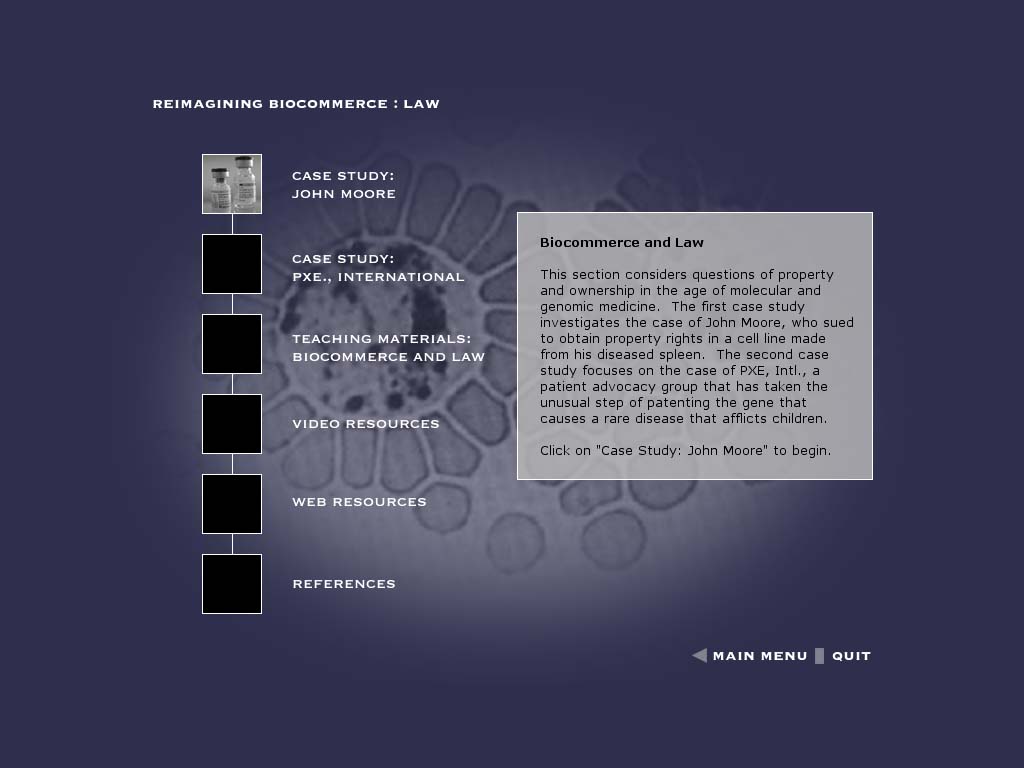
Each chapter in turn features two 'case studies,' which provide a strong underlying narrative. Moving from page to page in the case study narratives, the user encounters clickable items that provide different kinds (and levels) of explanatory item, including video interviews with experts from the fields of genetics, history, and law; video footage and computer animations of basic lab genetic procedures essential to biocommerce; and clips from popular films that have helped establish public perceptions of the possibilities and dangers of biocommerce. Beyond these "case studies," chapters also provides teaching resources and external links.
In developing these items, Burgess has managed to achieve a delicate balance between depth of contextual content and the forward motion of narrative. Since the clickable items are a reasonable length - and the case study are sufficiently compelling - the user never feels sidetracked or distracted by the information presented; the narrative spell is not broken.
One of the most appealing features of Biofutures is that the demonstrations and expert interviews provide a sense of getting first-hand information from many different disciplinary perspectives at once: while many attempts at the cultural studies of science are grounded in a specific discipline (anthropology, sociology, literary study), the truly interdisciplinary nature of this project makes it teachable in a wide variety of classrooms. According to Burgess and Mitchell, the scientists involved in the expert interviews have gotten more interested in the idea of teaching cultural and social perspectives through their participation in the project, and are looking forward to the release of the DVD.
A detailed description of the project is available here
Posted by lisa lynch at 11:32 AM
September 30, 2005
The Textbook Behind the Textbook: Western Civilization Course Portfolio
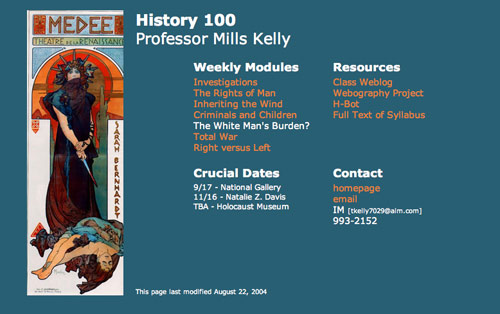
More than just a replacement for its print predecessor, the electronic textbook introduces new formats that help teachers improve course design and student learning. The public nature of online books can help transform the closed, teacher-centered, world of the lecture hall allowing students, teachers, and peer reviewers to examine and comment on all aspects of the course.
Dr. Mills Kelly's online textbook "Western Civilization" and the companion
Course Portfolio are an excellent case in point. The course portfolio is an open, running narrative of the course structure, goals, progress, conclusions, and, perhaps most importantly, the portfolio is "open to public scrutiny and is available to other members of the scholarly community for their use and elaboration." The course portfolio is the learning tool for teachers. It is a kind of textbook behind the textbook. Dr. Kelly used this twin-set (course portfolio and digital textbook) to answer the question, "how does the introduction of hypermedia into a history course influence student learning in that course?"

Dr. Kelly's creation of an online textbook and a course portfolio was part of an evolution in his thinking about the structure of the course itself. Over the years, he had become increasingly unhappy with the "coverage model introductory history survey course." Students, Dr. Kelly notes, have grown even more impatient with this format.
In survey after survey that I have conducted over the years, they tell me that the coverage model encourages the memorize-regurgitate-forget model of learning, but that a more focused approach helps them to think more carefully and to arrive at a deeper understanding of the material they are considering. In my surveys this year, fewer than 10% of the students said they preferred a coverage model course to one taught in a more focused manner.
To focus his teaching, Kelly decided to determine what the learning objectives for the course were and how he was going to assess whether or not the students had achieved the desired results. He followed Howard Gardner's advice, that a course should be designed with three concrete objectives in mind: "engage the central problem of the discipline, help students realize that source materials and subject matter do not exist in a pristine vacume, and give them opportunities to come at the same question or evidence from different perspectives."
Rather than approaching the curriculum as a chronology, (Plato to NATO in 14 weeks) Mills identified six essential concepts and broke the course into two-week blocks in which he addressed each of these main themes. Important events were discussed not in terms of what-happened-when, but in terms of how these happenings influenced larger concepts. The main objective was for students to gain skills and knowledge. Kelly's course design privileged understanding over information. He posted a detailed week-by-week chronicle of how the course unfolded.
Dr. Kelly's research led him to some interesting conclusions. He determined that students who access learning resources on the web display a higher level of recursive reading. According to Dr. Kelly, three-fourths of the students in the web sections went back to primary sources. Only one-fourth of students in the course section taught via print went back to materials assigned earlier in the semester. Their final essays bore out this finding, displaying a much lower use of sources assigned earlier in the semester.
Students I interviewed from the web sections said that because the documents they looked at from earlier in the semester were "just a click away," they were much more likely to use them. When I asked if they would have done the same thing with documents supplied in a course pack, all but one demurred, saying that, as one student put it, "having all that paper to sort through" would not be as immediate as a hyperlink. Or, as another student said in her interview, the web "is just easier to use than a book."
He found that the level of recursiveness was directly related to how well the web-based learning resources and assignments were designed.
He also concluded that the web does encourage independent investigation, but not as much as we would like, that the hypermedia revolution signals the doom of conventional history survey course, and historians must begin teaching web literacy. (He addresses this last conclusion in a more recent project, see below.)
Comments
The comment section addressed many interesting issues. I've decided to include excerpts from four authors on the two topics I felt were most important. First, there was a debate over Dr. Kelly's decision to focus on understanding rather than on facts.
Learning "facts" was not stated as a learning objective. One of the most widely touted examples of mediocrity in American public education is the dismal evidence that a significant proportion of people cannot correctly locate the Civil War within 50 years or so. Facts are important as a baseline for use of historical knowledge. -Samuel Thompson
This was refuted by Carolyn Schneider, who reminds us that reference books catalog the facts, but our job is to learn how the think and do.
ultimately, we don't want our students to KNOW as much as we want them to DO--which in our case would be THINKING, ANALYZING, EVALUATING--the "know" part they can always look up, and then that gets us to another "do"--which is research!
Another important point, had to do with the question of teaching vs. technology. Both commentors remind us that teaching is paramount, and solid course design always trumps technology.
I was struck by the extent to which student comments (Small Group Instructional Diagnosis) pertained not so much to web access as to the traditional classroom. Students remarked on the fact that you learned their names, that you delivered interesting lectures, that you encouraged discussions, that your grading focused too much on grammar, etc., etc. In other words, student consciousness of the web--whatever the reason--was certainly less over than my own. And perhaps that means--I should emphasize 'perhaps'--that the more conventional aspects of classroom teaching are still by far the most important thing in teaching, no matter whether the teacher hands them printed or web-accessible texts. -Dan Kaiser
This is especially noteworthy, to me, in your conclusions about technology and hypermedia--which do, as you say, have effects of various kinds but do not in themselves, alone, explain the most important things that do and do not happen in terms of student learning. What you show is that in a sense course design trumps technology. Or rather, technology needs to be seen as an aspect of course design rather than mostly as a different medium of delivery. This sounds obvious but I think it is not the dominant view. -Pat Hutchings

Dr. Kelly's Western Civilization Webography Project was a natural outgrowth of one of the conclusions he came to in his course portfolio research; historians must begin teaching web literacy.
Even the very best students simply do not think very much about whether or not a site is a good source of information. The only test most students impose on the sites they visit is a visual one--if the site appears to be very professional, then the information it contains must be valid.
The Webography project asks student to visit specific sites, rich with primary sources from European History. Students are given a rubric for analyzing the quality of the site. They review the site, assign it a numerical rating and write a brief review. These responses are posted to the database and made public. Dr. Kelly finds that this exercise significantly improves students' online research skills and, subsequently, the quality of their papers.
My on-going assessment of this project, dating back to the spring of 2003 is that very few of my students--meaning only one or two out of 50 in any given semester--turn in papers with poorly chosen websites once they have completed the webography project. In prior semesters as many as half of my students would receive reduced grades on writing assignments as a result of citing poor or misleading information from low quality sites.
In an email, Dr. Kelly told me of his latest efforts: "I have continued my research on the topics raised in my course portfolio, but have not put them into 'print.' Instead, I have funnelled my findings into various endeavors, such as World History Matters and the Western Civilization Webography Project. You'll see when you look at these, that I've veered from the more standard methods of representing my research into developing more practical applications of my findings for teachers and students."
Posted by kim white at 6:43 PM
August 1, 2005
Ivanhoe: An Online Playspace For Collaborative Interpretation
Back in 2000, University of Virginia English professors Jerome McGann and Johanna Drucker exchanged a series of emails in which they attempted to re-write the conclusion of Sir Walter Scott's epic romance, Ivanhoe. They did this to answer a question:
"How might the rewriting of a literary text provide self-conscious insight into the literary work and into the processes of interpretation constituted by any and every act of reading?"
The question stemmed from a larger preoccupation that they shared, namely that digital machines and the web are changing the way we read and process texts. The game of re-writing seemed somehow to fit with this. They wondered how this playful, interpretative experiment might be expanded and systematized for an online space - one that would allow multiple readers to interpret a text collaboratively, even competitively? Theories developed, diagrams were sketched, and before long, the foundations were laid for an exciting new approach to textual studies.
The Ivanhoe exercise led to a series of classroom experiments - interpretive games played around a variety of literary texts from Wuthering Heights to A Wrinkle In Time. The games were essentially collaborative research projects, and made use of the limited tools on hand, chiefly blogs. But the theoretical discussions that coincided were all focused on building some kind of specialized tool, a virtual game board. This was taken up by UVA's Applied Research in Patacriticism initiative in collaboration with the Speculative Computing Lab (SpecLab), bringing together textual studies, visual theory and serious programming power.
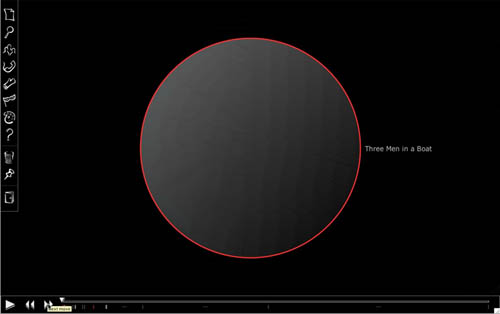
In its present form, Ivanhoe is an online playspace for multi-player collaboritive interpretation. Each player chooses a role, which is at the very least a kind of moniker, and at most an entirely new persona through which they will engage the text and other participants. A game is made up of "moves." A move might be a gloss, a comment, a re-write of a text, the presentation of a new document, an entry in a journal etc. Each player must provide justification before "publishing" a move, and once the move is published it is permanently logged in the game.
Like any great classroom discussion, a game can veer into tangential territory, new evidence can come to light, and playful inventions can arise. In the playspace, each of these developments, large and small, assumes a visual presence on the subjective landscape. It is a landscape that is constantly shifting, in part because it depicts a living process, but also because the point of view is always moving from player to player. This, too, is depicted visually. When one point of view is selected, its relationship to other players and to various moves and documents is highlighted.
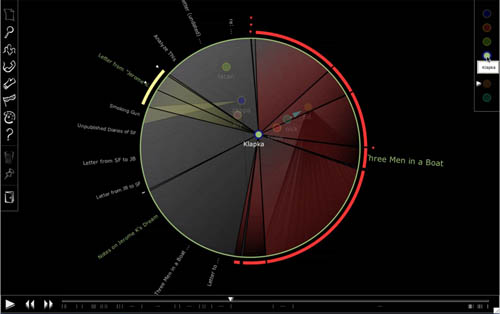
As stated in the online demo: a "role's position in the discourse field is the product of their relation to other players and actions taken." When games become sufficiently complex, with multiple players entwined in multiple subjective trajectories, they begin to resemble Suprematist paintings, with circles, triangles and vectors cutting across the central sphere.
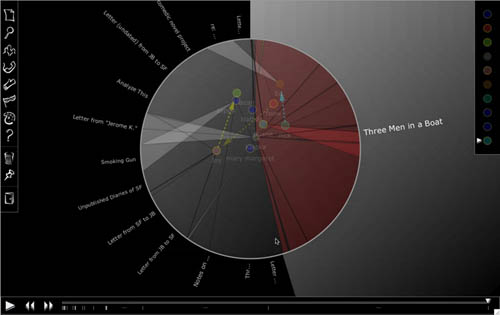
Ivanhoe is intended to investigate how human interaction with machines might illuminate and call attention to the interpretative processes of the individual reader. By situating these processes in a game space governed by certain rules and procedures, awareness is cultivated in the players of individual interpretive acts and of their place in a progression, or digression. It also asks how digital instruments and social software might facilitate collaboration - or even a more productive kind of competition - in the humanities. To quote from "Reflections on the Ivanhoe Game" in TEXT Technology (Drucker and Rockwell 1983) (download pdf), an article chronicling the project's history:
"Collaborative work is still novel in the Humanities, but will increase. Shared resources aggregated from geographically distributed collections create altered conditions for editing and study. Our aim is to concentrate the development of these features in a concerted effort towards increasing awareness of interpretation as a process. One might argue, in fact, that interpretation in its subjective and historical dimensions is the core activity of humanities."
Posted by ben vershbow at 10:51 PM
June 27, 2005
How Stuff Is Made: Using Wikis to Structure New Paradigms for Participation
How Stuff is Made (HSIM) is a student-authored visual encyclopedia documenting the manufacturing processes, labor conditions and environmental accounts of contemporary products. It is a collaboratively produced, independent, academic, wiki-based publication. Encyclopedia entries are summative photo essays created by engineering, design and art students guided by faculty who ensure high standards of evidence. (website FAQ page)
The project was initiated by Natalie Jeremijenko, of the University of San Diego. Inspired by the popular "How Stuff Works" website, Jeremijenko created an alternative format that would require her students to look more deeply, and more critically, at the objects they crave. Each semester, students must research a product, complete a photo essay that describes how it is manufactured, and publish the results on the HSIM wiki.
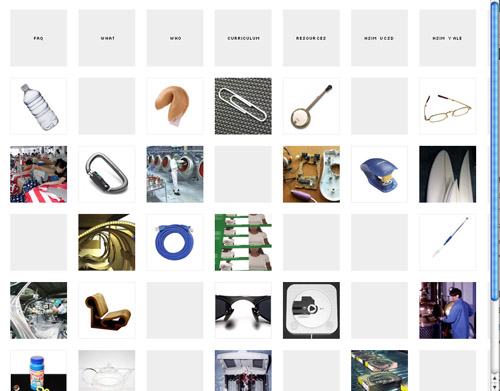
To complete their essays, students must gain access to the manufacturing process. This requirement lessens plagiarism, encourages higher standards of evidence, and helps student gain valuable insight into the human and environmental cost of consumerism. Additionally, as Jeremijenko notes, "it is not a bad idea if students of business, engineering and design are required to visit a manufacturing facility at least once in their college career." When the finished essays are published to the wiki, students must send notification to the product manufacturer with instructions regarding where to find the essay and how to edit its contents.
This project represents an interesting alternative to textbooks. Rather than passively receiving information, students are required to participate in the creation of open source knowledge. This helps them understand the process of knowledge creation and sharpens their critical faculties. Additionally, publishing an essay to a public site, heightens accountability. Students have been known to continue editing their wiki articles long after class is over.
In her abstract for the Share, Share Widely conference, Dr. Jeremijenko claims that the HSIM project provides "...evidence that the way we structure participation changes what information is produced, who produces it, and how it circulates." Additionally, the work "provides material to question what these changes may mean for learning."
Posted by kim white at 10:11 AM
June 14, 2005
Decameron Web: A Growing Hypermedia Archive of Materials Dedicated to Boccaccio's Masterpiece

A true encyclopedia of early modern life and a summa of late medieval culture, the Decameron is also a universal repertory of perennially human situations and dilemmas: it is the perfect subject for an experiment in a new form of scholarly and pedagogical communication aimed at renewing a living dialogue between a distant past and our present.
Started by graduate and undergraduate students in 1994 at Brown University's Italian Studies program, under the direction of Prof. Massimo Riva, Decameron Web has grown steadily up to the present day, providing a broad range of resources for scholars, students and general readers. Decameron Web suggests what might come to replace the conventional print textbook in the humanities: a dynamic learning environment through which investigators (at varying levels of experience) can trace trajectories.
The site can serve as a primer for newcomers to the Decameron, with useful sections on Boccaccio's period and literary influences, and profiles of major characters and themes. A more advanced scholar can take advantage of complete, searchable texts in Italian and English, period music recordings, an extensive critical bibliography, and analytical tools such as a motif index and a concordance. The "pedagogy" section provides resources that teachers and students can use in their courses - reading guides, sample papers, course modules, and a variety of articles on the meaningful use of technology in the classroom.

Decameron Web is not a static space:
...this collection of materials will continue to grow in years to come, as students and scholars at Brown University and other institutions contribute syllabi, successful teaching strategies, new essays, interpretations, images, and so forth.
It is, however, more closed than open. Authority is maintained by strict editorial oversight, and new modules, syllabi and resources are added through these filters. As it stands now, Decameron Web is an outstanding reference work with an array of useful tools. The site changes slowly over time, but does not at present provide forums for the community to engage with itself. The network of scholars and students that has arisen around Decameron Web would be well served by a more dynamic social software platform, one that could be built into the existing architecture. This could consist of a simple discussion board, or a community weblog for news and developments. It could also include more sophisticated tools like multi-player analytical games, or spaces for collaborative projects. We believe this should be the next stage of Decameron Web's evolution - to truly explore a "new form of scholarly and pedagogical communication."

(page on Pasolini's film of The Decameron)
Posted by ben vershbow at 11:29 AM