
October 14, 2005
Analog to Digital: The Electronic Bedford Handbook
What happens when textbooks go digital? Diana Hacker's Electronic Bedford Handbook 6.0 offers a unique opportunity to explore that question. The digital version of her best-selling grammar handbook retains the content and design of the print edition, while introducing new ways of organizing, navigating, updating, presenting lessons, and customizing.
A Different Way of Organizing
Hacker's book makes an interesting case study of what happens when a textbook moves from analog to digital. The content is word-for-word the same as the print version, but digital architecture enables a new way of organizing the information. Examples appear as links, which activate pop-out pages (annotations). This allows the author to place the illustrations exactly where they are mentioned without interrupting the flow of the text. The printed page forces a kind of lateral organization, with illustrations expanding chapters like urban sprawl, disorienting the reader as the main text is continually interrupted. The digital version, with its pop-out annotation feature, creates a sense of deep space that allows the reader to think of an example as an idea stacked underneath the main idea.
A New Way of "Paging" Through the Book
The forward/backward arrow buttons at the bottom right corner mimic the page-turning action of a paper book, but that is where the similarities end. Navigation in the electronic version is practical, intuitive, and instantaneous. In addition to the requisite left-hand sidebar navigation, the Bedford Handbook provides hot links to all citations. These links take readers directly to the handbook page mentioned (getting back, however, is not as easy) or to the companion website. Section heads in the upper right corner, have a useful menu of links to all subsections and to chapter exercises.
Staying Up-to-Date
Direct connections to the more-frequently-updated companion website allows the electronic handbook to stay current longer than a stand-alone print version could. The companion site also includes relevant links to web-based reference information, which further expands the scope of the handbook.
Interactive Exercises
The electronic handbook reimagines the grammar lesson as an interactive experience. The tutorials provide clear and instantaneous feedback. Students find out why an answer is right or wrong. I tried a few of the exercises and, in addition to being more informative than their print predecessors, the tutorials had the feel of a game. I was actually having fun and I imagine students will also find these lessons more engaging than their print counterparts.
Preserving the Handbook "feel"
The electronic version is about the same size as the print book, which gives it a charming handbook feel. However, the book cannot be resized, and this raises legibility issues. Illustrations on page e-57, for example, show rough and final drafts of a student paper in five point type, barely readable on the screen.
Customization
This digital textbook allows students to do all the things they might normally do to a print textbook: dog-ear pages, highlight passages, attach post-it notes, annotate. Unlike the print version, however, these digital markings can be automatically compiled and searched. This lets students and teachers create customized versions of the textbook. Grammar reference books in particular seem to call for customizability. When you type "grammar module" into the Google search engine it returns over one and a half million instances. Every major publisher of textbooks has a grammar book and most colleges and universities publish their own web-accessible reference work on the subject. Innumerable self-published works by teachers and editors are also available.
I'd like to suggest that this profile represents a tip of the iceberg view of this particular subject area. I've selected the Bedford Handbook because it represents a standard of excellence and because its best-selling print ancestor allows us to compare/contrast print and digital versions. However, a cursory review of offerings available online (in many cases for free) indicates that there are other excellent examples and that the grammar unit is a good case-in-point for the diversity and customizability engendered by digital media.
I'm interested to hear from readers on this subject. Do you use customized digital assets to teach grammar? And if so, what have you found to be most useful? Are there resources you can point to that specifically address dyslexic students, ESL students, sight impaired students, or other special cases? Is a comprehensive resource like The Bedford Handbook more useful for you or do you assemble your own collection of reference material?
Posted by kim white at 8:53 PM
September 21, 2005
Writing about Literature in the Media Age
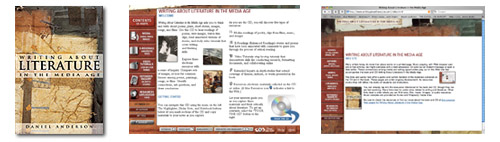
Publishers are addressing the need for multiple media in the textbook marketplace by placing additional assets on CD-Rom and/or password-protected companion websites, and packaging them inside printed textbooks. This ubiquitous trio of resources reflects the inevitable (if glacial) move away from exclusive dependence on print media.
Daniel Anderson's "Writing about Literature in the Media Age," published by Pearson Longman, pushes the print/media genre forward a bit. Mr. Anderson's project weaves a network of connections that draw the separate elements together, and attempt to close the unavoidable gap between print and multimedia resources.
Most interesting of the media trio is the CD Rom, which provides students with extensive media assets for study and introduces strategies for close scrutiny of multimedia resources. The CD is divided into five sections: media, e-readings, video tutorials, extended inquiry, and resources.
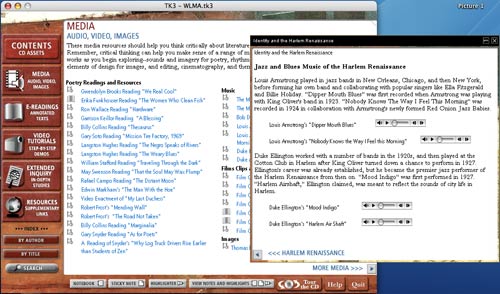
The media section includes audio, video and images that correspond with readings in the print textbook. Below is a screen-grab of a page that offers audio samples of Harlem Renaissance poets and musicians. Asking a student to consider poetry and music side by side creates a unique opportunity for understanding how artists communicate across disciplines. It also allows them to survey the aural landscape of a literary work, and to consider how sound and rhythm are employed by skillful writers.
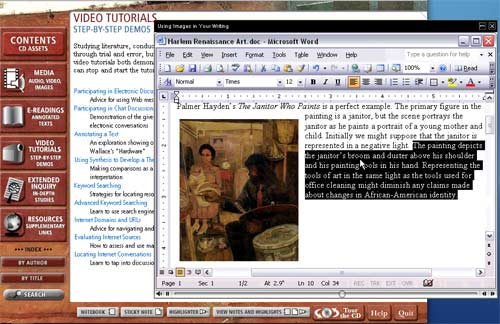
Most unique and useful are the video tutorials. Brief, but through mini-lessons on topics like: "Annotating a Text," "Giving Feedback Electronically," and "Using Images in Your Writing" (pictured below). The "Using Images" tutorial provides a clear example of how an image can enhance a written argument. It also gives the student instructions about how to place an image in a Word document, how to size the image and how to crop the image to focus the reader on a specific detail.
The "Extended Inquiry" section features five in-depth studies including, "The Political and the Personal In Hamlet." The print book has a corresponding section that includes the full text of Shakespeare's "Hamlet," along with a small sample of works created in response to the play. Among them, Margaret Atwood's short story, "Gertrude Talks Back"; Frederick Seidel's poem, "Hamlet"; and a black and white reproduction of John Everett Millais' "Ophelia." These responses to Hamlet introduce the lesson of artistic influence that the unit aims to teach. According to the book:
The works of Shakespeare have an incredible reach. Not only are quotations from his plays thrown around in our daily discourse, the larger messages of his works have become ingrained in the consciousness of contemporary society. Numerous artists have responded with paintings that represent scenes from Shakespeare's plays. Writers have composed adaptations and works that take up the key questions raised by the plays. Theatre companies have produced version of works like Hamlet continually for 400 years, and filmmakers regularly adapt Shakespeare's plays for the cinema.
The CD extends this argument with a color reproduction of John Everett Millais' "Ophelia," a reading of Hamlet's "to be or not to be" soliloquy, and video clips of scholars interpreting Hamlet. The Writing About Literature website extends the Hamlet inquiry even further with links to regularly updated online material.
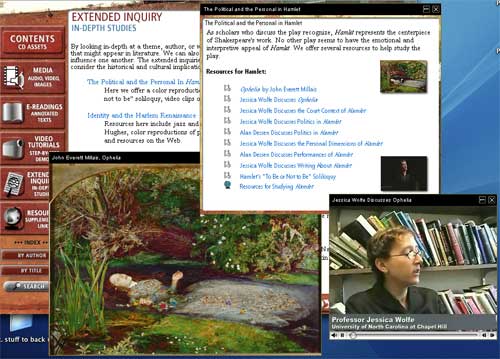
Including these media items gives a graphic representation of the "incredible reach" that the work has. It shows the diversity and complexity of artistic influence and it draws the student closer to an understanding of what literary scholars do as they attempt to consider the work from all relevant angles. Additionally, the concept of "extended inquiry" (central to all scholarly work) is illuminated by the interweaving of book, CD, and web resources.
Posted by kim white at 11:25 AM
August 29, 2005
The Colombia Project: A Portable Mini-Language Lab
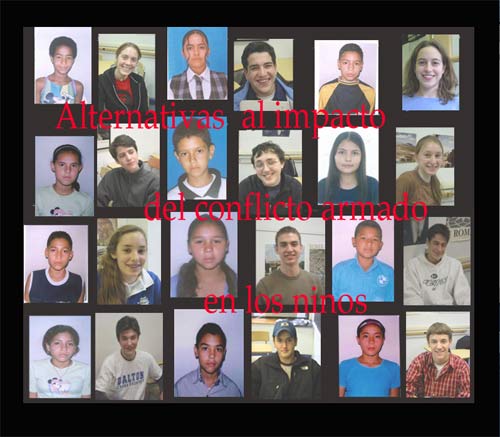


Until recently, the use of technology in language labs didn't go much further than pre-recorded audio to introduce the vernacular of native speakers, or a videotape to contextualize cultural issues. These canned, artificial products often presented generalized or stereotyped notions of life in foreign countries and rarely addressed harsh realities such as war, poverty, and internal displacement. Student interaction with these objects was equally artificial and seldom involved critical thinking or personal introspection.
Sol Gaitan, a high school teacher at the Dalton School in Manhattan, has found a way to use multiple media to create a learning environment for the foreign language classroom that goes well beyond the traditional language lab. Her mini-lab exists within a composite assignment for her Advanced Spanish IV class. According to Ms. Gaitan, "the project targets the multiple language skills involved in the process of learning a foreign language." The project, built in TK3, employs images, sound, live links, and annotated text to increase student investment and add depth and complexity to the language lab experience.
The framework for the project asks Dalton students to consider the impact of war on children in Colombia. An opening slideshow includes photographs that highlight the harsh reality of guerilla warfare in order to introduce Dalton students to the daily conditions faced by children living in these areas.
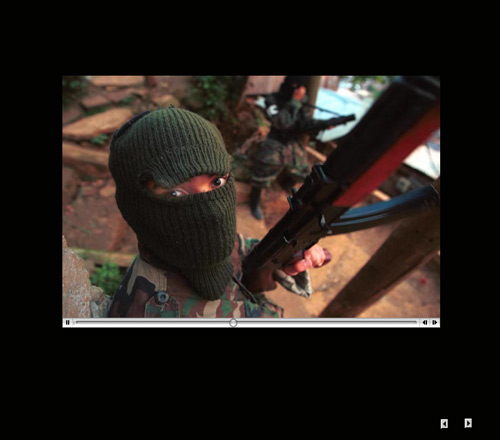
To prepare this project, Ms. Gaitan visited a school in Medellin, Colombia's second largest city. This particular school is located on the outskirts of Medellin, and is populated by people who have been displaced by war.
Ms. Gaitan asked the Colombian students to write essays about their lives. She took these handwritten documents back to New York to share with her students. The mini-biographies were scanned and incorporated into separate digital books. Each Dalton student received an essay written by a different Colombian student. They began the lab assignment by reading these short biographies, deciphering the handwritten text, and re-writing the essays in Spanish, correcting grammar and orthography.
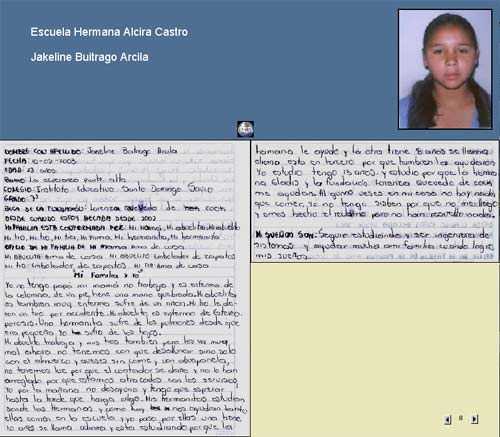
Once the essays were properly transcribed, students were assigned the task of translating them into English. Spanish and English versions were presented in parallel columns in the TK3 book, with a scrolling image of the primary source at the top of the page.

Students were then asked to think deeply about the material and to write an analytical essay addressing the impact of war and displacement on adolescents whose circumstances are different from their own. These essays were written in Spanish and added to the TK3 books. Students also produced short, improvised oral reactions to what they learned in the assignment. These oral exercises were recorded and included in their TK3 books. This year, Ms. Gaitan asked the students to produce dialogs instead of monologs. She found that dialogs, "gave the oral part a much more 'real' and impromptu character." She further improved the project by renaming it to emphasize the personal nature of the exploration:
The second time around, I called the project 'Reflexion/Reflejo. Vidas paralelas' and asked the students to see their Colombian counterparts as a mirror upon which they saw themselves, as a reflection (reflejo,) and then to write down their reflections (reflexion.) Their writing is much more personal than those of the previous year. The final pieces, complete with the dialogs, are sort of parallel lives (vidas paralelas.) Language, history and culture internalized this way, become intimate.
Instructor Sol Gaitan had this testimony about the success of the project.
Reading original manuscripts has exposed them to vernacular Spanish spoken by children their age in a way that printed text could never achieve. They have also realized how much Spanish they know, and how correct it is. They are thrilled to be authoring a little book on a topic on which they are becoming experts, thanks to the easy and direct access to the Internet provided by links created by me in the introductory material. For me, as language teacher, the icing on the cake is to have their oral commentary documented. This will allow me to assess each student's pronunciation patterns, fluency, and ability to improvise.
Posted by kim white at 11:43 AM