<?xml version="1.0" encoding="utf-8"?>
<feed version="0.3" xmlns="http://purl.org/atom/ns#" xmlns:dc="http://purl.org/dc/elements/1.1/" xml:lang="en">
<title>next\text</title>
<link rel="alternate" type="text/html" href="http://www.futureofthebook.org/next/text/" />
<modified>2006-05-10T22:58:41Z</modified>
<tagline></tagline>
<id>tag:www.futureofthebook.org,2007:/next/text/8</id>
<generator url="http://www.movabletype.org/" version="3.2">Movable Type</generator>
<copyright>Copyright (c) 2006, ray cha</copyright>
<entry>
<title>Teaching Math with OSSLETS: Open Source Sharable Applets</title>
<link rel="alternate" type="text/html" href="http://www.futureofthebook.org/next/text/2006/05/teaching_math_with_osslets_ope.html" />
<modified>2006-05-10T22:58:41Z</modified>
<issued>2006-05-10T21:28:36Z</issued>
<id>tag:www.futureofthebook.org,2006:/next/text/8.2055</id>
<created>2006-05-10T21:28:36Z</created>
<summary type="text/plain"> After viewing many examples of digital textbooks and learning objects, I have come to realize the importance of including teaching guides to help teachers incorporate these learning objects into their claases. Offering digital texts or exercises is only part...</summary>
<author>
<name>ray cha</name>

<email>ray.cha@gmail.com</email>
</author>
<dc:subject>websites</dc:subject>
<content type="text/html" mode="escaped" xml:lang="en" xml:base="http://www.futureofthebook.org/next/text/">
<![CDATA[<p><img alt="osslet.jpg" src="http://www.futureofthebook.org/next/text/osslet.jpg" width="450" height="336" /><br />
After viewing many examples of digital textbooks and learning objects, I have come to realize the importance of including teaching guides to help teachers incorporate these learning objects into their claases.  Offering digital texts or exercises is only part of the process. Here is an example that shows how learning objects which help teach mathematics can be presented to provide math teachers with the exercises, building tools and open source code that will assist them in applying the learning objects in the classroom.</p>

<p>The <a href="http://mathdl.maa.org/mathDL/3/?pa=content&sa=viewDocument&nodeId=1032">Open Source Sharable Applet</a> (OSSLET) Collection is part of the Mathematical Sciences Digital Library, hosted by the Mathematical Association of American.  The collection contains only a few entries, however the open source and collaborative approach is compelling.  Overall, the design is simple but functional, with the interactivity being more important to the osslet's success.  Allowing students to manipulate objects in order to see  mathematical relationships in real time cannot be replicated in print text.  Each applet demonstrates a mathematical concept through interactive exercises.  One can easily imagine, with an expanded collection, this resource could be used throughout an entire syllabus.  What this project needs (and I hope it finds) is a community with enough resources to contribute and develop the site to its potential.</p>

<p>To be included in the site the osslets, must be interactive, come with several curriculum units, work off the shelf, and be open source and editable. The initial examples use Flash and Director, whose sources files are also available for download.  Teachers without Flash or Director skills can use the pre-existing examples as well as use web forms to create new exercises. Discussion boards (which are admittedly underused) provide a space for teachers to share strategies and ask questions.</p>]]>
<![CDATA[<p><img alt="parameter.jpg" src="http://www.futureofthebook.org/next/text/parameter.jpg" width="450" height="380" /><br />
1. <a href="http://mathdl.maa.org/mathDL/3/?pa=content&sa=viewDocument&nodeId=1059">Multiparameter Animation</a>:<br />
Kerry Moore and Frank Wattenberg's "the Multiparameter Animation" osslet animates various functions to show students the effect of changing a parameter of a function.  Students can both watch the function animate automatically or adjust the parameters themselves.  The function is one of the most basic ideas in mathematics.  Being able to understand how parameters similarly work across all functions is crucial to understanding higher level mathematics.   </p>

<p>Moores and Wattenberg of the United States Military Academy provide the most fully developed resources to go along with the exercises.  The curriculum units offer full lesson plans on how to use the examples in a classroom. For instance, in the data-fitting exercise using the World Records for the Mile Run, students first see the raw data, and then the data plotted on a graph. Students, then use the controls  to fit a line to the data, thereby estimating the function which describes the data.  The lesson utilizes pedagogical concepts including inquiry-based and contextual learning through real world examples.  The authors also include a web form tool to create examples of new functions and graphs for students use.  In the case where the teacher knows how to use Director, they can have access to the actual source files and code.</p>

<p><img alt="linear.jpg" src="http://www.futureofthebook.org/next/text/linear.jpg" width="450" height="339" /><br />
2. <a href="http://mathdl.maa.org/images/upload_library/3/osslets/101linearTransformation/index.html">Linear Transformation</a>:<br />
Linear Algebra is used across many areas of advanced mathematics.  The Linear Transformation is a basic concept used in Linear Algebra, which involves the manipulation of vectors.  Jack Picciuto and Frank Wattenberg of the United States Military Academy created The Linear Transformation osslet and accompanying resources to be able to be used for a variety of applications and degrees of difficulty.  Students manipulate vectors on a graph to see how their values are related to each other.  Both quick examples and fully developed curriculum units are provided.  As well, extensive resources and instructions on how to create new exercises and sample exercises using a web form are included.  As with the Multiparamenter Animation osslet, teachers can download the Director source files.</p>

<p><img alt="planar.jpg" src="http://www.futureofthebook.org/next/text/planar.jpg" width="404" height="274" /><br />
3. <a href="http://mathdl.maa.org/images/upload_library/3/osslets/102PlanarGraphs/planarOverview.html">Planar Graphs</a>:<br />
The Planar Grapher Tool, developed by Doug Ensley of Shippensburg University, helps student understand connections between planar and non-planar graphs. Basically, a planar graph is a graph whose nodes (the dots in the figure) can be arranged such that the edges (the lines in the figure) do not cross.  This applet includes a sample exercise with instructions and questions to accompany the web-based activity.  As well, the osslet provides both step by step instructions to allow teachers to create their own Planar Graph exercises without using Flash, as well as, the Flash source files.</p>

<p>Mathematics is highly visual and interactivity, yet it is rarely taught in that matter. Recently, teachers have created an enormous number of small scale tools and modules which demonstrate and test mathematical concepts. However, they often act as permanent stand alone objects which other teachers cannot edit.  Further, the creators generally provide student directions on the operation of the learning object, but often fail to provide any guidance for teachers on how to integrate the material into a class lesson.  The OSSLET collection avoids these pitfalls.  More than offering simple-to-use tools, it provides enough support materials to assist other teachers.  The site is a strong model for future open source and collaborative math textbooks, however it is only a start.</p>]]>
</content>
</entry>
<entry>
<title>the blackout project: a networked history text</title>
<link rel="alternate" type="text/html" href="http://www.futureofthebook.org/next/text/2006/04/the_blackout_project_a_network.html" />
<modified>2006-04-19T00:59:05Z</modified>
<issued>2006-04-19T00:18:43Z</issued>
<id>tag:www.futureofthebook.org,2006:/next/text/8.1975</id>
<created>2006-04-19T00:18:43Z</created>
<summary type="text/plain"> Jim Sparrow, from the University of Chicago who also recently attended our next \ text history meeting, has created an intriguing project on the New York Metropolitan area Blackouts of 1965 and 1977. The Blackout History Project is an...</summary>
<author>
<name>ray cha</name>

<email>ray.cha@gmail.com</email>
</author>
<dc:subject>websites</dc:subject>
<content type="text/html" mode="escaped" xml:lang="en" xml:base="http://www.futureofthebook.org/next/text/">
<![CDATA[<p><img alt="blackout.jpg" src="http://www.futureofthebook.org/next/text/blackout.jpg" width="400" height="298" style="margin:15px; border:0px;" title="image sources=blackouts.gmu.edu"/></p>

<p>Jim Sparrow, from the University of Chicago who also recently attended our next \ text history meeting, has created an intriguing project on the New York Metropolitan area Blackouts of 1965 and 1977.  <a href="http://blackouts.gmu.edu/">The Blackout History Project</a> is an ethnographic history repository for the collected experiences of people who lived through either blackouts. A key strength to the site is the depth of layers of information. In addition to personal anecdotes, the Blackout site offers a historical context for these events through <a href="http://blackouts.gmu.edu/events/timeline.html">timelines</a> and articles written by both historians and <a href="http://blackouts.gmu.edu/archive/a_power.html">experts on the electric utilities</a>.  Covering everything from <a href="http://blackouts.gmu.edu/forum/interviews.html">audio clips of interviews</a> of survivors who witnessed the event to technical reports, people can explore the factors that led up to historic moment and its aftermath.  The site shows how, what was basically a failure of technology, reveals aspects of modern society as well.  Issues that arise range from a city's dependence on electricity to a spectrum of reactions across the city from looting to impromptus street fairs.</p>

<p><img alt="blackout3.jpg" src="http://www.futureofthebook.org/next/text/blackout3.jpg" width="400" height="294" style="margin:15px; border:0px;" title="image sources=blackout.gmu.edu/blackoutadd.html"/></p>

<p>Because the blackout are historical events that were directly experienced by millions of people there is a huge pool of potential sources to document.  The project capitalizes on its location in the network by displaying information as well as collection <a href="http://blackouts.gmu.edu/forum/surveys.html">survey</a> and <a href="http://blackouts.gmu.edu/forum/interviews.html">interviews</a> via the site.  Survivors were able to leave testimonials and then some where contacted for in depth interviews. Therefore, the site embodies not only a vehicle of the research, but the research results as well.  This diversity of information reveals new ways this text can be used in the classroom.</p>

<p>As a teaching resource, students from many disciplines can explore and learn from the primary and secondary sources provided. Science and engineering students can gain insight on the technology they build has direct influence on people.  For the history student, they have to opportunity to see the impact of technology on history, and how historical events evolve. In the promotion of inquiry based learning of history, students can also gain insight on how ethnography studies of this kind are implemented. Therefore, the Blackout Project makes explicit the processes that historians use. There are many opportunities to have students use these first hand accounts to construct their own ideas concerning the blackouts.  (It would be nice if the site is search engine to assist exploration for students and other users.)   Also, students can see how history is an ongoing, dynamic phenomena, rather than a static event.  In 2003, three years after the launch of the site, the East Coast including New York experienced another blackout.  After the Blackout of 2003, the project members built an additional space to share further accounts of this third historic event.  Students who lived through the Blackout can now enter their own experiences.   In showing how the networked historic document continuously grows over time, it creates new visions of what the born digital textbook can be.</p>]]>

</content>
</entry>
<entry>
<title>Cultura: a glimpse at the future of the student generated textbook</title>
<link rel="alternate" type="text/html" href="http://www.futureofthebook.org/next/text/2006/04/cultura_a_glimpse_at_the_futur_1.html" />
<modified>2006-04-10T17:57:17Z</modified>
<issued>2006-04-10T22:04:35Z</issued>
<id>tag:www.futureofthebook.org,2006:/next/text/8.1830</id>
<created>2006-04-10T22:04:35Z</created>
<summary type="text/plain"> Cultura is an methodology for foreign language learning created by Gilberte Furstenberg, Sabine Levet, Shoggy Waryn, and was first implemented at MIT. The premise of Cultura is to provide an authentic learning experience by supporting student discussion and interaction...</summary>
<author>
<name>ray cha</name>

<email>ray.cha@gmail.com</email>
</author>
<dc:subject>higher education</dc:subject>
<content type="text/html" mode="escaped" xml:lang="en" xml:base="http://www.futureofthebook.org/next/text/">
<![CDATA[<p><img alt="cultura_title.gif" src="http://www.futureofthebook.org/next/text/cultura_title.gif" width="511" height="122" /></p>

<p><a href="http://web.mit.edu/french/culturaNEH/">Cultura</a> is an methodology for foreign language learning created by Gilberte Furstenberg, Sabine Levet, Shoggy Waryn, and was first implemented at MIT.</p>

<p>The premise of Cultura is to provide an authentic learning experience by supporting student discussion and interaction between two foreign language classes, where each class is studying the other's native tongue in their respective countries.  Thus, a french class in the US partners with an English class in France.  Although immersion is the best method of learning a foreign language, spending extended time in a foreign country is generally not feasible for the vast majority of students.  Offering student authentic experiences in their language of study is a clear second choice to immersion, but can still greatly assist the learning process.</p>]]>
<![CDATA[<p>Students first answer a series of questionnaires, which have formats such as word association, sentence completion, and fill in the blank.  The students discuss the responses to the questionnaire in bulletin boards.  Teachers use both the answered questionnaires and the discussion boards in their classroom.  Interestingly, the students are directed to write in their native language. Although this may seems counter intuitive, the creators found through experimentation that the communication was much more meaningful in their own language.  Student read in their language of study, and teacher lead in-class discussions in the foreign language. Therefore, Cultura provides ample opportunity for students to practice the other language.  The founders allow anyone to use their methodology, however, they do request that teachers contact them so that they may track its usage. They have also made available past examples for teachers who do not have access to partnering schools. </p>

<p>Cultura not only creates motivation for learning, it actually creates an actual text for learning. Further, access to their contemporaries offer an experience of authenticity that is impossible to provide in traditional textbooks learning, partially due to the typical life cycle and generalization nature of textbooks. Further, students have an opportunity to ask questions and explore the culture of their partnering students in a way that was rarely available before now. In the most successful implementations of Cultura, students ask questions about not only language usage, but also on newly perceived understanding of cultural differences.</p>

<p>Cultura, in a way, creates an open source textbook.  The students create their own cultural foreign language textbooks with a level of that authenticity that traditional authors cannot match.  It transforms the entire idea of what a textbook can be and how it is written.  Cultura does not rely on complicated technology. Although Cultura is only feasible with the advent of the web,  it is not about the technology. The technology itself is quite simple, online surveys and discussion boards have been used since the early days of the internet. Often, digital textbooks are loaded with technical wizardry that <a href="http://slashdot.org/article.pl?sid=06/01/09/2316229">obfuscates the learning</a>, as seen in certain studies.  Different technologies can be used from hand coded html pages to CGI scripts. In fact, one could use off the shelf and often free services, such as survey monkey and yahoo groups, or the course management systems, such as <a href="www.sakaiproject.org">Sakai</a>  or Blackboard that many institutions now use.  Cultura hints that the next generation of textbooks and learning environments that will challenge what the textbook will look like, who will author it, and how it will utilize the network.</p>]]>
</content>
</entry>
<entry>
<title>learning from our next \ text history meeting</title>
<link rel="alternate" type="text/html" href="http://www.futureofthebook.org/next/text/2006/04/learning_from_our_next_text_hi.html" />
<modified>2006-04-08T10:56:47Z</modified>
<issued>2006-04-04T23:31:33Z</issued>
<id>tag:www.futureofthebook.org,2006:/next/text/8.1913</id>
<created>2006-04-04T23:31:33Z</created>
<summary type="text/plain">We recently held the first of a series of discipline specific meetings with higher education teachers who use new media in their teaching and scholarship. We invited leading American History scholars to share their thoughts and experiences with history and...</summary>
<author>
<name>ray cha</name>

<email>ray.cha@gmail.com</email>
</author>

<content type="text/html" mode="escaped" xml:lang="en" xml:base="http://www.futureofthebook.org/next/text/">
<![CDATA[<p>We recently held the <a href="http://www.futureofthebook.org/blog/archives/2006/03/next_text_new_media_in_history.html">first of a series of discipline specific meetings</a> with higher education teachers who use new media in their teaching and scholarship.  We invited leading American History scholars to share their thoughts and experiences with history and new media.  What is most exciting is that after listening to the group for the day, that we left an idea of what the next generation history textbook could be.</p>

<p>Some background findings.</p>

<p>1.  teachers / scholar<br />
We spent much on the day talking about applications of new media to this areas of study, however, we always circled back to the fundamentals of teaching (with or without technology), as it soon became apparent that these scholars viewed their teaching as equally important as their research.  Many of them first discovered the potential uses of technology with their teaching through using these tools in their scholarship.  </p>

<p>2. access to historical documents<br />
In the area of American History, teachers have access to vast array of primary historical documents that have been digitalized and made easily available.  Access to these documents changed their teaching, which lead to attendee's John McClymer's idea of a "pedagogy of abundance."  </p>

<p>3. "pedagogy of abundance" and  inquiry-based learning, <br />
We found that this group belonged to the higher echelon of teachers who limit the use of traditional textbooks, and place less importance on the rote memorization of historical facts. They encouraged an environment of inquiry and focused on the teaching objective of getting students to learn how historians think through a structured exploration of documents.</p>

<p>4. the spectrum of teaching approaches / needs. <br />
This group acknowledged that there is a range of history teaching.  Although they prefer the limited use of traditional textbooks, many still teachers adhere the traditional "march through" of the American History textbook.  Inquiry-based learning shifts some of the authority of the classroom to the student, which challenges the idea of the traditional lecturer's role of the interpreter of history.</p>

<p>What's next? </p>

<p>We envision the next \ text American History survey textbook to be a curricula which integrates teaching guides with digital archives of primary historical documents.  The teaching guides would address the teaching requirements of the spectrum of styles from the "march through" history lecturer to the independent instructor who wants to design her own course.  We are excited by support the transformation of how American History is taught.</p>

<p>Of course, much work still needs to be done. Active learning through student inquiry is a direct challenge to the entrenched lecture/ textbook teaching style.  We foresee sponsoring one or several master teachers to create and teach a digital primary document based curricula for a history survey course.  These curricula and experiences would be used to create guides for future teachers to use. Over time, existing guides for the same course could be refined and new guides developed to address the varying needs of the diverse landscape of higher education (from the large public university to the small liberal arts college to the community college.)   For example,  the nomadic and resource strapped adjunct teacher, who often relies the traditional narratives and exercises, would also have access to guides or pieces of guides that could be applied on an ad-hoc basis.  By offering a breathe of material, we acknowledge that radical changes in curricula cannot happen instantaneously.</p>

<p>To support these efforts, the coverage of the next \ text site will expand to address that teaching tools and resources are equally important to the creative teacher.  Since launching the next \ text project, we have been collecting exemplary works in education technology.  They span various media and hardware from CD-ROMs to websites to augmented reality goggles.  However, we have come to realize that many examples are not available to the general public and only show a portion of the changes occurring with teaching with new media.  Due to technological obsolescence, institutional firewalls, password protected Course Management Systems, subscription fees and limits of fair use, important and innovative applications of new media to education have limited accessibility.  The issues reveal larger underlying factors which influence the creation and sharing of syllabi and learning material,  including the economics of textbook publication, educational use of copyrighted material, and privacy. Further, these factors limit our ability to how they are being used in the classroom.  However, we clearly see from our history meeting that digital technology is changing the classroom.  </p>

<p>While CD-ROM have revealed the possibilities of adding interactive multimedia in teaching and learning, they are still bounded education texts.  Similarly, online textbooks are often self-contained websites which do not utilize the potential of the being located on a network.  In that, the network allows the opportunity for social computing and collaborative learning is a new way, that challenges the traditional lecture-based learning. We found that the our collection of best practices was weighted toward work that was still bounded, and had limited acknowledgment of the importance of the teacher.  In the case of American History, we have only begun to think about what tools would assist the exploration of the digital archives for both students and teachers.  Therefore, we share on the next\text site our investigation of the new processes and forms of learning in a networked and open source environment. In addition to reviewing examples of successful uses of new media with textbooks, we will also address teaching using educational technology. If you just want to view the gallery of showcase of best practices of next \ text, click on the "gallery" in the categories section.</p>

<p>The mission of next \ text is to encourage the next generation of textbooks which will fully utilize the potentialities of the digital technology.  We realized early in the project that the future of the textbook will look quite different from the traditional textbook, but we now clearly see how the it will be taught in a very different way.  In the case of the history classroom, the networked textbook allows for an active learning experience, which moves away from the "covering" of history to the "uncovering" of history.</p>]]>

</content>
</entry>
<entry>
<title>next \ text update</title>
<link rel="alternate" type="text/html" href="http://www.futureofthebook.org/next/text/2006/03/next_text_update.html" />
<modified>2006-03-24T20:05:28Z</modified>
<issued>2006-03-16T22:26:54Z</issued>
<id>tag:www.futureofthebook.org,2006:/next/text/8.1831</id>
<created>2006-03-16T22:26:54Z</created>
<summary type="text/plain">We are pleased to annouce the relaunch of the next \ text site. Many changes are afoot with the project, so we thought the site could use some graphical tinkering. A detailed explanation of the substantive changes to the inintiative...</summary>
<author>
<name>ray cha</name>

<email>ray.cha@gmail.com</email>
</author>
<dc:subject>General</dc:subject>
<content type="text/html" mode="escaped" xml:lang="en" xml:base="http://www.futureofthebook.org/next/text/">
<![CDATA[<p>We are pleased to annouce the relaunch of the next \ text site.  Many changes are afoot with the project, so we thought the site could use some graphical tinkering. A detailed explanation of the substantive changes to the inintiative is coming soon.</p>]]>

</content>
</entry>
<entry>
<title>Learning Language Pronunciation</title>
<link rel="alternate" type="text/html" href="http://www.futureofthebook.org/next/text/2006/01/learning_language_pronunciatio.html" />
<modified>2006-03-07T21:08:16Z</modified>
<issued>2006-01-10T21:29:00Z</issued>
<id>tag:www.futureofthebook.org,2006:/next/text/8.1618</id>
<created>2006-01-10T21:29:00Z</created>
<summary type="text/plain"> The University of Iowa hosts a great example of using digital technology to improve teaching language pronunciation. The Phonetics Flash Animation Project demonstrates how to pronounce sounds with: flash animations of anatomic diagrams, video clips of people making a...</summary>
<author>
<name>ray cha</name>

<email>ray.cha@gmail.com</email>
</author>
<dc:subject>websites</dc:subject>
<content type="text/html" mode="escaped" xml:lang="en" xml:base="http://www.futureofthebook.org/next/text/">
<![CDATA[<p><img alt="phonetics01.jpg" style="margin:15px;" src="http://www.futureofthebook.org/blog/archives/phonetics01.jpg" width="500" height="242" border="1"/></p>

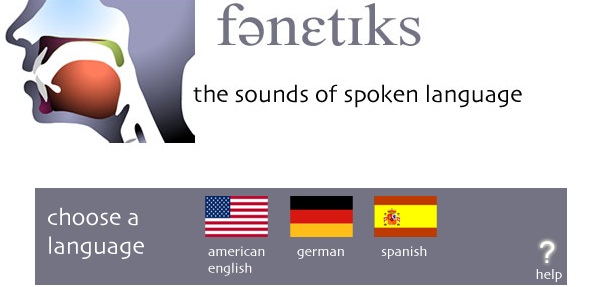
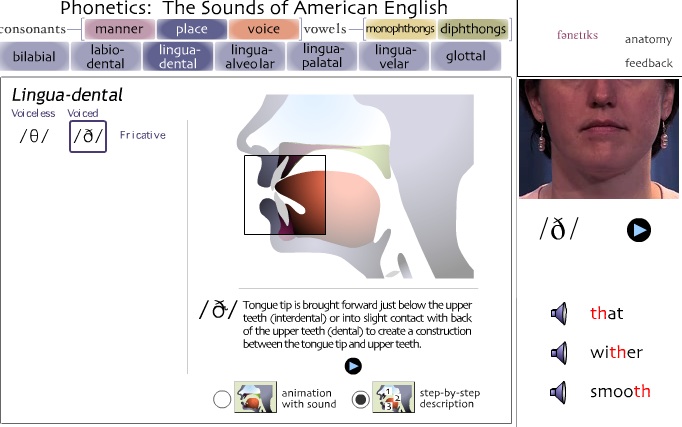
<p>The University of Iowa hosts a great example of using digital technology to improve teaching language pronunciation.  The <a href="http://www.uiowa.edu/%7Eacadtech/phonetics/#">Phonetics Flash Animation Project</a> demonstrates how to pronounce sounds with: flash animations of anatomic diagrams, video clips of people making a particular sound, audio files of words with those sounds, as well as traditional written descriptions.</p>]]>
<![CDATA[<p><img alt="phonetics02.jpg" style="margin:15px;" src="http://www.futureofthebook.org/blog/archives/phonetics02.jpg" width="500" height="304"  border="1"/><br />
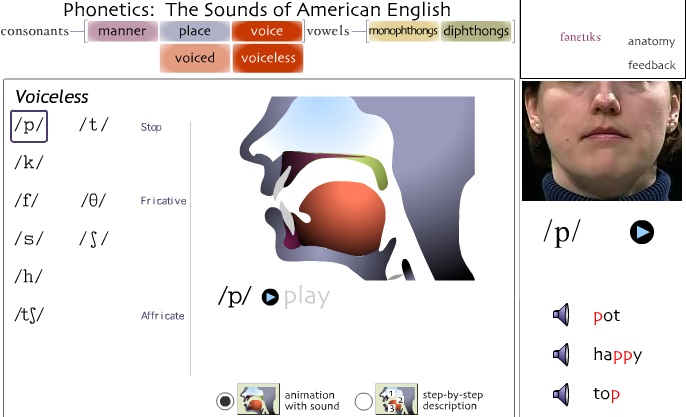
The clear visual and interface design requires little written directions and documention.  A key to the success of the project relies in the fact that it provides students with information in many different ways.  There are step-by-step directions on what part of your body are used.  Animated drawings of a person's profile show the sound being produced.  Where as, the video clips show a real person (shown in the front view) making the sound. Finally by providing three examples of the sound in a word, the student receives an opportunity to contextualize its use in an actual word. Another appreciated feature is that the project includes sounds used in German and Spanish that are not used in English, for example the rolling Rs found in Spanish. </p>

<p><img alt="phonetics03.jpg" style="margin:15px;" src="http://www.futureofthebook.org/blog/archives/phonetics03.jpg" width="500" height="304"  border="1"/><br />
Phonetics was a collaborative effort with the Department of Spanish and Portuguese, Speech and Pathology and Audiology, and Academic Technologies. Clearly, the end results show expert knowledge from all three participants.  As well, a clean interface provides an enjoyable user experience which comes from many wise and simple design decisions. For example, using video versus animation for specific purposes.  The front-on shot videos are more clear than would have been with animation, and the animations reveal a view that obviously would be impossible to show otherwise.</p>

<p>The site offers a drastically improved way of teaching how to produce sounds over traditional paper-based texts.  This example hints that educators are only beginning to explore the vast possibilities of digital media in the classroom.  It is difficult to imagine how any language class would not benefit from access to this kind of material for that particular language of study.</p>]]>
</content>
</entry>
<entry>
<title>Narrative Structure and Medium: &quot;The Red Planet&quot; and the Future of the Educational DVD-ROM</title>
<link rel="alternate" type="text/html" href="http://www.futureofthebook.org/next/text/2006/01/narrative_structure_and_medium.html" />
<modified>2006-03-08T19:42:11Z</modified>
<issued>2006-01-06T19:37:05Z</issued>
<id>tag:www.futureofthebook.org,2006:/next/text/8.1617</id>
<created>2006-01-06T19:37:05Z</created>
<summary type="text/plain"> As we&apos;ve noted before in Next/Text, a key question in considering the future of the digital textbook is whether the text should be delivered to the user via the web or on a disc. In the 1990s — when...</summary>
<author>
<name>lisa lynch</name>

<email>liesell@mac.com</email>
</author>
<dc:subject>cd/dvd-rom</dc:subject>
<content type="text/html" mode="escaped" xml:lang="en" xml:base="http://www.futureofthebook.org/next/text/">
<![CDATA[<p><img alt="mars2.jpg" src="http://www.futureofthebook.org/blog/archives/mars2.jpg" width="500" height="372" /></p>

<p>As we've noted before in Next/Text, a key question in considering the future of the digital textbook is whether the text should be delivered to the user via the web or on a disc.  In the 1990s — when Voyage pioneered the development of the educational CD-ROM — the choice was clear: accessing video and audio was far too difficult to make developing web content worthwhile.  </p>

<p>Since the demise of Voyager, however, the production of disc-based educational material has gradually decreased, and it has become less clear that ROM discs are the medium of choice for delivering "thick" multimedia content. As some of the examples we've written about (especially the WebCT film course and the MIT Biology class) demonstrate, streaming video can be easily integrated into online instructional material: there's still much room for improvement, but it's clear that online video and audio delivery will only improve over time.</p>]]>
<![CDATA[<p>So what is the future of the disc-based educational text?  The question seems especially relevant now that the recent industry debate over the formats of next-generation DVDs has provoked more than a few technology analysts to wonder aloud whether discs themselves are a doomed delivery medium.  I'm not completely convinced by these arguments, as I feel that, as far as educational media are concerned, there may still be good reasons to put things on disc.  In what follows, I'll be weighing the pros and cons of scholarly work on DVD-ROM through a discussion of <a href="http://www.upenn.edu/pennpress/book/13517.html"><i>The Red Planet,</i></a> a DVD-ROM project published in 2001 by the University of Pennsylvania Press.</p>

<p><i>The Red Planet</i> is the first publication in Penn's Mariner 10 Series, a publishing venture that represents the first attempt by a university press to publish scholarly work on DVD-ROM. The titles chosen for this Penn series are interdisciplinary studies that blend what C.P. Snow might call the "two cultures" of science and the humanities; each also includes a wide range of textual, visual and audio resources.  Thus far, in addition to <i>The Red Planet,</i> Penn has published a volume on humanistic approaches to medicine; a physics text, "The Gravity Project," is forthcoming.</p>

<p>Interestingly, <i>The Red Planet</i> has its roots in an unsuccesful venture in online education: project co-author Robert Markely was first approached to do a series of video interviews to be embedded in a web course about science fiction.  When that project fell through in 1997, Markley realized that such interviews would be an ideal first step towards creating a digital scholarly text that explored the roles Mars has played in 19th and 20th century astronomy, literature and speculative thought.  Teaming up with multimedia designer/theorists Helen Burgess (also a co-author for <i>Biofutures,</i> a DVD-ROM-in-progress that I've previously discussed) Harrison Higgs and Michele Kendrick, Markley approached Penn with his idea for the project.</p>

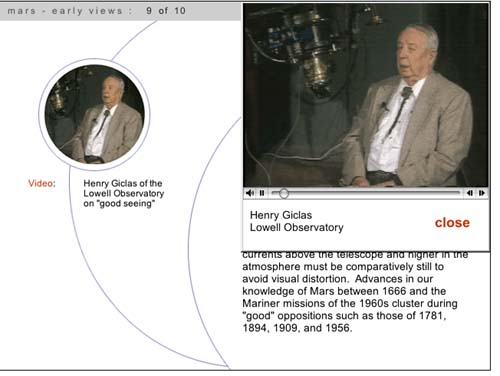
<p>After getting the go-ahead from Penn — and substantial funding from West Virgina University and Washington State University — the group spent more than four years completing the project.  Markley wrote a 200-page monograph on cultural and scientific approaches to Mars divided into nine chapters — Early Views; The Canals of Mars; The War of the Worlds; Dying Planet; Red and Dead; Missions to Mars; Ancient Floods; Dreams of Terraforming, and Life On Mars.  He and others in the group in the group then interviewed science fiction writers including Kim Stanley Robinson, cultural critics such as N. Katherine Hayles and a diverse group of major scientific figures including Richard Zare, Carol Stoker, Christopher McKay and Henry Giclas (the Giclas interview is pictured below).  They also assembled hundreds of current and archival photos, quotations from scientific and literary texts, dozens of clips from science fiction films, and an impressive array of diagrams explaining key concepts in astronomy.  And to complement the DVD-ROM project, they authored a <a href="http://www.redplanet.mariner10.com/">website</a> with educational resources, a timeline, and updatable discussions of debates about Mars exploration.</p>

<p><img alt="mars1.jpg" src="http://www.futureofthebook.org/blog/archives/mars1.jpg" width="500" height="376" border="1"/></p>

<p>The success of <i>The Red Planet</i> stems from the fact that all of this multimedia does not serve simply to gloss on Markley’s monograph: it changes Markley’s own authoring process as well.  As Markely points out in a chapter he wrote on the project for a book titled <i>Eloquent Images,</i> his main challenge was to create a work that was scholarly enough to be considered worthy by tenure committees, a requirement that has been a serious hurdle to the willingness of academics to invest time and effort in the creation of digital scholarly work.   "The majority of commercial educational software treats content as a given," Markley wrote, "reified as information that has to be encoded within a programming language and designed in such a way as to enhance its usuability."  To Markley, moving beyond this "usable information" paradigm, involved more than just foregrounding the text: it meant that the designers should make a significant contribution to the intellectual shape of the project that extended beyond usability issues and promoted them to the status of co-authors.</p>

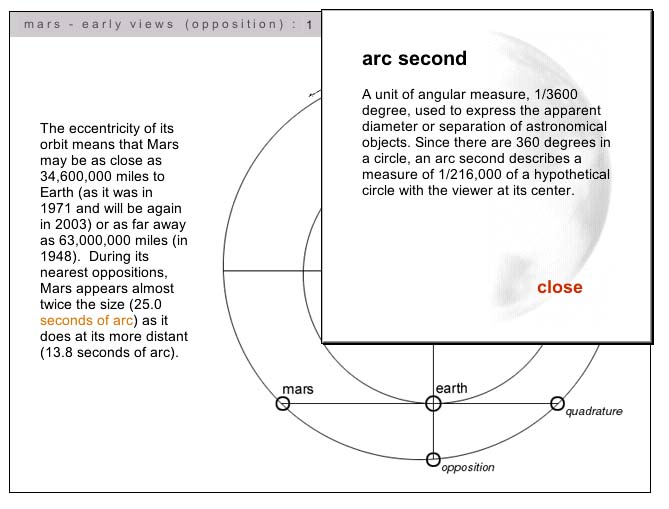
<p>With this in mind, Markley and his co-authors worked collaboratively to develop a navigation structure for the project that reflected both scholarly and pedagogical concerns. The resulting interface eschews the hypertext structures of many web-based projects and relies instead on a chronological narrative structure that the authors felt best maintained the integrity of the scholarly text.  In other words, hyperlinks don’t move the user around  inside the central text, but rather lead to film clips or selections of explanatory material (such as the diagram illustrating the term ‘arc second,’ pictured below).  </p>

<p>The structure of <i>The Red Planet</i> thus resembles, in some ways, the structure of Columbia University’s Gutenberg-e publications: if the reader chooses, they can read straight through the text and ignore the linked explanations and supporting material.  For the most part, video interviews open on seperate pages and launch automatically (the screenshot above actually shows an exception to this), but the reader can always use the forward navigation key to advance the narrative.   </p>
<p><img alt="mars3.jpg" src="http://www.futureofthebook.org/blog/archives/mars3.jpg" width="500" height="376" /></p>

<p><i>The Red Planet</i> demonstrates that this text-centric approach to digital scholarly work need not come at the expense of the quality of multimedia integrated into the project.  From the beginning, Markley and his collaborators wanted <i>The Red Planet</i> to be a standout in terms of both the amount and the quality of supporting media. This, in turn, determined their choice of medium: in writing grant proposals to fund the development of the project, Markley stressed the importance of using DVD-ROM instead of CD-ROM to construct the volume. At the time <i>The Red Planet</i> was produced, the disc was able to hold about six times more data than a traditional CD-ROM; it was also able to read this data about seven times faster, meaning that the video segments played much more smoothly and were of far higher quality. As Markely wrote in his chapter for <i>Eloquent Images</i>, "video on CD-ROM is a pixilated, impressionistic oddity: on DVD-ROM, video begins to achieve something of the semiotic verisimilitude we associate with film."</p>

<p>The DVD-ROM format also allows <i>The Red Planet's</i>designers to incorporate much longer video clips into their project: interviews are up to five minutes in length, and video clips are the maximum length allowable under fair use.  In the case of the interviews, the longer interviews allow for detailed explorations of the question at hand: in the case of the film clips, the expansiveness of the selections gives the viewer a sense that they are experiencing a portion of the actual film rather than a snapshot.</p>

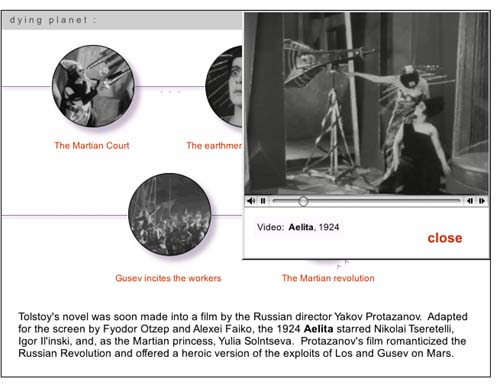
<p><img alt="mars8.jpg" src="http://www.futureofthebook.org/blog/archives/mars8.jpg" width="500" height="385" /></p>

<p>Still, though the videos are high quality, they are not full screen (as shown by the screenshot above, which shows a page that features a series of clips from the 1924 Russian film <i>Aelita</i>).  The limited size of the clips is one of a series of tradeoffs Markley and his team found they had to make when confronted with their own limited budgets and realistic pricing expectations for their DVD-ROM.  In his chapter for <i>Eloquent Images,</i> Markley writes:</p>

<p><i>In authoring The Red Planet, we were caught in an ongoing process of having to decide what we could afford in time, money and labor to live up to our grant application claims that DVD ROM could do what neither CD Rom nor the web could manage: integrate hours of high-quality video into a scholarly multimedia project.  At the same time, we had to engineer downward the minimum requirements of RAM, operating systems, monitor resolutions, etc to avoid pricing our project out of the mainstream educational market.</i></p>

<p>Markley's point is an important one: DVD-ROMs have the <i>potential</i> to deliver amazing multimedia content, but that is simply the capacity of the medium.  A successful DVD-ROM author not only has to  find the time, money, and skill to produce the project; they also have to operate within the constraints of a market which is increasingly accustomed to getting educational content online for free.  In the end, <i>The Red Planet</i> was probably more successful at the former than the latter: as a example of the genre, it is exceptional both in content and design, yet the disc has yet to find the wide audience of both scholars and Mars enthusiasts that its authors had hoped it would find. </p>

<p>Looking at <i>The Red Planet</i> and reading Markley's theorization of the work done by his team, I'm impressed by their very self-reflective effort to author a major project over several years in the midst of a rapidly shifting new media landscape.  I'm convinced by Markley's argument claims in <i>Eloquent Images</i> that the DVD-ROM format allows multimedia authors to create projects that are more narrative-centered, and thus also, perhaps, more scholarly and more acceptable to the legitimating bodies of academia.  At the same time, I'm unsure what will happen to the market for such work: either we will see a critical mass of DVD-ROMS emerge that will create a critical mass of reader/users, or the format will atrophy as the web becomes more and more the preferred method of distribution.  Markley himself is aware of the uncertain future of projects such as his own: while making the case for  <i>The Red Planet</i> as the best fit between form, content and medium, he also notes that the project is less "a model to be emulated" as much as it is "a historical document, a means to think through the scholarly and professional legitimation of video and visual information."</p>

<p>So should scholars persist in authoring in the medium?  I think so, as long as they take a clear-eyed view of its advantages and pitfalls, and as long as they realize — as Markley and his team did all along — that while the time and effort spent on a DVD-ROM project is greater than the time spent on a traditional academic monograph, the audience might ultimately be more limited.  Not always: a project such as the <i>Biofutures</i> DVD (discussed in an earlier post), which has been developed with a very specific pedagogical aim, might find a more extensive academic audience even if it doesn't find a non-academic one.  The same might be said for <i>Medicine and Humanistic Understanding</i>, the newest title in the <i>Mariner 10</i> series.  The key is finding a way to create a new media object that is stable enough to allow users to take advantages of its merits both now and in the foreseeable future.</p>

<p><img alt="mars5.jpg" src="http://www.futureofthebook.org/blog/archives/mars5.jpg" width="500" height="380" /></p>]]>
</content>
</entry>
<entry>
<title>Reading the &quot;Augmented&quot; Digital Text: AR Volcano</title>
<link rel="alternate" type="text/html" href="http://www.futureofthebook.org/next/text/2006/01/reading_the_augmented_digital.html" />
<modified>2006-03-07T21:16:35Z</modified>
<issued>2006-01-03T19:35:05Z</issued>
<id>tag:www.futureofthebook.org,2006:/next/text/8.1616</id>
<created>2006-01-03T19:35:05Z</created>
<summary type="text/plain"> When we talk about &quot;digital textbooks&quot; here at Next/Text, we&apos;re usually referring to textbooks that have moved from the printed page to the computer screen. But there are other types of digital texts — and digital learning environments —...</summary>
<author>
<name>lisa lynch</name>

<email>liesell@mac.com</email>
</author>
<dc:subject>works in progress</dc:subject>
<content type="text/html" mode="escaped" xml:lang="en" xml:base="http://www.futureofthebook.org/next/text/">
<![CDATA[<p><img alt="volcano1.jpg" src="http://www.futureofthebook.org/blog/archives/volcano1.jpg" width="500" height="298" /></p>

<p>When we talk about "digital textbooks" here at Next/Text, we're usually referring to textbooks that have moved from the printed page to the computer screen.  But there are other types of digital texts — and digital learning environments — that move beyond the boundaries of the screen to rethink our assumptions of what books might be.  One example is the use of augmented reality to create texts which resemble books in their basic physical form, but have features that dramatically alter the experience of reading and learning.  </p>

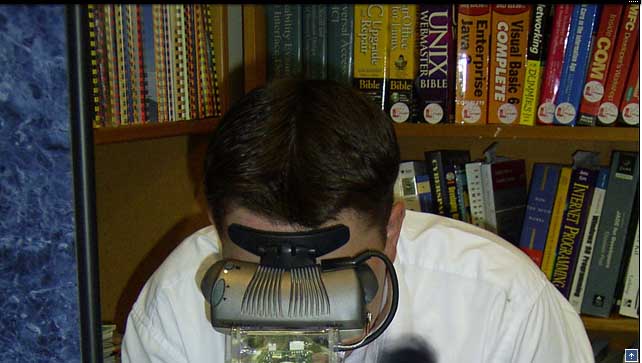
<p>Over the past five years, HCI engineer Mark Billinghurst (formerly based at the University of Washington and now director of the Human Interface Technology Lab at the University of New Zealand) has been working on a series of "magic books" which use AR technology to project three-dimensional animations off of each page, allowing the user to learn about a topic by watching a series of scenarios and demonstrations at their own pace. <i>AR Volcano</i>, created with the assistance of Eric Woods, Graham Aldridge, uses AR to teach students about the science of volcanoes, including details on tectonic plates, subduction, rifts, 'the ring of fire,' volcano formation, and eruptions.  I'm going to discuss this project here, with the caveat that I haven't used it: I've only read through articles and documentation and watched a few demonstration videos.</p>

<p>What is augmented reality? While most digitally literate folks might be familiar with virtual reality, augmented reality has generally gotten less attention.  An article from from the April 2002 issue of <a href="http://www.sciam.com/article.cfm?articleID=0006378C-CDE1-1CC6-B4A8809EC588EEDF"><i>Scientific American</i></a> neatly outlines the differences between the two media:</p>]]>
<![CDATA[<p><i>Augmented reality (AR) refers to computer displays that add virtual information to a user's sensory perceptions. Much AR research focuses on "see-through" devices, usually worn on the head, that overlay graphics and text on the user's view of his or her surroundings. (Virtual information can also be in other sensory forms, such as sound or touch, but this article will concentrate on visual enhancements.) AR systems track the position and orientation of the user's head so that the overlaid material can be aligned with the user's view of the world. Through this process, known as registration, graphics software can place a three-dimensional image of a teacup, for example, on top of a real saucer and keep the virtual cup fixed in that position as the user moves about the room. AR systems employ some of the same hardware technologies used in virtual-reality research, but there's a crucial difference: whereas virtual reality brashly aims to replace the real world, augmented reality respectfully supplements it.</i></p>

<p><img alt="volcano2.jpg" src="http://www.futureofthebook.org/blog/archives/volcano2.jpg" width="500" height="298" /></p>

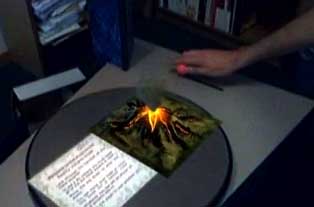
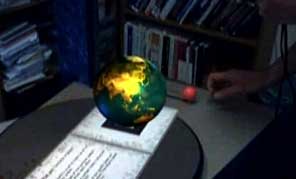
<p>The image above illustrates how Billinghurst's <i>AR Volcano</i> supplements the reality of the "book" that the user encounters.  Without goggles, someone approaching <i>AR Volcano</i> would only see what looked like a conventional paper book propped (albeit one which is only six pages long) on a podium.  With the goggle, the computer software recognizes special patterns embedded in the book and replaces them with photo-realistic 3D objects.  In this photo, a volcanic eruption takes place over the course of several minutes.  The image will appear no matter where the user positions themselves around the book, and a new image can be seen by simply turning the page.</p>

<p><i>AR Volcano</i> has a significant feature that sets it apart from Billinghurst's previous magic books and makes the technology much more suitable for creating learning environments. In earlier books — such as the <a href="http://www.hitlabnz.org/route.php?r=prj-view&prj_id=1"><i>Black Magic Book</i></a>, which tells the story of the America's Cup Race — the user was positioned as a passive spectator in an enhanced "reading" environment.   <i>AR Volcano</i>, however, provides an interactive slider that allows the user to control volcano formation and eruption as well as the movement of tectonic plates.  In the image above, the slider (a physical slider attached to the book podium), is adjusted so that the volcano is erupting at a rapid pace; in the image below, the slider is adjusted downwards so that the movement of tectonic plates on the earth's surface occurs more gradually.  The audio narrative also adjusts, so that it keeps pace with the user's movement through the pages of the book.</p>

<p><img alt="volcano3.jpg" src="http://www.futureofthebook.org/blog/archives/volcano3.jpg" width="500" height="298" /></p>

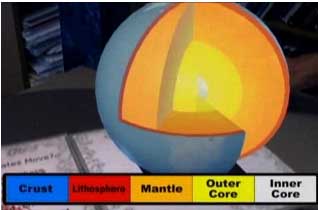
<p>Another useful feature, common to all "magic books," is a zoom function connected to the user's experience of physical space — simply put, as a user moves physically closer to the book the image grows larger, mirroring the experience of approaching an object in the real world.  The photo below is taken from the vantage point of someone who has moved closer to the 3-D visualization of the earth's various layers in order to examine it more closely.  Notice that the three-dimensional globe is overlaid with a two-dimensional text label which color-keys the layers indicated by the cross-section.</p>

<p><img alt="volcano5.jpg" src="http://www.futureofthebook.org/blog/archives/volcano5.jpg" width="500" height="298" /></p>

<p>Since it reflects a user's bodily experience, the physical zoom enhances the reality effect of AR books; ideally, the technology will evolve to the point where the augmentations will become less cartoonish and more natural, even "transparent" to the user.  The improvement of what AR designers call the "immersion effect" is the focus of another project at Billinghurst's HIT lab, <a href="http://www.hitlabnz.org/route.php?r=prj-view&prj_id=11"><i>AR Relight</i></a>, which attempts to improve shadow casting in 3D models. </p>

<p>Making AR more believable is only one of the challenges faced by researchers like Billinghurst; another is integrating interactive functions into a text in a manner that would make it more portable and booklike than <i>AR Volcano</i>; while the <i>Black Magic Book</i> resembles a conventional spiral bound volume, <i>AR Volcano</i> depends on its computerized podium.  Since portability is one of the hallmark features of textbooks — including digital ones, if one has a laptop —  the technology has a ways to go before it can emulate the combination of interactivity and portability of the <i>Young Ladies' Illustrated Primer</i> imagined by Neal Stephenson in his novel <i>The Diamond Age</i>, a book which uses the wonders of nanotechnology to generate three dimensional, interactively narrated animations to guide the protagonist through the challenges of her girlhood.</p>

<p>AR researchers probably won't need to wait for functional nanotechnology to make viable AR books that could be used in teaching contexts; medical books, for example, in which 3D visualizations emerge from the pages.  Alternately, educational uses of AR might move away the book metaphor as a means of navigation: for example, a project called MARIE at the University of Sussex uses AR technology to allow students taking online courses to view and interact with three-dimensional objects that the instructor is describing.  But AR has made its impact as a way of imagining a form of digital textuality that is not physically wedded a computer screen — or, for that matter, to immersion in an entirely simulated world.  </p>

<p>For those who are interested in experimenting with the technology themselves, Billinghurst and his group have released an <a href="http://www.hitl.washington.edu/artoolkit/">AR toolkit</a>, which they describe as "a collection of libraries, utilities applications, and documentation and sample code aimed at creators of augmented reality applications."  The libraries allow users to capture images from video sources, process those images to optically track markers in the images, composite computer-generated content with the real-world images, and finally display the result using the graphics language OpenGL.</p>]]>
</content>
</entry>
<entry>
<title>&quot;The American Film&quot; -- Using WebCT To Author Digital Texts</title>
<link rel="alternate" type="text/html" href="http://www.futureofthebook.org/next/text/2005/12/the_american_film_using_webct.html" />
<modified>2006-03-07T22:05:45Z</modified>
<issued>2005-12-29T18:24:00Z</issued>
<id>tag:www.futureofthebook.org,2005:/next/text/8.1615</id>
<created>2005-12-29T18:24:00Z</created>
<summary type="text/plain"> Over the past few years, more and more professors have begun using course management software such as WebCT or Blackboard (and, increasingly, the non-commercial and open-source Sakai) to organize their syllabi, place assignments online, and create online forums for...</summary>
<author>
<name>lisa lynch</name>

<email>liesell@mac.com</email>
</author>
<dc:subject>cd/dvd-rom</dc:subject>
<content type="text/html" mode="escaped" xml:lang="en" xml:base="http://www.futureofthebook.org/next/text/">
<![CDATA[<p><img alt="filmwebct.jpg" src="http://www.futureofthebook.org/blog/archives/filmwebct.jpg" width="500" height="298" border="1" /></p>

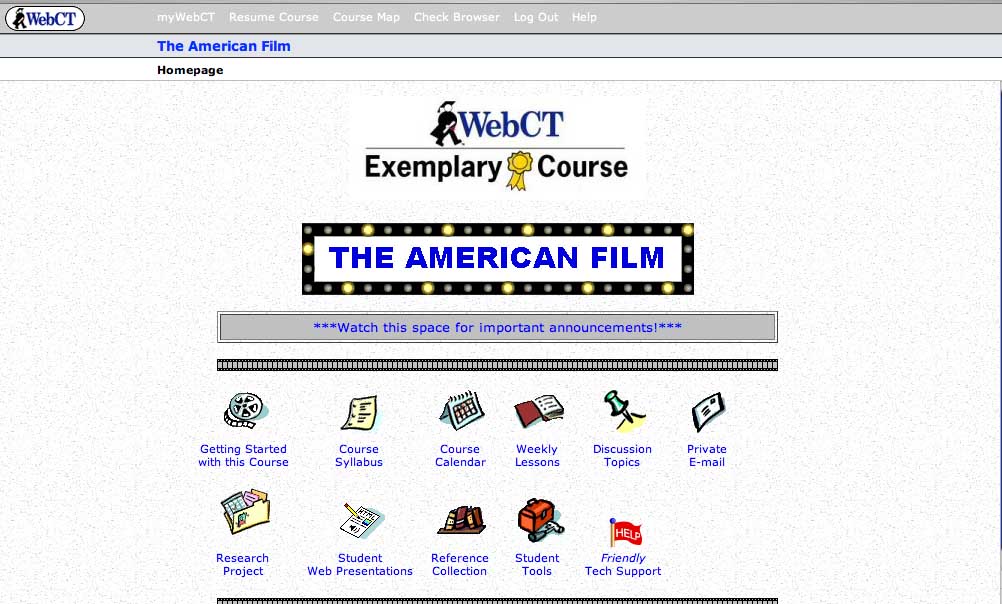
<p>Over the past few years, more and more professors have begun using course management software such as WebCT or Blackboard (and, increasingly, the non-commercial and open-source <a href="http://www.sakaiproject.org/index.php?option=com_content&task=view&id=103&Itemid=208">Sakai</a>) to organize their syllabi, place assignments online, and create online forums for class discussion.  In some cases, WebCT courses are designed so comprehensively that they come to resemble digital course texts, including a substantial amount of original pedagogical material.  One example of this is <i>The American Film,</i> a course taught by Thomas Valasek at Raritan Valley Community College that has been recognized this year as an Exemplary Course by in an annual WebCT competition (a description of the class and guest access are available <a href="http://www.webct.com/exemplary/viewpage?name=exemplary_2005_valasek"> here</a> through the WebCT site).</p>

<p>Valasek, who uses WebCT as a distance-learning platform, has incorporated his own lectures and film analyses into the site, and included relevant film clips which are annotated by his own voiceover narration.  This means that students are able to access unique content through the site, instead of using WebCT merely as a portal to download information authored elsewhere.  It also means that Valasek has managed to create an online-only film course that give students the feeling of being present when the professor is walking them through scenes of a film — perhaps the most important part of a lecture-based film class.</p>]]>
<![CDATA[<p><i>The American Film </i> introduces students to American cinema through a discussion of the narrative and visual style of Hollywood movies.  After a section on the culture of Hollywood (centered around the film <i>The Player</i>), and on narrative and visual style in film (centered respectively on <i>American Beauty</i>  and <i>On The Waterfront</i>),  Valasek focuses on four popular film genres: romantic comedy, the western, science fiction, and film noir.  Students are expected to watch a series of films on their own and to use the lectures and discussions on the course site as a launching point for their own research projects.  In each case, Valasek pairs a classic example of the genre with a contemporary adaptation, with the expectation that students might be able to draw on their familiarity with the more recent film to help with their interpretations of the older work.</p>

<p><img alt="waterfront.jpg" src="http://www.futureofthebook.org/blog/archives/waterfront.jpg" width="500" height="296"  border="1" /></p>

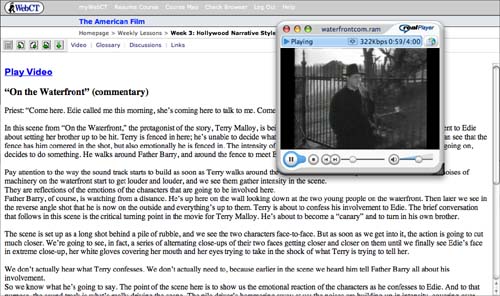
<p>An example of Valasek's voiceover work can be found in his discussion of the crucial scene from <i>On The Waterfront</i> when the priest Father Barry tries to convince Terry Malloy, the films protagonist, to confess to his fiancee that he had helped organize a mob hit on his own brother.  As the clip plays, Valasek's narration asks us to pay attention the metaphorical use of a high metal fence in the background: "Terry is fenced in here; he’s unable to decide what he wants to do and what the right thing to do is. We can see that the fence has him cornered in the shot, but also emotionally he is fenced in."</p>

<p>As the scene shifts, Valasek continues to describe in detail both the visual and aural techniques used by Kazan to convey emotional intensity, making sure that his voiceover keeps pace with the film itself:</p>

<p><i>The scene is set up as a long shot behind a pile of rubble, and we see the two characters face-to-face. But as soon as we get into it, the action is going to cut much closer. We’re going to see, in fact, a series of alternating close-ups of their two faces getting closer and closer on them until we finally see Edie’s face in extreme close-up, her white gloves covering her mouth and her eyes trying to take in the shock of what Terry is trying to tell her...The point of the scene here is to show us the emotional reaction of the characters as he confesses to Edie. And to that purpose, the sound track is what’s really driving the scene. The pile driver’s hammering away at us; the noises are building up in intensity, covering over their words, drowning out everything that they say, but adding this powerful emotional overlay to the scene.</i></p>

<p>Valasek's clips are about three minutes long — ample, but still within the boudaries of fair use — and students can choose to watch them with or without Valesek's voiceovers.  They can also read the transcripts of Valasek's comments seperately from watching the clip.</p>

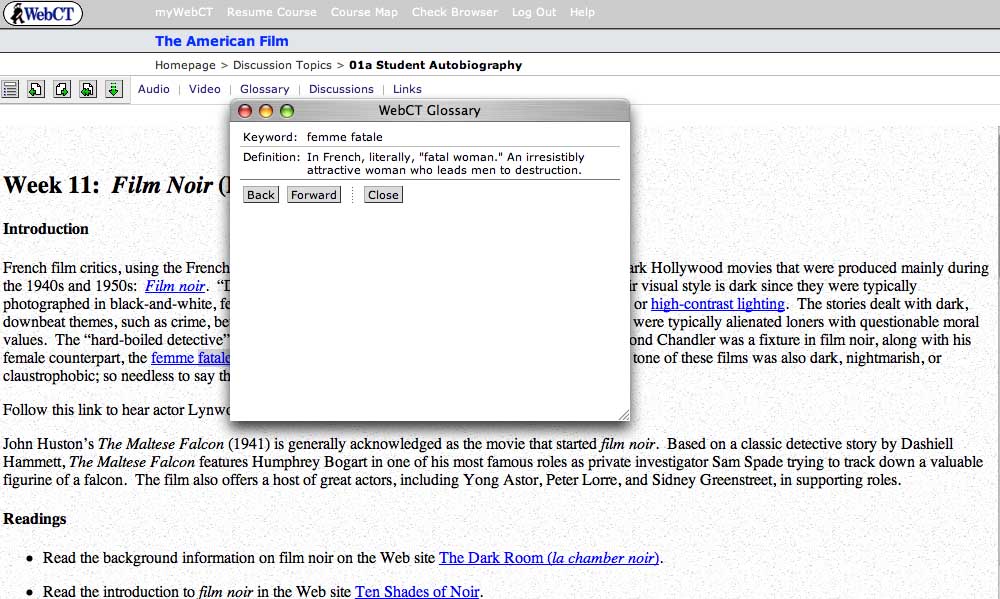
<p><img alt="glossary.jpg" src="http://www.futureofthebook.org/blog/archives/glossary.jpg" width="500" height="298"  border="1"/></p>

<p>Additional features of the site include a hyperlinked glossary of film terms (pictured above), linked assignments, and an online forum in which students analyze the films they watch — a necessary addition, since class discussion takes place entirely online.</p>

<p>At present, the primary limitations of <i>The American Film</i> seem to be those of WebCT itself.  As a piece of software, WebCT is designed more for efficacy than elegance, and the clunky interface can be headache-producing: it's also the case that students who have all of their classes on the platform sometimes experience "WebCT blur," the feeling that all of their courses are seeping together.  Of course, Valasek could move past these limitations by developing the multimedia content on this site even further; instead of embedding it in a WebCT platform, he could potentially create a DVD with his film analyses and discussion for broader use as an introductory film text.  I'm curious as to whether anyone working in WebCT has considered the fact that they, like Valasek, are already well on the way to producing a digital textbook.  Now that such labor-intensive multimedia learning objects are being created with increasingly frequency for course-specific situations, there needs to be more conversation about how to "free" such scholarly effort for broader academic use.</p>]]>
</content>
</entry>
<entry>
<title>Learning from the Simulated Fruit Fly</title>
<link rel="alternate" type="text/html" href="http://www.futureofthebook.org/next/text/2005/12/learning_from_the_simulated_fr.html" />
<modified>2006-03-08T19:43:26Z</modified>
<issued>2005-12-29T18:20:00Z</issued>
<id>tag:www.futureofthebook.org,2005:/next/text/8.1614</id>
<created>2005-12-29T18:20:00Z</created>
<summary type="text/plain"> The Virtual Courseware Project creates interactive, online simulations for the life and earth sciences on their sciencecourseware.org site, including Drosophila. Taking its name from the fruit fly used in genetics research, Drosophila uses the classic fruit fly example to...</summary>
<author>
<name>ray cha</name>

<email>ray.cha@gmail.com</email>
</author>
<dc:subject>cd/dvd-rom</dc:subject>
<content type="text/html" mode="escaped" xml:lang="en" xml:base="http://www.futureofthebook.org/next/text/">
<![CDATA[<p><img alt="fruitfly01.jpg" src="http://www.futureofthebook.org/blog/archives/fruitfly01.jpg" width="392" height="281"   style="margin:15px;" border="1"/></p>

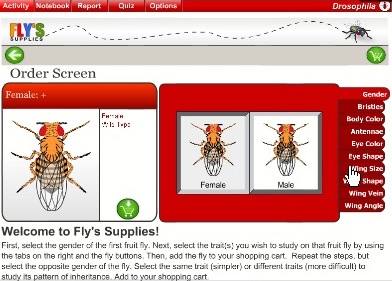
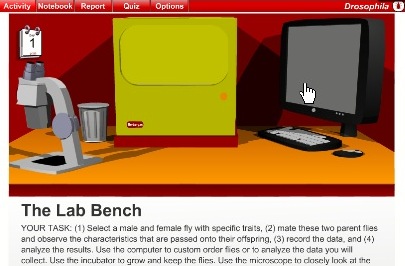
<p>The Virtual Courseware Project creates interactive, online simulations for the life and earth sciences on their <a href="http://www.sciencecourseware.org/">sciencecourseware.org</a> site, including <a href="http://www.sciencecourseware.org/vcise/drosophila/">Drosophila</a>.  Taking its name from the fruit fly used in genetics research, Drosophila uses the classic fruit fly example to teach basic genetic concepts. Using an inquiry-based approach, students begin by ordering flies with certain attributes, such as gender, eye color and wing angle.  Then, in the "lab bench" screen below, students mate male and female flies with certain attributes and observe which characteristics get passed along to their offspring. Then, they report their findings.  These steps are designed to also teach the scientific method, which include making observations, formulating hypothesis, creating experiments, analyzing results, and writing up findings. Finally, students also get assessed on their learning.</p>]]>
<![CDATA[<p><img alt="fruitfly02.jpg" src="http://www.futureofthebook.org/blog/archives/fruitfly02.jpg" width="405" height="266" style="margin:15px;" border="1"/><br />
A comment submitted by a teacher using Drospohila explained how this module was helpful in <i>conjunction</i> with experiments using real fruit flies. Working with both the real and the virtual may be the ideal.  On one hand, the minor inconsistencies that result from real-life experiments can be an important part of the learning process, and virtual experiments don't allow for such inconsistencies.  On the other hand, simulations offer the ability to repeat experiments many times to ensure understanding for class discussions or exams.  In the real world, repeating experiments is often time or cost prohibitive.</p>

<p><img alt="fruitfly03.jpg" src="http://www.futureofthebook.org/blog/archives/fruitfly03.jpg" width="396" height="266"  style="margin:15px;"  border="1"/><br />
I appreciate the structured learning aspects of these lessons, especially the assessment feature.  Too often, learning modules leave out the any assessment. Even ungraded assessment allows students to an opportunity to make sure they understand concepts or prepare questions for class. The site also includes how their materials meet the standard requirements for each state in the US. The creators of Drosophila have taken steps to create a deep learning experience which re-enforce scientific methods using digital technology that paper-based science textbooks cannot replicate.</p>]]>
</content>
</entry>
<entry>
<title>&quot;Liberty, Equality, Fraternity&quot; and &quot;Imaging The French Revolution:&quot; Two Generations of Digital Texts</title>
<link rel="alternate" type="text/html" href="http://www.futureofthebook.org/next/text/2005/12/liberty_equality_fraternity_an.html" />
<modified>2006-03-08T19:59:32Z</modified>
<issued>2005-12-13T20:18:00Z</issued>
<id>tag:www.futureofthebook.org,2005:/next/text/8.1613</id>
<created>2005-12-13T20:18:00Z</created>
<summary type="text/plain"> Since 1994, Roy Rozensweig&apos;s Center For History And New Media at George Mason University has pioneered the use of digital media to document and analyze historical events. Their particular focus is to transform history from an elite activity practiced...</summary>
<author>
<name>lisa lynch</name>

<email>liesell@mac.com</email>
</author>
<dc:subject>higher education</dc:subject>
<content type="text/html" mode="escaped" xml:lang="en" xml:base="http://www.futureofthebook.org/next/text/">
<![CDATA[<p><img alt="lefs.jpg" src="http://www.futureofthebook.org/blog/archives/lefs.jpg" width="500" height="300" /></p>

<p>Since 1994, Roy Rozensweig's <a href="http://chnm.gmu.edu">Center For History And New Media</a> at George Mason University has pioneered the use of digital media to document and analyze historical events.  Their particular focus is to transform history from an elite activity practiced mainly in the academy to a more democratic form of inquiry that both draws on and appeals to new audiences.  Thus far, they have sponsored over a dozen ambitious digital history projects, ranging from the widely heralded  <a href="http://911digitalarchive.org/">September 11 Digital Archive</a> to a digital recreation of P.T. Barnum's 19th century New York City museum of oddities.</p>

<p>In this review, I'll be looking at two CHNM-sponsored efforts — <a href="http://chnm.gmu.edu/revolution/">Liberty, Equality, Fraternity</a> and <a href="http://chnm.gmu.edu/revolution/imaging/">Imaging the French Revolution</a> — that explore the cultural history of eighteenth century France through both scholarly analysis and an extensive archive of cultural artifacts.  Seven years divide the production of the two sites: <i>Liberty, Equality, Fraternity</i> was published by the Center in 1998, while <i>Imaging The French Revolution</i> was published in early 2005 as part of a joint effort with <i>American Historical Review,</i>.  While both sites are engaging and useful, both also reflect the moment of their production: they thus can tell us something about the history of digital publishing even as they provide a deeper understanding of the history of the French Revolution.</p>]]>
<![CDATA[<p><i>Liberty, Equality, Fraternity</i> is a collaboration between the CHNM and the American Social History Project, a center at the City University of New York which shares CHNM's goal of revitalizing the study and teaching of history through the use of digital tools.  Prior to working on <i>Liberty, Equality, Fraternity</i>, the Social History Project partnered with Voyager to produce a digital edition of their award-winning textbook <a href=<http://www.futureofthebook.org/next/text/?q=node/23>Who Built America</a>, which is still available as two seperate CD-ROMs (the second CD-ROM was produced in the post-Voyager era by Worth Publishers).</p>

<p>Like <i>Who Built America,</i> <i>Liberty, Equality, Fraternity</i> has a CD-ROM component: those interested in the project can either rely exclusively on the website or purchase an accompanying text and CD-ROM from Penn State University Press.  The decision to produce a CD-ROM stems partly from the fact that when the site was first published in 1998, this form of extensive online scholarship was still in its pre-adolescence.  In 2005, it's far more likely to find a project such as this one authored entirely on the web (or published as a textbook with a password-protected website), but back then the availability of broadband was not something to be taken for granted.  The CD-ROM also contains video interviews that aren't available online at all for much the same reasons.  It's also possible that the authors found it hard to conceive of a project as ambitious as this without thinking of it in the context of a published volume.</p>

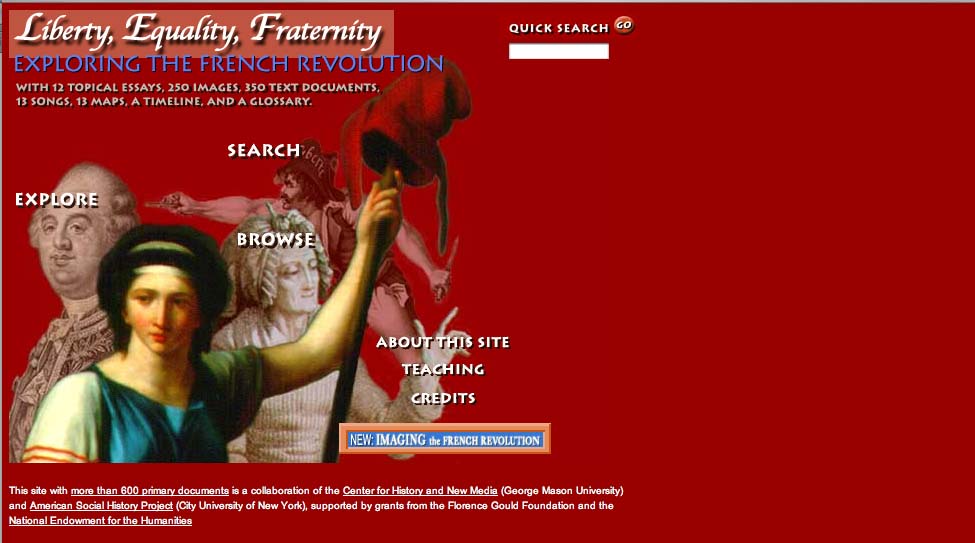
<p>In any case, both versions of <i>Liberty, Equality and Fraternity</i> work well as texts for teaching the revolution; they pair substantial scholarly research with an extensive archive of maps, songs and images. Depending on their specific needs, users of the <i>Liberty, Equality, Fraternity</i> can choose from three main navigational paths — explore, search, and browse.  The "explore" section features twelve essays, written by historians Lynn Hunt of UCLA and Jack Censer of George Mason University, that can be accessed through a drop-down menu.  Ten of these provide a succinct history of the Revolution, covering topics including the social causes of revolution, the fall of the monarchy, women and the revolution, the story of Napoleon, and the revolution's legacy in France and elsewhere.  Two further essays provide analytic tools for scholars interested particularly in imagery or songs from the period.  </p>

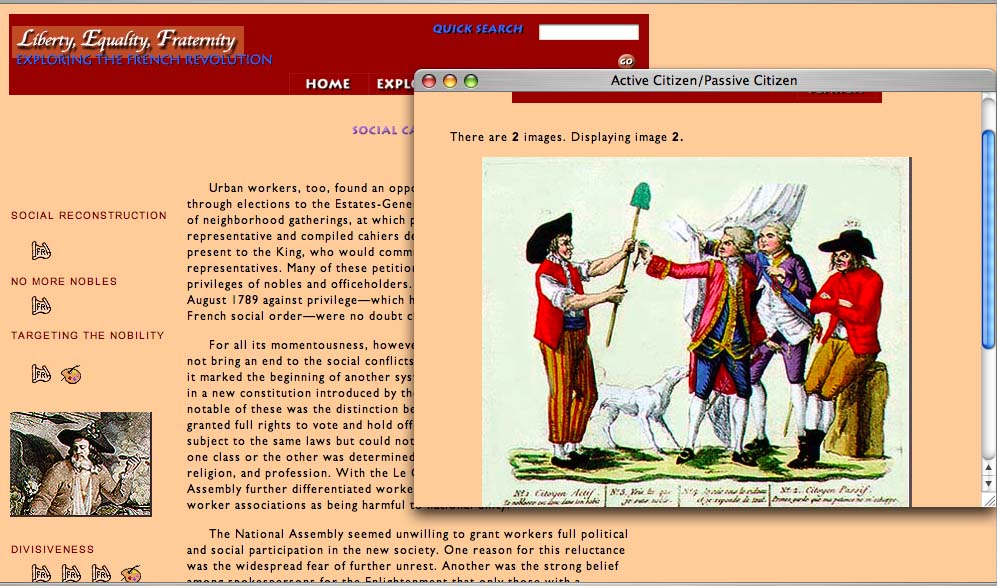
<p>Once the user moves past the main menu window, the "look" of the site is, on the whole, somewhat spartan.  In the case of the essays, the type is on the small side, though readable: a series of icons running down the left side of the page  signal hyperlinks to primary source documents.  In the image below, for example a political cartoon,  "Active Citizen/Passive Citizen," is used to illustrate an essay on the social causes of the Revolution.</p>

<p><img alt="lef1.jpg" src="http://www.futureofthebook.org/blog/archives/lefb.jpg" width="500" height="245" /></p>

<p>The images, songs and maps on the site — along with a timeline and glossary — can be accessed through the "Search" or "Browse" function, depending on whether the user knows in advance what they're looking for.  There is wonderful material here: 245 images including political cartoons and pictures of decorated fans and porcelain from the period, 338 documents including personal memoirs, official reports, treatises and eyewitness accounts, 13 maps created especially for the project, and finally, 13 songs also produced uniquely for the project by musicians who worked from an 1899 songbook Playable in Quicktime, the songs are transcribed and translated in pop-up windows.</p>

<p>Interestingly, at the time the Center negotiated for permissions for their visual documents in <i>Liberty, Equality, Fraternity</i>, they paid much less than they would have had they wanted to include them in a print volume: recently, however rights holders have been asking for much higher royalty fees for the display of images and documents online.</p>

<p>Overall, <i>Liberty, Equality, Fraternity</i> is a site that works a bit better than it looks.   Students and scholars can use the site both as a textual introduction to the French Revolution  and as a valuable archive of visual and aural resources, but the project’s visually bland and formally conservative interface is unlikely to encourage the uninitiated to explore the site.  It's difficult to fault the site for this — it relies on design tools and protocols that have shifted over time.  As a digital classroom text, it certainly exceeds what  a conventional paper text can do: it’s just that the medium has evolved since the site was put online, both in terms of how archives are organized and in terms of the way in which the medium itself is often intertwined in the scholar's process of research and presentation.</p>

<p><img alt="ifra.jpg" src="http://www.futureofthebook.org/blog/archives/ifra.jpg" width="500" height="290" /></p>

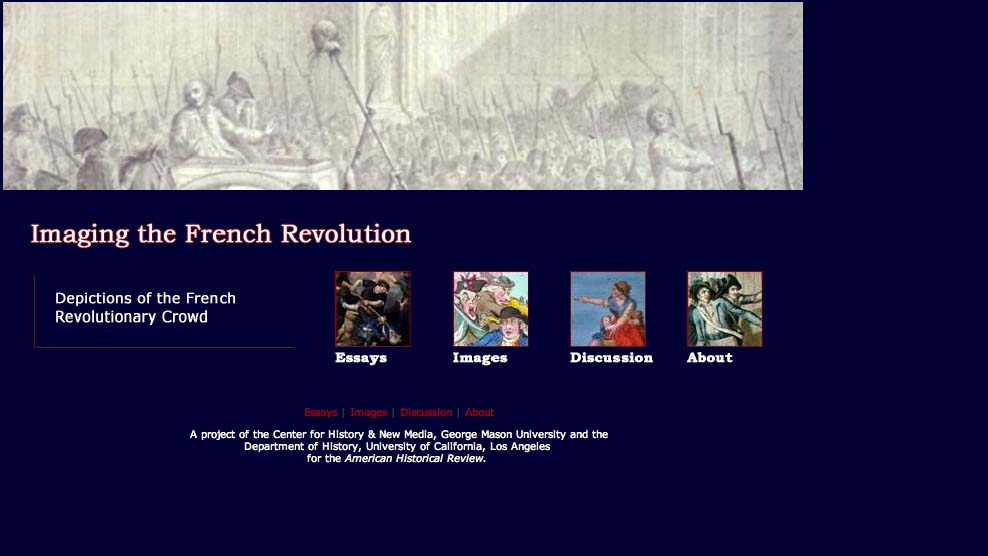
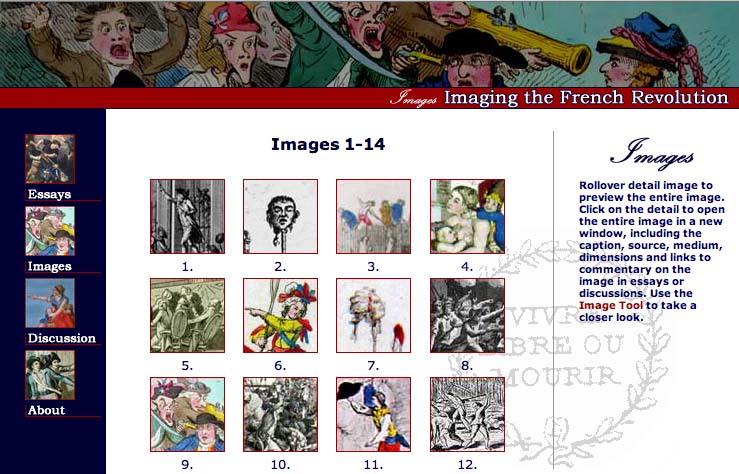
<p>To get a sense of the evolution of the digital history text, click a button at the bottom right corner of the home page of <i>Liberty, Equality, Fraternity</i> and look at the site <i>Imaging The French Revolution,</i> a later work also authored by Censer and Hunt in collaboration with the CHMN. <i>Imaging The French Revolution</i> builds on and updates the original project by using recent developments in digital scholarship to take a closer look at some of the original primary source material. Described as "an experiment in digital scholarship," <i>Imaging The French Revolution</i> features seven essays from seven scholars asked to analyze forty-two images of crowds and crowd violence stored in a shared archive. These images, drawn from the original site, are made available in a fresh interface along with a flash-based "Image Tool" (created by a 12-year-old programming wiz) that allows them to magnify and layer images in order to draw their own conclusions. </p>

<p><img alt="imagingcrop.jpg" src="http://www.futureofthebook.org/blog/archives/imagingcrop.jpg" width="500" height="290"  border="1"/></p>

<p>Part of the value of <i>Imaging The French Revolution</i>, then, stems from the way the user is positioned within the site — not as a passive browser of archived information, but as an active observer who can use the image tool both to think through the images on their own and to interrogate the decisions made by the seven scholars who describe them.  In the process of interrogating these decisions, the user can also access online discussions between these seven scholars that took place before they actually wrote their essays.  All seven met during the summer of 2003 on an online forum to discuss issues of interpretation, methodology and the impact of digital media on scholarship: the discussion they had then filtered down into their final analytical work.</p>

<p>In other words, <i>Imaging The French Revolution</i> is innovative in two primary ways: it incorporates the user into the piece in a more interactive fashion, and it incorporates the digital medium into the process of knowledge-making — a method of inquiry that has become increasingly common among saavy digital scholars.  There's another way that <i>Imaging The French Revolution</i> reflects the current moment in online scholarship: as an "online-only" publication of <i>American Historical Review,</i> it is a sign of the changing attitudes towards digital scholarship. In 1998, the authors of <i>Liberty, Equality, Fraternity</i> felt the project needed an offline component to be both respectable and accessible; in 2005, the same authors were comfortable working on an online-only project for a journal whose readership had been primarly print-based until recently.</p>

<p>So what does this have to tell us about the future of the digital text?  For one thing, it suggests that now that it has become more commonplace to find deep, rich online archives, we might come to expect more of the archive: rather than simply celebrating the fact that material is accessible, more attention will be paid to the conditions and interface of that accessibility.  At the same time, it's also an indication that scholars are increasingly willing to eschew paper-based scholarship for serious scholarly analysis that embraces the methodological shifts implicit in the digital medium.</p>]]>
</content>
</entry>
<entry>
<title>Online Science For The Wired Classroom: The &quot;Disease Spread&quot; Gizmo from Explore Learning</title>
<link rel="alternate" type="text/html" href="http://www.futureofthebook.org/next/text/2005/12/online_science_for_the_wired_c.html" />
<modified>2006-03-21T22:46:40Z</modified>
<issued>2005-12-09T20:53:00Z</issued>
<id>tag:www.futureofthebook.org,2005:/next/text/8.1612</id>
<created>2005-12-09T20:53:00Z</created>
<summary type="text/plain"> When considering the ways in which born-digital learning materials might replace conventional textbooks, it&apos;s important to think about how digital material might change the notion of what a textbook can be � for example, replacing the idea of a...</summary>
<author>
<name>lisa lynch</name>

<email>liesell@mac.com</email>
</author>
<dc:subject>K-12</dc:subject>
<content type="text/html" mode="escaped" xml:lang="en" xml:base="http://www.futureofthebook.org/next/text/">
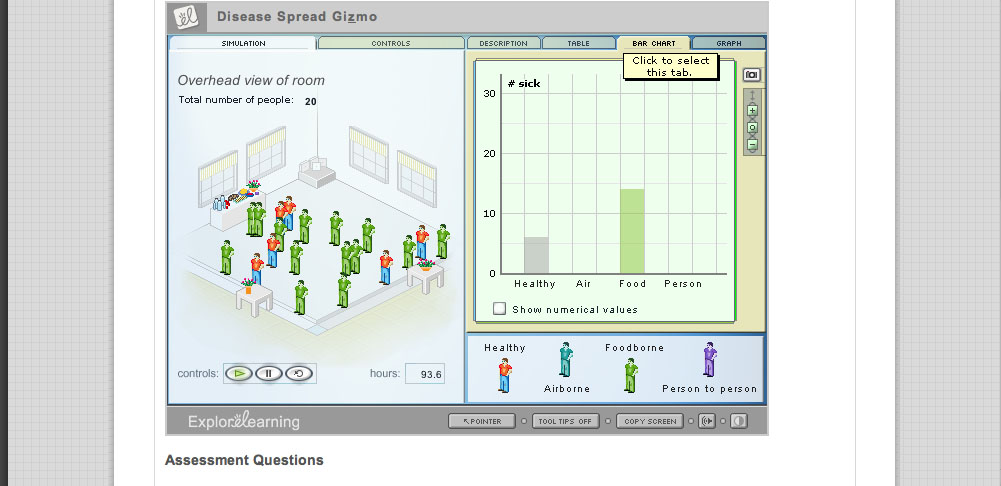
<![CDATA[<p><img alt="diseasegiz1.jpg" src="http://www.futureofthebook.org/blog/archives/diseasegiz1.jpg" width="500" height="245" border="1"/></p>

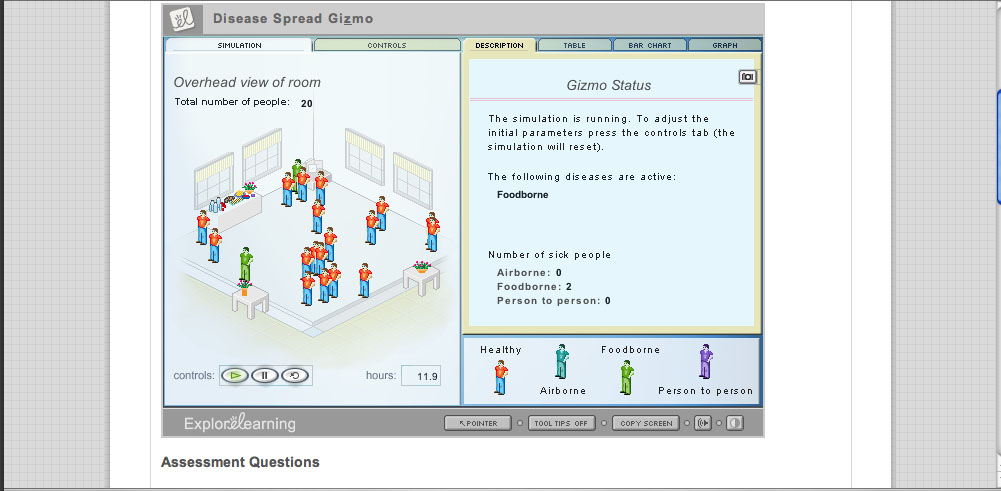
<p>When considering the ways in which born-digital learning materials might replace conventional textbooks, it's important to think about how digital material might change the notion of what a textbook can be � for example, replacing the idea of a "one size fits all" standard classroom text with a number of smaller, atomized learning modules. The six-year-old company <a href="http://www.explorelearning.com/">Explore Learning</a> has produced over 400 such interactive modules, which they call "gizmos," for use in math and science classrooms.  Each gizmo is a brief, animated Shockwave presentation, accompanied by a control panel, a series of assessment questions, and an "exploration guide" that suggests a series of experiments for students.  Available through subscription, Explore Learning gizmos have won e-learning awards and recognition from the National Science Foundation, and are widely used in schools around the country.</p>]]>
<![CDATA[<p>Browsing through the gizmos (the company allows the user a 30-day free trial before asking them to purchase a subscription), I found them fairly sophisticated both in conceptualization and design. Explore Learning has managed to avoid the hypercolorful "edutainment software" approach of some K-12 digital instructional material, but they've also made their experiments visually interesting enough to capture the often variable attention of high school science students.  The selection encompasses  most math and science requirements for grades 6 through 12 (and early collecge): algebra, geometry, physics, data analysis, biology, chemistry, and earth and space science.  There are gizmos which reveal the structure of snowflakes, teach about RNA and protein synthesis, and explore the interior surface of the Earth.</p>

<p>What makes gizmos pedagogically valuable is that they are not simply demonstrations of scientific principles, but experiments in which students are asked to collect data and report results. One such experiment is the "Disease Spread" gizmo, a relatively straightforward module intended for life sciences classrooms in grades 6 thought 8.  "Disease Spread" teaches about airborne, food-born, and person-to-person transmission of disease. The gizmo is centered around a "simulation room" containing an adjustable number of persons and a buffet table filled with food. A s shown in the image above, red figures are healthy, while blue figures are infected with airborne disease, green with foodborne diseases, and purple with diseases obtained through person-to-person contact. Using the control panel, students select how many people are in the room, and study the patterns of disease tranmission by consulting tables and by looking at the figures in the room to see if they have changed color.  The image below shows the effects of foodborne disease transmission over a brief interval of time: </p>

<p><img alt="diseasegiz2.jpg" src="http://www.futureofthebook.org/blog/archives/diseasegiz2.jpg" width="500" height="243"  border="1"/></p>

<p>After the simulation has run through on its own, the instruction sheet linked to the gizmo asks the student to manipulate the controls on the simulation in order to answer research questions. One question focuses on whether multiple methods of contagion allow a disease to spread more quickly: </p>

<p><i>If the same disease could spread through both airborne and foodborne transmission, would it spread more quickly or more slowly than if it could only spread by one of these means? Think about your answer, and then check it by running another trial of the simulation with both Airborne and Foodborne turned on under Allowed diseases on the Controls tab. Explain how the simulation's results support your answer.</i></p>

<p>I found the "disease transmission" gizmo to be a simple and effective teaching tool; I could easily see it work in a middle school biology or health classrom.  I did wonder, however, whether the gizmo, oversimplified the idea of "person to person" disease contact.  The explanatory text claims that "some diseases can spread through physical contact between healthy and infected people. For example, a person infected with one of these diseases might accidentally pass on his or her pathogens to healthy people by shaking their hands or patting them on the back." </p>

<p>In the absence of a other information� and given the proliferation of misinformation about disease � I'm concerned that such a simplified approach might lead middle school students to believe that diseases such as HIV/AIDS could be spread through handshakes or pats on the back.  This suggests, in turn, the need for teachers to insert gizmos inside a balanced curriculum that goes beyond the included exploration guides to anticipate and compensate for what the gizmos can't do. An overreliance on atomized tools like gizmos may make for a lively classroom, but it could also potentially underemphasize the "connecting the dots" or thinking deeply about an issue.  Learning aids have been around for decades, but the success of Explore Learning and <a href="http://www.brainpop.com/">Brainpop</a> suggests that teachers are increasingly relying on online aids both in and out of the classroom. It's important to consider whether this has produced a structural change in math and science pedagogy that needs to be assessed beyond thinking through whether these online modules teach the lessons they promise to teach.</p>

<p>Finally, it's interesting to note that over the past year, explore learning was acquired by Proquest, a leading provider of online information resources that hasn't until recently made inroads into the world of K-12.  The fact that Proquest -- instead of a K-12 publishing house -- is now in charge of determining the direction of explore learning suggests that the company will continue as an archive of indexed and searchable learning materials, rather than exploring how various groups of gizmos might be woven into a multimedia math or science text.</p>]]>
</content>
</entry>
<entry>
<title>Virtual Village Allows Virtual &quot;Fieldwork&quot;</title>
<link rel="alternate" type="text/html" href="http://www.futureofthebook.org/next/text/2005/12/virtual_village_allows_virtual.html" />
<modified>2006-03-07T21:19:13Z</modified>
<issued>2005-12-08T19:02:00Z</issued>
<id>tag:www.futureofthebook.org,2005:/next/text/8.1611</id>
<created>2005-12-08T19:02:00Z</created>
<summary type="text/plain"> At Wesleyan, faculty interested in creating multimedia learning environments turn to the Learning Objects Studio, a substantial multimedia development lab that has produced everything from flash animations of body wall formations in the chick embryo to the Ricardian Explorer,...</summary>
<author>
<name>lisa lynch</name>

<email>liesell@mac.com</email>
</author>
<dc:subject>cd/dvd-rom</dc:subject>
<content type="text/html" mode="escaped" xml:lang="en" xml:base="http://www.futureofthebook.org/next/text/">
<![CDATA[<p><img alt="village1.jpg" src="http://www.futureofthebook.org/blog/archives/village1.jpg" width="500" height="242" /></p>

<p>At Wesleyan, faculty interested in creating multimedia learning environments turn to the <a href="http://learningobjects.wesleyan.edu">Learning Objects Studio</a>, a substantial multimedia development lab that has produced everything from flash animations of body wall formations in the chick embryo to the Ricardian Explorer, an "interactive computer game that simulates the functioning of the Ricardian model of international trade." Like Columbia, Weslyan restricts access of some of its "objects" (such as the Ricardian Explorer) to its student population, but there are a fair number of interesting projects available online.</p>

<p>One of the most extensive is the four-year-old site <a href="http://learningobjects.wesleyan.edu/virtualvillage/">"A Virtual Village,"</a> a project co-authored by Wesleyan religion professor Peter Gottschalk and Holy Cross religion professor Mathew Schmalz that maps and documents a small town in North India. Though Gottschalk decided to give it the pseudonym "Arampur," the village is "A Virtual Village" is a real place. Like many rural towns in the area, it has a population of about 5000 Indians with different caste, class and religious backgrounds; it also has geographical and cultural features such as a fifteenth-century mausoleum, numerous Sufi tombs, and temples devoted to a variety of gods and goddesses.</p>]]>
<![CDATA[<p>What's great about this web project is the balance it achieves between interactive mapping and scholarly text.  The site is divided into eight primary sections, four of them textual and four of them visual. The first textual section, "About Arampur," is divided into pages that discuss topics such as the town's relationship to the city of Banaras, the state of Bihar, India as a nation, and the global economy.  Like the later section "Topics In Village Life," these pages (example shown below) are hyperlinked to a glossary, but otherwise resemble the pages of a traditional college textbook:</p>

<p><img alt="village3.jpg" src="http://www.futureofthebook.org/blog/archives/village3.jpg" width="500" height="243" /></p>

<p>These geographic essays provide the user with a strong framework for the actual geographic exploration that begins in the next two sections of the project,  "Roam,"  and "Thematic Maps"  "Roam" allows the user to explore a map of the village. Clicking on a spot indicated by a pale blue circle reveals a Quicktime VR panorama of the area: when the village map is reduced in size, the QTVR panorama displays additional features such as interviews with locals and "hotspots" that provide additional views of a given location (see red on photo below)</p>

<p><img alt="village2.jpg" src="http://www.futureofthebook.org/blog/archives/village2.jpg" width="500" height="270" /></p>

<p>In the "Thematic Maps" section, this basic village maps is overlaid with a series of further map coordinates that reveal things such as local medical practicioners and foodways.</p>

<p>Another section that makes good use of visual material is "My Life," a series of photo essays of the village taken by actual village residents.  According to the site developers, these photos � and the extensive series of interviews recorded and transcribed on the site � "allow students using the site  work independently through virtual fieldwork and independent investigation."  In other words, "A Virtual Village" does more than provide students with a rich scholarly introduction to the North Indian village it documents: it allows them to hone their own research methods, and draw their own conclusions about the "evidence" gathered by both scholars and native informants.</p>

<p>According to the Learning Objects website, the project designers are considering the creation of CD-rom based on the website: given that access to the internet is limited in rural India, this would certainly allow those who are documented in "A Virtual Village" greater access to the site.  On the other hand, a great (though underdeveloped) aspect of the site is an "update" section, intended to track the changes in the village as it goes through various stages of development: a 2004 update, for example, describes the first cell phone tower in the village.  Given the rapid nature of technological change in India, updates such as this would ensure that "A Virtual Village" truly remained a virtual document of the town.</p>]]>
</content>
</entry>
<entry>
<title>Team Up With Timo: Vocabulary Builder With Speech Synthesis</title>
<link rel="alternate" type="text/html" href="http://www.futureofthebook.org/next/text/2005/12/team_up_with_timo_vocabulary_b.html" />
<modified>2006-03-07T21:19:36Z</modified>
<issued>2005-12-07T19:49:00Z</issued>
<id>tag:www.futureofthebook.org,2005:/next/text/8.1610</id>
<created>2005-12-07T19:49:00Z</created>
<summary type="text/plain"> Children with speech difficulties � whether stemming from hearing impairment, autism, or language impediment � often benefit from drills in which they practice mimicking the facial muscle, jaw and tongue movements of instructors. However, as anyone who has taught...</summary>
<author>
<name>lisa lynch</name>

<email>liesell@mac.com</email>
</author>
<dc:subject>cd/dvd-rom</dc:subject>
<content type="text/html" mode="escaped" xml:lang="en" xml:base="http://www.futureofthebook.org/next/text/">
<![CDATA[<p><img alt="timo1.jpg" src="http://www.futureofthebook.org/blog/archives/timo1.jpg" width="500" height="345" /></p>

<p>Children with speech difficulties � whether stemming from hearing impairment, autism, or language impediment � often benefit from drills in which they practice mimicking the facial muscle, jaw and tongue movements of instructors. However, as anyone who has taught or taken speech classes is well aware, such exercises are often fraught: children can become frustrated or embarassed by the face-to-face encounter such drills require.</p>

<p>Team Up With Timo, a collaboration between psychology professor Dom Massaro and software developer Dan Feshbach, is an interactive tutorial that allows K-4 students to closely study the mouth movements of an animated 3-D vocal coach and practice both pronounciation and reading comprehension.  Timo, the software-driven language tutor, is a commercial spinoff of Baldi, a similar language tutor created more than 15 years ago in Dr. Dominic Massaro's Perceptual Science Lab at the University of California at Santa Cruz.</p>]]>
<![CDATA[<p>The software interface is very straightforward: after choosing from one of 127 vocabulary lessons, students are directed to a screen with three central elements: a central window in which the lesson takes place and two side windows containing Timo's talking head and a scoreboard.  The lesson begins with Timo pronouncing the name of an object pictured in the lesson screen � in the screenshot above, a pot of gravy from a Thanksgiving meal � while the word itself appears below the set of images.  The student is asked first to select the image based on a visual cue; the image they must select is highlighted).  Then, they are asked to select the image according to a verbal cue from Timo; if they are hearing impaired, they will need to lip-read in order to understand what to select.  After this, they must select the vocabulary word for each image based on the same verbal cue; finally, they must pronounce the word themselves following both verbal and visual cues (in the screenshot below, Timo is asking students to say the words planets, sun and moon: because this is a trial version of the program, the microphone function is turned off).</p>

<p><img alt="timo2.jpg" src="http://www.futureofthebook.org/blog/archives/timo2.jpg" width="500" height="345" /></p>

<p>I originally assumed that Timo would contain a speech recognition program that would be able to evaluate students� pronounciations, but there isn�t � which makes sense, because, to my knowledge, speech recognition software isn�t sophisticated yet enough to recognize or evaluate speech impairments.  Instead, Timo has a recording function, so that teachers and therapists can evaluate student�s speech on their own.  </p>

<p>The lack of internal speech evaluation is thus understandable, but it does lead to one peculiarity in the program: while students only get �points� for correct answers in the first three stages of the tutorial, (these points indicated in the scoring window, somewhat mysteriously, by the accumulation of sand dollars on the beach) they get points every time the microphone records them trying to pronounce a word, no matter how it is pronounced.  This design quirk, in turn, might lead the student to decide that their pronounciation of a word is ultimately emphasized less than their recognition of it, but several academic studies using Timo have shown that it�s effective at teaching pronounciation.</p>

<p>Personally, I wanted Timo to show a little more soul: his facial expressions are doubtless constrained by the software's focus on modeling speech, but it seemed like it would be possible for him to be a bit happier-looking when students get the answers right -- sand dollars are well and good, but what about a smile?  According to the product website, Baldi (the original version of Timo) has been used to teach austitic children the meaning of facial expressions, so it seems like more expressiveness is certainly possible.</p>

<p>Massaro and Feschbach are now developing a Timo authoring program, which is currently looking for beta testers: it�s designed to let speech therapists and parents create their own lessons with Timo.  If you�re interested, contact them at pilot@animatedspeech.com.</p>]]>
</content>
</entry>
<entry>
<title>Supported Reading: Ambedkar Multimedia Study Environment</title>
<link rel="alternate" type="text/html" href="http://www.futureofthebook.org/next/text/2005/12/supported_reading_ambedkar_mul.html" />
<modified>2006-03-08T20:00:32Z</modified>
<issued>2005-12-06T19:35:00Z</issued>
<id>tag:www.futureofthebook.org,2005:/next/text/8.1609</id>
<created>2005-12-06T19:35:00Z</created>
<summary type="text/plain"> The Columbia Center for New Media Teaching &amp; Learning (CCNMTL), one of the largest university centers devoted to creating new media education curricula, has been creating Multimedia Study Environments (MSE) for a number of years. During that time, they...</summary>
<author>
<name>ray cha</name>

<email>ray.cha@gmail.com</email>
</author>
<dc:subject>higher education</dc:subject>
<content type="text/html" mode="escaped" xml:lang="en" xml:base="http://www.futureofthebook.org/next/text/">
<![CDATA[<p><img alt="ambedkar.jpg" src="http://www.futureofthebook.org/next/text/files/ambedkar.jpg" width="450" height="324" align="center"  border="1"/></p>

<p><br><br />
The Columbia Center for New Media Teaching & Learning (CCNMTL), one of the largest university centers devoted to creating new media education curricula, has been creating Multimedia Study Environments (MSE) for a number of years.  During that time, they have taken a variety of written texts and transformed them into interactive digital texts. A few of them are open to the general public, including "<a href="http://ccnmtl.columbia.edu/projects/mmt/ambedkar/">The Annihilation of Caste</a>."</p>

<p>This MSE explores the writings of Dr. B.R. Ambedkar, the first highly educated member of the Hindu "Untouchable" caste. Ambedkar's writings have extensive annotations in a variety of media, created by leading scholars from Columbia University.  For example, early in the text, the word Hindu appears in the text.  The term links its annotation, which includes: a definition relevant to Ambedkar's usage, a listing of every appearance for the word in the text, and video clips of leading scholars at Columbia giving further discussion on the term Hindu.</p>]]>
<![CDATA[<p>Links and multimedia are purposefully used to help clarify abstract terms for the novice reader and add details for the advanced reader. Further, the annotations themselves have hyperlinks to other parts of the site and to external resources. The annotations improve what glossaries and indexes have traditionally done. It makes much more intuitive sense to have annotations within a text, rather than at the bottom of a page or in the back of a book.  This simple step of integrating the glossary and indexes into the text makes explicit the implicit idea that texts are part of a larger body of knowledge.</p>

<p>CCNMTL shows that basic web technology and interfaces can significantly increase the meaningfulness of a user's experience. This example shows that digital textbooks do not require the most sophisticated technology. Rather, strong visual and interaction design and well thought out content make this website a good model of how to support the exploration of new or familiar material.</p>]]>
</content>
</entry>

</feed>