
« Analog to Digital: The Electronic Bedford Handbook | Main | Leveling the Playing Field: SAT Math Pro »
October 20, 2005
The Beethoven's Ninth Symphony CD Companion
"Music appreciation" is a much-maligned scholarly subset -- a throwaway course at university for saps and jocks, "clapping for credit" to the hackneyed strains of Vivaldi's Four Seasons or The Brandenburg Concerti. But anyone who has taken one of these courses with a talented teacher knows that the results can be life-changing. Like great popular science writers Stephen Jay Gould or Richard Feynman, who unlocked the secrets of nature and mathematics for a general audience, a great introductory music course can teach the art of listening to people bound for various non-musical futures. Wherever they end up, their ear is forever wiser.
A great teacher provides context, weaves a narrative, and helps you get inside the mechanics and mathematics of the music. It's a process of deconstructing the complex organism that is the orchestra -- picking it apart, leading you through its components, and training your ear to put it back together again. The best music history lectures I attended in college involved the professor running back and forth between the stereo system, the podium and the blackboard. Occasionally he'd dash over to piano and hammer out a few bars. Sometimes, if we were examining a chamber work, he'd invite a trio or quartet from the neighboring conservatory, stopping them and starting them like a DJ, going over certain passages intensively. I would sit back and listen, sometimes taking notes, as new pieces of the puzzle were introduced. Later, I would immerse myself in the recordings and connect the dots from what I'd learned.
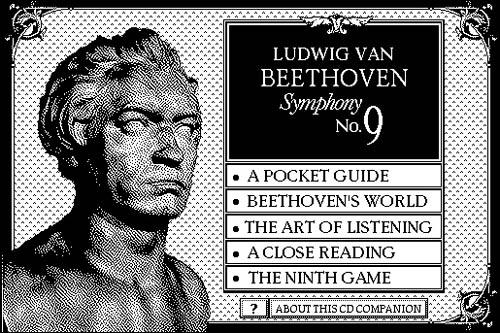
In 1989, the Voyager Company produced what is generally considered to be the first interactive electronic publication: The Beethoven's Ninth Symphony CD Companion. Developed in Apple's HyperCard, it was the first CD-ROM publication to wed a computer program to an audio disk. Most important, it was the combination in one work of recording, text, and inspired instruction -- all the tools needed to unlock the secrets of the music.
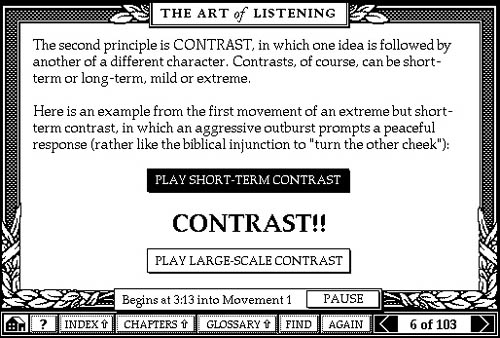
If the CD-ROM was a bottle, than the genie -- the inspired instructor, the individual creative voice that ties it all together -- was Robert Winter, a pioneering music scholar, pianist and author at UCLA who went on to develop two more titles with Voyager in this series, including Stravinsky's Rite of Spring (view demo) and Dvorak's Symphony No. 9 "From the New World". The Beethoven stack is built around an excellent recording of the Ninth Symphony by the Vienna Philharmonic. A single-page overview provides a menu of the symphony, allowing the reader to jump to any section instantaneously.
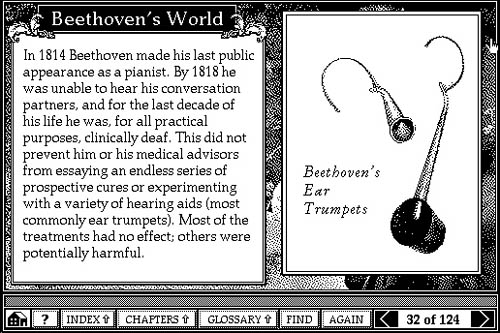
In other sections, Winter ties in basic theory, counting out sections of the music, explaining shifts in rhythm (especially helpful with Stravinsky). He also provides ample textual materials going in depth on various musical conventions and concepts, and providing a rich sense of Beethoven's world and the cultural cosmos in which he worked. There is even a quiz section to help give you a sense of how your listening has improved.
But the central element of the CD-ROM is close reading. As you listen, a cursor takes you through the score measure by measure with a running a commentary from Winter -- identifying themes, elucidating passages, and drawing attention to the effects of particular instruments.
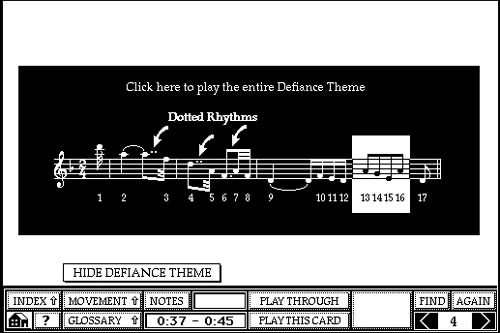
From a design standpoint, this is the major breakthrough of Beethoven's Ninth: the tying of text to specific sections of music in "time-based events."

Putting the teacher inside the book infuses it with the dynamism and precision of a live lecture. It also expands our conception of what it means to illustrate a page. We know how to handle still images or diagrams -- these are relatively easy to arrange in relation to the main flow of the argument. But for time-based media such as music and film -- or in works for which music or film provides the "spine" of the book -- the rhetorical devices must be updated. It's no problem in a live lecture. The professor can simply talk over the symphony or film -- pausing, replaying, emphasizing certain sections. But how do you get this inside the book? How do you write a critical work on time-based media that is not alienated from its subject? Beethoven's Ninth was the program that first suggested a solution.
Posted by ben vershbow at October 20, 2005 6:50 PM