Listing entries tagged with media_consumption


reading fewer books Post date  02.13.2006, 11:04 AM

We've been working on our mission statement (another draft to be posted soon), and it's given me a chance to reconsider what being part of the Institute for the Future of the Book means. Then, last week, I saw this: a Jupiter Research report claims that people are spending more time in front of the screen than with a book in their hand.

"the average online consumer spends 14 hours a week online, which is the same amount of time they watch TV."

That is some 28 hours in front of a screen. Other analysts would say it's higher, because this seems to only include non-work time. Of course, since we have limited time, all this screen time must be taking away from something else.

The idea that the Internet would displace other discretionary leisure activities isn't new. Another report (pdf) from the Stanford Institute for the Quantitative Study of Society suggests that Internet usage replaces all sorts of things, including sleep time, social activities, and television watching. Most controversial was this report's claim that internet use reduces sociability, solely on the basis that it reduces face-to-face time. Other reports suggest that sociability isn’t affected. (disclaimer - we're affiliated with the Annenberg Center, the source of the latter report).

Regardless of time spent alone vs. the time spent face-to-face with people, the Stanford study is not taking into account the reason people are online. To quote David Weinberger:

"The real world presents all sorts of barriers that prevent us from connecting as fully as we'd like to. The Web releases us from that. If connection is our nature, and if we're at our best when we're fully engaged with others, then the Web is both an enabler and a reflection of our best nature." --Fast Company

Hold onto that thought and let's bring this back around to the Jupiter report. People use to think that it was just TV that was under attack. Magazines and newspapers, maybe, suffered too; their formats are similar to the type of content that flourishes online in blog and written-for-the-web article format. But books, it was thought, were safe because they are fundamentally different, a special object worthy of veneration.

"In addition to matching the time spent watching TV, the Internet is displacing the use of other media such as radio, magazines and books. Books are suffering the most; 37% of all online users report that they spend less time reading books because of their online activities."

The Internet is acting as a new distribution channel for traditional media. We've got podcasts, streaming radio, blogs, online versions of everything. Why, then, is it a surprise that we're spending more time online, reading more online, and enjoying fewer books? Here's the dilemma: we're not reading books on screens either. They just haven't made the jump to digital.

While there has been a general decrease in book reading over the years, such a decline may come as a shocking statistic. (Yes, all statistics should be taken with a grain of salt). But I think that in some ways this is the knock of opportunity rather than the death knell for book reading.

…intensive online users are the most likely demographic to use advanced Internet technology, such as streaming radio and RSS.

So it is 'technology' that is keeping people from reading books online, but rather the lack of it. There is something about the current digital reading environment that isn't suitable for continuous, lengthy monographs. But as we consider books that are born digital and take advantage of the networked environment, we will start to see a book that is shaped by its presentation format and its connections. It will be a book that is tailored for the online environment, in a way that promotes the interlinking of the digital realm, and incorporates feedback and conversation.

At that point we'll have to deal with the transition. I found an illustrative quote, referring to reading comic books:

"You have to be able to read and look at the same time, a trick not easily mastered, especially if you're someone who is used to reading fast. Graphic novels, or the good ones anyway, are virtually unskimmable. And until you get the hang of their particular rhythm and way of storytelling, they may require more, not less, concentration than traditional books." --Charles McGrath, NY Times Magazine

We’ve entered a time when the Internet’s importance is shaping the rhythms of our work and entertainment. It’s time that books were created with an awareness of the ebb and flow of this new ecology—and that’s what we’re doing at the Institute.

Posted by jesse wilbur at 11:04 AM | Comments (1)
tags: Jupiter_Reports , NYTimes , RSS , TV , demographics , ebooks , magazines , media_consumption , radio , reading , report , sociability

ESBNs and more thoughts on the end of cyberspace Post date  01.12.2006, 7:31 AM

Anyone who's ever seen a book has seen ISBNs, or International Standard Book Numbers -- that string of ten digits, right above the bar code, that uniquely identifies a given title. Now come ESBNs, or Electronic Standard Book Numbers, which you'd expect would be just like ISBNs, only for electronic books. And you'd be right, but only partly. esbn.jpg ESBNs, which just came into existence this year, uniquely identify not only an electronic title, but each individual copy, stream, or download of that title -- little tracking devices that publishers can embed in their content. And not just books, but music, video or any other discrete media form -- ESBNs are media-agnostic.

"It's all part of the attempt to impose the restrictions of the physical on the digital, enforcing scarcity where there is none," David Weinberger rightly observes. On the net, it's not so much a matter of who has the book, but who is reading the book -- who is at the book. It's not a copy, it's more like a place. But cyberspace blurs that distinction. As Alex Pang explains, cyberspace is still a place to which we must travel. Going there has become much easier and much faster, but we are still visitors, not natives. We begin and end in the physical world, at a concrete terminal.

When I snap shut my laptop, I disconnect. I am back in the world. And it is that instantaneous moment of travel, that light-speed jump, that has unleashed the reams and decibels of anguished debate over intellectual property in the digital era. A sort of conceptual jetlag. Culture shock. The travel metaphors begin to falter, but the point is that we are talking about things confused during travel from one world to another. Discombobulation.

This jetlag creates a schism in how we treat and consume media. When we're connected to the net, we're not concerned with copies we may or may not own. What matters is access to the material. The copy is immaterial. It's here, there, and everywhere, as the poet said. But when you're offline, physical possession of copies, digital or otherwise, becomes important again. If you don't have it in your hand, or a local copy on your desktop then you cannot experience it. It's as simple as that. ESBNs are a byproduct of this jetlag. They seek to carry the guarantees of the physical world like luggage into the virtual world of cyberspace.

But when that distinction is erased, when connection to the network becomes ubiquitous and constant (as is generally predicted), a pervasive layer over all private and public space, keeping pace with all our movements, then the idea of digital "copies" will be effectively dead. As will the idea of cyberspace. The virtual world and the actual world will be one.

For publishers and IP lawyers, this will simplify matters greatly. Take, for example, webmail. For the past few years, I have relied exclusively on webmail with no local client on my machine. This means that when I'm offline, I have no mail (unless I go to the trouble of making copies of individual messages or printouts). As a consequence, I've stopped thinking of my correspondence in terms of copies. I think of it in terms of being there, of being "on my email" -- or not. Soon that will be the way I think of most, if not all, digital media -- in terms of access and services, not copies.

But in terms of perception, the end of cyberspace is not so simple. When the last actual-to-virtual transport service officially shuts down -- when the line between worlds is completely erased -- we will still be left, as human beings, with a desire to travel to places beyond our immediate perception. As Sol Gaitan describes it in a brilliant comment to yesterday's "end of cyberspace" post:

In the West, the desire to blur the line, the need to access the "other side," took artists to try opium, absinth, kef, and peyote. The symbolists crossed the line and brought back dada, surrealism, and other manifestations of worlds that until then had been held at bay but that were all there. The virtual is part of the actual, "we, or objects acting on our behalf are online all the time." Never though of that in such terms, but it's true, and very exciting. It potentially enriches my reality. As with a book, contents become alive through the reader/user, otherwise the book is a dead, or dormant, object. So, my e-mail, the blogs I read, the Web, are online all the time, but it's through me that they become concrete, a perceived reality. Yes, we read differently because texts grow, move, and evolve, while we are away and "the object" is closed. But, we still need to read them. Esse rerum est percipi.

howl page one.jpg Just the other night I saw a fantastic performance of Allen Ginsberg's Howl that took the poem -- which I'd always found alluring but ultimately remote on the page -- and, through the conjury of five actors, made it concrete, a perceived reality. I dug Ginsburg's words. I downloaded them, as if across time. I was in cyberspace, but with sweat and pheremones. The Beats, too, sought sublimity -- transport to a virtual world. So, too, did the cyberpunks in the net's early days. So, too, did early Christian monastics, an analogy that Pang draws:

...cyberspace expresses a desire to transcend the world; Web 2.0 is about engaging with it. The early inhabitants of cyberspace were like the early Church monastics, who sought to serve God by going into the desert and escaping the temptations and distractions of the world and the flesh. The vision of Web 2.0, in contrast, is more Franciscan: one of engagement with and improvement of the world, not escape from it.

The end of cyberspace may mean the fusion of real and virtual worlds, another layer of a massively mediated existence. And this raises many questions about what is real and how, or if, that matters. But the end of cyberspace, despite all the sweeping gospel of Web 2.0, continuous computing, urban computing etc., also signals the beginning of something terribly mundane. Networks of fiber and digits are still human networks, prone to corruption and virtue alike. A virtual environment is still a natural environment. The extraordinary, in time, becomes ordinary. And undoubtedly we will still search for lines to cross.

Posted by ben vershbow at 07:31 AM | Comments (1)
tags: Copyright and Copyleft , DRM , ESBN , ISBN , Mediated Existence , Publishing, Broadcast, and the Press , Web2.0 , copyright , cyberspace , ebooks , ginsberg , media_consumption , poetry , publishing , reality

.tv Post date  01.09.2006, 6:15 PM

People have been talking about internet television for a while now. But Google and Yahoo's unveiling of their new video search and subscription services last week at the Consumer Electronics Show in Las Vegas seemed to make it real.

Sifting through the predictions and prophecies that subsequently poured forth, I stumbled on something sort of interesting -- a small concrete discovery that helped put some of this in perspective. Over the weekend, Slate Magazine quietly announced its partnership with "meaningoflife.tv," a web-based interview series hosted by Robert Wright, author of Nonzero and The Moral Animal, dealing with big questions at the perilous intersection of science and religion.

life_banner_mono.gif

Launched last fall (presumably in response to the intelligent design fracas), meaningoflife.tv is a web page featuring a playlist of video interviews with an intriguing roster of "cosmic thinkers" -- philosophers, scientists and religious types -- on such topics as "Direction in evolution," "Limits in science," and "The Godhead."

This is just one of several experiments in which Slate is fiddling with its text-to-media ratio. Today's Pictures, a collaboration with Magnum Photos, presents a daily gallery of images and audio-photo essays, recalling both the heyday of long-form photojournalism and a possible future of hybrid documentary forms. One problem is that it's not terribly easy to find these projects on Slate's site. The Magnum page has an ad tucked discretely on the sidebar, but meaningoflife.tv seems to have disappeared from the front page after a brief splash this weekend. For a born-digital publication that has always thought of itself in terms of the web, Slate still suffers from a pretty appalling design, with its small headline area capping a more or less undifferentiated stream of headlines and teasers.

Still, I'm intrigued by these collaborations, especially in light of the forecast TV-net convergence. While internet TV seems to promise fragmentation, these projects provide a comforting dose of coherence -- a strong editorial hand and a conscious effort to grapple with big ideas and issues, like the reassuringly nutritious programming of PBS or the BBC. It's interesting to see text-based publications moving now into the realm of television. As Tivo, on demand, and now, the internet atomize TV beyond recognition, perhaps magazines and newspapers will fill part of the void left by channels.

Limited as it may now seem, traditional broadcast TV can provide us with valuable cultural touchstones, common frames of reference that help us speak a common language about our culture. That's one thing I worry we'll lose as the net blows broadcast media apart. Then again, even in the age of five gazillion cable channels, we still have our water-cooler shows, our mega-hits, our television "events." And we'll probably have them on the internet too, even when "by appointment" television is long gone. We'll just have more choice regarding where, when and how we get at them. Perhaps the difference is that in an age of fragmentation, we view these touchstone programs with a mildly ironic awareness of their mainstream status, through the multiple lenses of our more idiosyncratic and infinitely gratified niche affiliations. They are islands of commonality in seas of specialization. And maybe that makes them all the more refreshing. Shows like "24," "American Idol," or a Ken Burns documentary, or major sporting events like the World Cup or the Olympics that draw us like prairie dogs out of our niches. Coming up for air from deep submersion in our self-tailored, optional worlds.

Posted by ben vershbow at 06:15 PM | Comments (6)
tags: Publishing, Broadcast, and the Press , TV , broadband , broadcast , documentary , google , internet , journalism , media , media_consumption , multimedia , network , photography , religion , science , slate , television , yahoo

the future of the book(store), circa 1899 and 2005 Post date  12.20.2005, 2:47 PM

Leafing through an 1899 issue of the literary magazine The Dial, I came across an article called "The Distribution of Books" which resonated with the present moment at several uncanny junctures, and got me thinking about the evolving relationship between publishers, libraries, bookstores, and Google Book Search -- thoughts which themselves evolved after a conversation with a writer from Pages magazine about the future of bookstores.

"The Distribution of Books" focused mainly on changes in the way books were marketed and distributed, warning that bookstores might go out of business if they failed to change their own business practices in response. "Once more the plaint of the bookseller is heard in the land," lamented the author, "and one would be indeed stony-hearted who could view his condition without concern."

Bookseller.jpg

According to "The Distribution of Books," what should have been the privileged domain of the bookseller was being eroded at the century's end by the book sales of "the great dealers in miscellaneous merchandise." The article was referring to the department stores that sold books at a loss in order to lure in customers: a bit less than a century later, critics would make the same claims about Amazon, that great dealer in miscellaneous merchandise now celebrating its tenth anniversary. "The Distribution of Books" also complains of the direct marketing practices of publishers who attempted to market to readers directly. This past year, similar complaints were made after Random House joined Scholastic and Simon and Schuster this year in establishing a direct-sale online presence.

Of course, 2005 is not 1899, and this is what makes the Dial piece so startling in its familiarity: in 1899, after all, the distinction between publisher and bookseller was much fresher than now. Hybrid merchant/tradesman who printed, marketed and distributed books at the same time had been the norm for a much longer interval than the shop owner who ordered books from a variety of different publishing houses. In this sense, the publisher's "new" practice of selling books directly was in fact a modification of bookselling practices that predated the specialized bookshop. Ultimately, the Dial piece is less about the demise of the bookseller than about the imagined demise of a relatively recent phenomenon — the specialized book seller with an investment in promoting the culture of books generally rather than the work of a specific author or publisher.

This tension between specialization and generalization also revealed itself in the article's most indignant passage, in which the author expressed outrage over the idea that libraries might themselves get involved in bookselling. According to the Dial, bookstore owners had been subjected to:

an onslaught so unexpected and so startling it left [them] gasping for breath — [a suggestion] made a few months ago by librarian Dewey, who calmly proposed that the public libraries throughout the country should be book-selling as well as book-circulating agencies... Booksellers have always looked askance at public libraries, not understanding how they create an appetite for reading that is sure in the end to redound to the bookseller's advantage, but their suspicious fears never anticipated the explosion in their camp of such a bombshell as this.

After delivering the "bombshell," the author goes on to reassure the reader that Dewey's suggestion (yes, that would be Melvil Dewey, inventor of the Dewey Decimal System) could never be taken seriously in America: such a venture on the part of the nation's libraries would represent a socialistic entangling of the spheres of government and industry. Books sold by libraries would be sold without an eye to profit, conjectured the author, and publishing — and perhaps the notion of the private sector itself — would collapse. "If the state or the municipality were to go into the business of selling books at cost, what should prevent it from doing the like with groceries?"

While the Dial piece made me think about the ways in which the perceived "new" threats to today's bookstores might not be so new, it also made me consider how Dewey's proposal might emerge in modified form in the digital era. While present-day libraries haven't been proposing the sale of books, they certainly are planning to get into the business of marketing and distribution, as the World Digital Library attests. They are also proposing, as Librarian of Congress librarian James Billington has said, a shift toward significant partnerships with for-profit businesses which have (for various reasons) serious economic stakes in sifting through digital materials. And, as Ben noted a few weeks ago, libraries themselves have been using various strategies from online retailers to catalog and present information.

Just as libraries are starting to embrace the private sector, many bookstores are heading in the other direction: driven to the verge of extinction by poor profits, they are reinventing themselves as nonprofits that serve a valuable social and cultural function. Sure, books are still for sale, but the real "value" of a bookstore is now lies not in its merchandise, but in the intellectual or cultural community it fosters: in that respect, some bookstores are thus akin to the subscription libraries of the past.

Is it so impossible to imagine a future in which one walks into a digital distribution center, orders a latte, and uses an Amazon-type search engine to pull up the ebook that can be read at one's reading station after the requisite number of ads have flashed on the screen? Is this a library? Is this a bookstore? Does it matter? Should it?

Posted by lisa lynch at 02:47 PM | Comments (3)
tags: bookstores , future , history , libraries , media_consumption

the "talk to me" crew talks with the institute Post date  12.15.2005, 5:29 PM

liz_and_bill.jpgLiz Barry and Bill Wetzel, the people behind Talk to Me, stopped by the institute offices for lunch today. It is easy to describe what they do, they carry a sign that says "talk to me" and travel the country talking to strangers. However, it is a bit harder to categorize what they do. While not quite a social experiment, they playfully recounted how various places contextualize what they do. In the Upper West Side of New York they are quasi-therapists, while further south in the East Village they are performance artists. Recently, they biked across the country and back, all the while talking to strangers.

The thing that struck me is how they spend their time talking to people just to do it, without some agenda. They are not fund raisers for a non-profit or religious organization, nor do they take money from people after they talk to them (although they accept paypal and mailed donations.) There is no big book deal, reality tv show, or documentary film project looming in the background. They just wanted to start talking to different people and over three years later, the conversation is still ongoing. When I was in graduate school, by my second year, I started feeling that I only did things, so that I could document them for future projects. I get no such impression from Bill and Liz. talk_to_me.jpg

With blogs, photo sharing services, social networking sites, and affordable digital photography and video cameras, anyone can become a content creator and publisher. Documentation begins to drive all activity. Often, I have seen people walking in Times Square with a digital video camera in hand. Oblivious to their surroundings, they were completely preoccupied with documenting everything. Will they ever watch the endless hours of footage they are recording? Obviously, the camera filters their experience. When Liz and Bill set up shop in Time Square, they mainly want to engage in conversation. Their experiences would be very different if they held cameras, because the interaction shifts from a conversation to an interview.

I am glad that they collected some photos along their journey and recorded their thoughts in journals. I am also glad that they did not let that documentation process interfere with their project, whatever "it" is.

Posted by ray cha at 05:29 PM | Comments (1)
tags: Mediated Existence , conversation , documentation , media_consumption , performance_art , social_experiment , social_research , talk_to_me

pages à la carte Post date  11.04.2005, 7:20 AM

The New York Times reports on programs being developed by both Amazon and Google that would allow readers to purchase online access to specific sections of books -- say, a single recipe from a cookbook, an individual chapter from a how-to manual, or a particular short story or poem from an anthology. Such a system would effectively "unbind" books into modular units that consumers patch into their online reading, just as iTunes blew apart the integrity of the album and made digital music all about playlists. We become scrapbook artists.

It seems Random House is in on this too, developing a micropayment model and consulting closely with the two internet giants. Pages would sell for anywhere between five and 25 cents each.

Posted by ben vershbow at 07:20 AM | Comments (1)
tags: Publishing, Broadcast, and the Press , Transliteracies , amazon , books , e-commerce , google , google_print , literature , media_consumption , publishing , randomhouse , reading

a future written in electronic ink? Post date  10.18.2005, 8:47 AM

Discussions about the future of newspapers often allude to a moment in the Steven Spielberg film "Minority Report," set in the year 2054, in which a commuter on the train is reading something that looks like a paper copy of USA Today, but which seems to be automatically updating and rearranging its contents like a web page. This is a comforting vision for the newspaper business: reassigning the un-bottled genie of the internet to the familiar commodity of the broadsheet. But as with most science fiction, the fallacy lies in the projection of our contemporary selves into an imagined future, when in fact people and the way they read may have very much changed by the year 2054.

eink paper.jpg Being a newspaper is no fun these days. The demand for news is undiminished, but online readers (most of us now) feel entitled to a free supply. Print circulation numbers continue to plummet, while the cost of newsprint steadily rises -- it hovers right now at about $625 per metric ton (according to The Washington Post, a national U.S. paper can go through around 200,000 tons in a year).

Staffs are being cut, hiring freezes put into effect. Some newspapers (The Guardian in Britain and soon the Wall Street Journal) are changing the look and reducing the size of their print product to lure readers and cut costs. But given the rather grim forecast, some papers are beginning to ponder how other technologies might help them survive.

Last week, David Carr wrote in the Times about "an ipod for text" as a possible savior -- a popular, portable device that would reinforce the idea of the newspaper as something you have in your hand, that you take with you, thereby rationalizing a new kind of subscription delivery. This weekend, the Washington Post hinted at what that device might actually be: a flexible, paper-like screen using "e-ink" technology.

An e-ink display is essentially a laminated sheet containing a thin layer of fluid sandwiched between positive and negative electrodes. Tiny capsules of black and white pigment float in between and arrange themselves into images and text through variance in the charge (the black are negatively charged and the white positively charged). Since the display is not light-based (like the electronic screens we use today), it has an appearance closer to paper. It can be read in bright sunlight, and requires virtually no power to maintain an image.

PolymerVision-readius-in-hand-13016.jpg Frank Ahrens, who wrote the Post piece, held a public online chat with Russ Wilcox, the chief exec of E Ink Corp. Wilcox predicts that large e-ink screens will be available within a year or two, opening the door for newspapers to develop an electronic product that combines web and broadsheet. Even offering the screens to subscribers for free, he calculates, would be more cost-efficient than the current paper delivery system.

A number of major newspaper conglomerates -- including The Hearst Corporation, Gannett Co. (publisher of USA Today), TOPPAN Printing Company of Japan, and France's Vivendi Universal Publishing -- are interested enough in the potential of e-ink that they have become investors.

But maybe it won't be the storied old broadsheet that people crave. A little over a month ago at a trade show in Berlin, Philips Polymer Vision presented a prototype of its new "Readius" -- a device about the size of a mobile phone with a roll-out e-ink screen. This, too, could be available soon. Like it or not, it might make more sense to watch what's developing with cell phones to get a hint of the future.

But even if electronic paper catches on -- and it seems likely that it, or something similar, will -- I wouldn't count on it to solve the problems of the print news industry. It's often tempting to think of new technologies that fundamentally change the way we operate as simply a matter of pouring old wine into new bottles. But electronic paper will be a technology for delivering the web, or even internet television -- not individual newspapers. So then how do we preserve (or transfer) all that is good about print media, about institutions like the Times and the Post, assuming that their prospects continue to worsen? The answer to that, at least for now, is written in invisible ink.

Posted by ben vershbow at 08:47 AM | Comments (2)
tags: Online , Publishing, Broadcast, and the Press , The Ideal Device? , book , books , computer , e-ink , ebook , eink , gadget , gadgets , interactive , internet , ipod , journalism , media , media_consumption , newspaper , paper , print , publishing , reading , readius , spielberg , technology , web

media consumption #2 Post date  10.04.2005, 6:18 AM

While browsing bookstores in london yesterday — still one of my most favorite pastimes — i came across a beautiful box of 70 thin-spined pocketbooks, the colors of the spine intentionally creating a stunning run of the spectrum from blue to orange. turns out it is a series of 70 essays and short fiction celebrating Penguin's 70th anniversary and its claim to have initiated the 'paperback revolution.' [note: legendary editor jason epstein claims to have done this for Doubleday. does anyone have any insight into whether either claimant really has bragging rights?].
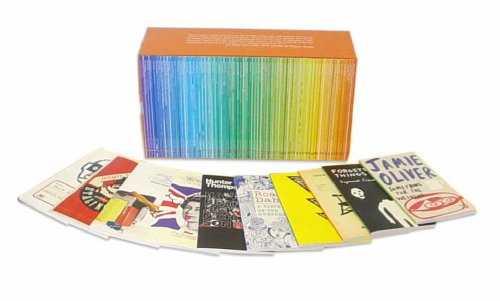
penguin 70.jpg
Although i wanted to spring for the whole box, the $125 price tag was too daunting so i bought 3 of the slim volumes — "The Desert and the Dancing Girls,", a travelogue by Gustave Flaubert describing his journey to Egypt; On Seeing and Noticing," a collection of philosopher Alain de Botton's short essays, and "The Mirror of Ink," seven of Jorge Luis Borge's wonderful short stories. the cover of each volume is exquisitely and thoughtfully designed, each by a different artist.
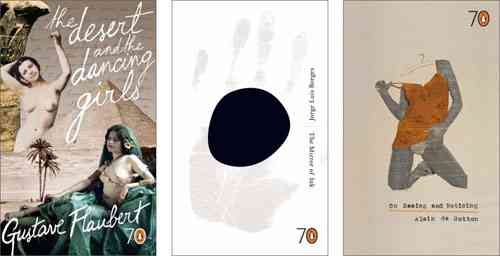

penguintitles.jpg


Each title is so beautiful in its own right, Penguin has succeeded in putting together a series which underlines the appeal of books as objects. the success of the series stems less from the elegance of the graphic design than from the decision to "go small." none of the books in the series exceeds 60 pages; given the size of the page and the font, they are probably equivalent to a long piece in the New Yorker or the chapter of a book. had Penguin decided to celebrate their birthday with 70 beautifully designed books i would have wanted to own the objects but wouldn't necessarily expect to read any of them. however, the curatorial intelligence behind this series seems to have come up with a concept which is "just right." there is something about the discrete boundaries of these short volumes which makes me think i could read them and that i want to read them, not just own them. the closest analogy is to a box of incomparably appetizing chocolates where i browse the contents over and over, making decsions of which to eat first and which to save for later. somehow the packaging has assured me this is a prospect worth attending to.

Sad to say i can't even imagine writing the above to describe offerings in the digital domain. we may get there, but the terms will be different.

(media consumption #1)

Posted by bob stein at 06:18 AM | Comments (7)
tags: book , books , graphic_design , media_consumption , packaging , penguin , reading

hive mind Post date  08.31.2005, 12:02 PM

escher.gif I spend a lot of time looking for specific resources on the web. That means sifting through Google search results and following links that seem promising. A semi-interesting link may take me to an article with another semi-interesting link; that link takes me to another, and so on. As I progress, the articles become more thinly related to the topic, but I pursue them anyway, hoping they will lead me on a trajectory I hadn't thought of, to a great idea that I couldn't have anticipated.

During the whole process, however, I can't shake the unpleasant sensation that I am not the master of my own destiny. I come out of a Google session with a wrung-out feeling, like I've just been lead along a path that was not entirely of my own choosing, marching behind an army of web searchers carving networked pathways into the information landscape, but not necessarily finding that unique morsel that will knit my ideas together. Lee Bryant explains this phenomenon as entaglement in the complex systems addressed by complexity theory. "Complexity theory," says Bryant, "shows us that from the seeds of such small inter-connected actions, large trees of system behaviour can grow. These physical phenomena are reflected online as well, where the emergence of the Wiki movement and the growing cult of Google both display a simple form of collective intelligence." He gives us this metaphor to consider:

The classic pop-science example that illustrates the point is the way in which ants forage for food. Ants display a kind of collective intelligence (described by some as a “hive mind” ) that is based on apparently dumb rules, repetitively followed by thousands of individual insects. Each ant forages for food in an apparently random manner, but when it finds food it marks a pheromone trail back to its colony. Trails fade over time, but positive feedback means that well-travelled paths will attract more and more ants until the particular food source is exhausted. The system works because there are enough ants each following the same rules to ensure comprehensive coverage of any given area.

The fact that my participation in the web, even at the browsing level, means that I will be drawn, unavoidably, into the group effort evokes a mixed response. My independent artistic sensibility hates anything that erases the individual voice and immerses me in a placid groupthink. But my social human sensibility sincerely wants to know what everyone else is doing; it makes me want to dive in, pitch in, follow along, and celebrate the complex social web we are weaving.

Posted by Kim White at 12:02 PM | Comments (1)
tags: ants , collective_intelligence , complex_systems , complexity , complexity_theory , emergence , google , hivemind , media_consumption

death of the album? (or, for that matter, the novel?) Post date  08.23.2005, 1:35 PM

Warner is trying out a new business model for selling music over the web (BBC, CNET). The new "e-label" will sell music exclusively online (no CDs) in three-song clusters, abandoning the conventional album format and allowing emerging artists to prove themselves gradually, without the pressure of a sink-or-swim album deal. What would Sgt. Pepper say?

Crusty aficionados have for some time been lamenting the death of the album in the age of .mp3s, file-sharing and iTunes, where kids are growing up with vast, shifting libraries of individual tracks instead of meticulously ordered, packaged collections. While it's true that a generation of shufflers may not have much respect for the integrity of albums, it's important to remember that most albums don't have all that much integrity to begin with. When the recording industry moved from singles to the longer format of albums, it's not as though there was a corresponding growth in the amount of quality material. As a result, most albums consist of a couple of hit singles padded with filler. No one should mourn the disappearance of this sort of album.

Albums the world would be better off without:

hanson.jpgvanilla ice.jpgtime for regis.jpg

Making a good album is difficult, not unlike putting together a good collection of short fiction, or, in the case of concept albums, an entire novel. I like Warner's idea because it allows musicians to mature gradually, building a fan base and working their way up to the longer form. In turn, one-hit wonders can fizzle out naturally without burdening the world with rotting, opus-sized legacies.

I'm not too worried about the death of the album, at least not for some time. Artists that are capable of producing worthwhile albums will continue to release long format work, and kids will continue to pick and choose songs, and shuffle away carefully chosen track orders. But at the same time, they will make eclectic playlists, some of them uncovering hidden connections that can only be made manifest by porous, digital libraries. It seems to me that it will be a healthy give and take. Just as I'm confident that the novel will survive in an age of scattershot online reading, so will the album in the age of the iPod.

(One way to foil the shufflers would be to release albums in one big track. Remember "Thick As A Brick"?)

Posted by ben vershbow at 01:35 PM | Comments (1) | TrackBack
tags: Publishing, Broadcast, and the Press , media_consumption

the book has been dead for a long time Post date  07.09.2005, 1:06 PM

"The newspaper kills the book, as the book has killed architecture, and as artillery has killed courage and muscular strength. We are not aware of what pleasures newspapers deprive us. They rob everything of its virginity; owing to them we can have nothing of our own, and cannot possess a book all to ourselves; they rob you of surprise at the theatre, and tell you all the catastrophes beforehand; they take away from you the pleasure of tattling, chattering, gossiping and slandering, of composing a piece of news or hawking a true one for a week through all the drawing-rooms of society. They intone their ready-made judgments to us, whether we want them or not, and prepossess us against things that we should like; it is owing to them that the dealers in phosphorus boxes, if only they have a little memory, chatter about literature as nonsensically as country Academicians; it is also owing to them that all day long, instead of artless ideas or individual stupidity, we hear half-digested scraps of newspaper which resemble omelettes raw on one side and burnt on the other, and that we are pitilessly surfeited with news two or three hours old and already known to infants at the breast; brandy drinkers and file and rasp swallowers, who have ceased to find any flavour in the most generous wines, and cannot apprehend their flowery and fragrant bouquet."

(from Theophile Gautier's preface to Mademoiselle de Maupin, May 1834)

Posted by dan visel at 01:06 PM | Comments (0)
tags: media_consumption

transliteracies: research in the technological, social, & cultural practices of online reading Post date  06.16.2005, 10:06 AM

Bob's post last week about changing patterns of media consumption kicked off an interesting discussion, one that leads up perfectly to the "Transliteracies" conference we are attending this weekend at UC Santa Barbara.
Alan Liu
, director of the Transliteracies project, posted this response, which very elegantly lays out some of the important questions. He's allowed me to re-post it here..

BEGIN: The relationship between "browsing" and the "sheer volume" of information is complicated. To start with, I think there is much to be gained in complicating our usually uniform concepts of "browsing" (all shallow, fragmented, attention-deficient) and "volume" ("sheer," as in a towering, monolithic cliff).

We get a sense of the hidden complexity I indicate if we think historically. Below is a passage from Roger Chartier -- the leading scholar in the "history of the book" field -- that should give us pause about making any quick associations between browsing and today's information glut:

"Does this reaction toward the end of the [18th] century indicate a consciousness that reading styles had changed, that the elites in western Europe had passed from intensive and reverent reading to a more extensive, nonchalant reading style, and that such a change called for correction? . . . In the older style: (1) Readers had the choice of only a few books, which perpetuated texts of great longevity. (2) Reading was not separated from other cultural activities such as listening to books read aloud time and again in the bosom of the family, the memorization of such texts . . . , or the recitation of texts read aloud and learned by heart. (3) The relation of reader to book was marked by a weighty respect and charged with a strong sense of the sacred character of printed matter. (4) The intense reading and rereading of the same texts shaped minds that were habituated to a particular set of references and inhabited by the same quotations. It was not until the second half of the eighteen century in Germany and the beginning of the nineteenth century in New England that this style of reading yielded to another style, based on the proliferation of accessible books, on the individualization of the act of reading, on its separation from other cultural activities, and on the descralization of the book. Book reading habits became freer, enabling the reader to pass from one text to another and to have a less attentive attitude toward the printed word, which was less concentrated in a few privileged books." -- Roger Chartier, "Urban Reading Practices, 1660-1770," in his The Cultural Uses of Print in Early Modern France, trans. Lydia G. Cochrane (Princeton: Princeton Univ. Press, 1987), pp. 222-24

It's pretty certain that browsing in the face of sheer volume were deep habits of literacy (specifically, of high print literacy). By contrast, one might ask: who read so intensely and deeply -- to instance the extreme -- that they only really read one book? There were probably just three classes of such people: the very poor (I remembe r, but can't find at present, an essay by Chartier about people in the past who owned just one book, which was found on their body after a coach accident in Paris), the extremely pious (who read the Bible), or the "genius" author. (Think of Blake, for example: no matter how many books he read, he really only had one or two books on his mental bookshelf: the Bible and Milton.) By contrast, everyone else browsed.

Mass literacy in the twentieth century, perhaps, may be a phenomenon of browsing. Think of Reader's Digest. After my family immigrated to the U.S. in my childhood, we were a kind of microcosm of assimilation (into English literacy) in this regard. There were two major investments in books in my household: the Reader's Digest series of condensed books (a kind of packaged browsing) and The World Book encyclopedia (a veritable lesson in reading as browsing-cum-volume). I drank deeply from both founts as a child, since these were the main books in the house. I was intense in my browsing.

So now let's snap back to the present and the act of browsing cyber- or multi-media volumes of information. I've started a project (combining humanists, social scientists, and computer scientists) called Transliteracies to look into "online reading." It's my hypothesis that there are hidden complexities and intelligences in low-attention modes of browsing/surfing that we don't yet know how to chart. Google, after all, is making a fortune for algorithms enacting this hypothesis. Or to cite a historical googler: Dr. Johnson, sage of the Age of Reason, was famous for "devouring" books just by browsing them instead of reading "cover to cover." (To allude to the titles of the two serial magazines he was involved with, he would have called browsing Rambling or Idling [The Rambler, The Idler.)

Just as "browsing" is complex, so I think that there are hidden complexities in the notion of "sheer volume." Some of the digital artists I know -- e.g., George Legrady, Pockets Full of Memories -- are "database artists" whose work asks the question, in essence: what happens to the notion of art when we gaze not at one work in rapt wonder but several thousand works -- when, in other words, the "work" is "volume"? What if quantity, in other words, was a matter of quality? Aren't there different kinds of "volume," some more intelligent, beautiful, kinder, humane (not to mention efficient and flexible, the usual postindustrial desiderata) than others?

I'd better stop, since this comment is too long. As Blake said about volume: "Enough! or too much."

Posted by ben vershbow at 10:06 AM | Comments (3) | TrackBack
tags: Transliteracies , conferences_and_excursions , media_consumption

Something is happening here but you don't know what it is, do you, Mr. Jones?
— me either for that matter.
Post date  06.08.2005, 11:18 AM

book2.jpg Came across this on a web-site i'd never heard of while searching for audio samples of a sound artist i'd never heard of (Todd Dockstader) that was referenced in a copy of magazine called The Wire that i purchased for the first time.

Stacked in almost innumerable dusty piles around my room are the incoming CDs of many a publicist’s hardwork & toil. And for reasons that have more to do with esoteric alignments of the stars than any particular dislike, they often remain untouched & unheard for far, far too long. This very column is somewhat of an attempt to remedy this situation while also commenting on the sheer volume of music, especially electronic music, that continues to be released. It’s a deluge of expression via our machines, which has resulted in an inverse response of criticism, a lack of perspective, an inability to perfect the zoom-out on the overall picture of what is being produced by this wired and wireless culture. . .
tobias c. van veen in cut-up

reminded me for the 323rd time in the past several months that something profound is happening relative to the "sheer volume" of media being produced and new (online) distribution patterns. would love to start to understand the ramifications. here's one i see in my own behavior -- and you can't imagine how painful it is to own up to this:

in 2001, 2 and 3 i made a scrapbook of things i collected on the web. i included in the scrapbook a record of all the books i read cover-to-cover. each year the number was at least 24. suddenly in 2004 the number went to ONE, and that was a graphic novel that i read in a few hours.

i'm still reading quite a bit but most of it is online and in much smaller chunks than books or even long articles. but also, with the advent of big notebook computers with dvd drives and large screens, some of my reading time has been supplanted by watching time as i've begun to absorb TV series (sopranos, 24, Six Feet Under) — viewing all the segments in as few sittings as possible, much like the experience of a page-turner novel.

i'm also browsing quite a bit more. when i was a teenager i went to the record store (yes, i'm that old) and would spend quite a long time choosing one or maybe two to buy. then i would bring those home and listen to them over and over and over. now i find i hardly ever have to come out of browsing mode. between othermusic.com, earplug, etc. etc. a scary amount of my conscious music listening can be subsumed by surfing for new sounds.

i'd like to find a way to get people to talk about their media consumption so that we can begin to understand what actually is happening, not just quantitatively, but qualitatively.

any suggestions?

(image by Gregory Vershbow)

Posted by bob stein at 11:18 AM | Comments (14) | TrackBack
tags: Thought Experiments , media_consumption
