
Listing entries tagged with lessig
lessig: read/write internet under threat
02.17.2006, 1:51 PM
In an important speech to the Open Source Business Conference in San Francisco, Lawrence Lessig warned that decreased regulation of network infrastructure could fundamentally throw off the balance of the "read/write" internet, gearing the medium toward commercial consumption and away from creative production by everyday people. Interestingly, he cites Apple's iTunes music store, generally praised as the shining example of enlightened digital media commerce, as an example of what a "read-only" internet might look like: a site where you load up your plate and then go off to eat alone.
Lessig is drawing an important connection between the question of regulation and the question of copyright. Initially, copyright was conceived as a way to stimulate creative expression -- for the immediate benefit of the author, but for the overall benefit of society. But over the past few decades, copyright has been twisted by powerful interests to mean the protection of media industry business models, which are now treated like a sacred, inviolable trust. Lessig argues that it's time for a values check -- time to return to the original spirit of copyright:
It's never been the policy of the U.S. government to choose business models, but to protect the authors and artists... I'm sure there is a way for [new models to emerge] that will let artists succeed. I'm not sure we should care if the record companies survive. They care, but I don't think the government should.
Big media have always lobbied for more control over how people use culture, but until now, it's largely been through changes to the copyright statutes. The distribution apparatus -- record stores, booksellers, movie theaters etc. -- was not a concern since it was secure and pretty much by definition "read-only." But when we're dealing with digital media, the distribution apparatus becomes a central concern, and that's because the apparatus is the internet, which at present, no single entity controls.
Which is where the issue of regulation comes in. The cable and phone companies believe that since it's through their physical infrastructure that the culture flows, that they should be able to control how it flows. They want the right to shape the flow of culture to best fit their ideal architecture of revenue. You can see, then, how if they had it their way, the internet would come to look much more like an on-demand broadcast service than the vibrant two-way medium we have today: simply because it's easier to make money from read-only than from read/write -- from broadcast than from public access."
Control over culture goes hand in hand with control over bandwidth -- one monopoly supporting the other. And unless more moderates like Lessig start lobbying for the public interest, I'm afraid our government will be seduced by this fanatical philosophy of control, which when aired among business-minded people, does have a certain logic: "It's our content! Our pipes! Why should we be bled dry?" It's time to remind the media industries that their business models are not synonymous with culture. To remind the phone and cable companies that they are nothing more than utility companies and that they should behave accordingly. And to remind the government who copyright and regulation are really meant to serve: the actual creators -- and the public.
Posted by ben vershbow at 01:51 PM
| Comments (6)
tags: Copyright and Copyleft , DRM , Network_Freedom , broadband , copyleft , copyright , internet , lessig , media , network_freedom , network_neutrality , policy , read/write_web
lessig in second life
01.20.2006, 9:27 AM

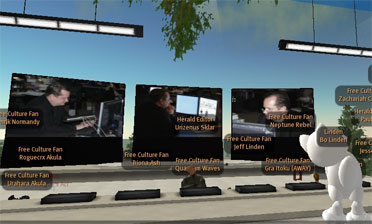
Wednesday evening, I attended an interview with Larry Lessig, which took place in the virtual world of Second Life. New World Notes announced the event and is posting coverage and transcripts of the interview. As it was my first experience in SL, I will post more on the experience of attending an interview/ lecture in a virtual space. For now, I am going to comment upon two quotes that Lessig covered as it relates to our work at the institute.
Lawrence Lessig: Because as life moves online we should have the SAME FREEDOMS (at least) that we had in real life. There's no doubt that in real life you could act out a movie or a different ending to a movie. There's no doubt that would have been "free" of copyright in real life. But as we move online things that were before were free now are regulated.
Yesterday, Bob made the point that our memories increasingly exist outside of ourselves. At the institute, we have discussed the mediated life, and a substantial part of that mediation occurs as we continue to digitize more parts of our lives, from photo albums to diaries. Things we once created in the physical world now reside on the network, which means that it is being published. Photo albums documenting our trips to Disneyland or the Space Needle (whose facade is trademarked and protected) that one rested within the home, are uploaded to flickr, potentially accessible to anyone browsing the Internet, a regulated space. This regulation has enormous influence on the creative outlets of everyone, not just professionals. Without trying to sound overly naive, my concern is not just that speech and discourse of all people are being compromised. As companies become more litigious towards copyright infringement (especially when their arguments are weak), the safe guards of the courts and legislation are not protecting its constituents.
Lawrence Lessig: Copyright is about creating incentives. Incentives are prospective. No matter what even the US Congress does, it will not give Elvis any more incentive to create in 1954. So whatever the length of copyright should be prospectively, we know it can make no sense of incentives to extend the term for work that is already created.
The increasing accessibility of digital technology allows people to become creators and distributors of content. Lessig notes that with each year, the increasing evidence from cases such as the Google Book Search controversy show the inadequacy of current copyright legislation. Further, he insightfully suggests to learn from the creations that young people produce such as anime music videos. Their completely different approach to intellectual property informs the cultural shift that is running counter to the legal status quo. Lessig suggest that these creative works have the potential to inform policy makers that these attitudes are moving toward the original intentions of copyright law. Then, policy makers hopefully may begin to question why these works are currently considered illegal.
The courts' failure to clearly define an interpretation of fair use puts at risk the discourse that a functioning democracy requires. The stringent attitudes towards using copyrighted material goes against the spirit of the original intentions of the law. Although, it may not be a role of the government and the courts to actively encourage creativity. It is sad that bipartisan government actions and courts rulings actively discourage innovation and creativity.
Posted by ray cha at 09:27 AM
| Comments (0)
tags: Copyright and Copyleft , conferences_and_excursions , copyright , intellectual_property , lessig , publishing , second_life
more grist for the "pipes" debate
01.18.2006, 5:47 PM
A couple of interesting items:
Larry Lessig wrote an excellent post last week debunking certain myths circulating the "to regulate or not to regulate" debate in Washington, namely that introducing "net neutrality" provisions in the new Telecom bill would impose unprecedented "common carriage" regulation on network infrastructure. Of course, the infrastructure was regulated before -- when the net was accessed primarily through phone lines. Lessig asks: if an unregulated market is so good for the consumer, then why is broadband service in this country so slow and so expensive?
Also worth noting is a rough sketch from internet entrepreneur Mark Cuban of the idea of "tiered" network service. This would entail prioritizing certain uses of bandwidth. For example, your grandma's web-delivered medical diagnostics would be prioritized over the teenager downloading music videos next door (if, that is, someone shells out for the priority service). This envisions for the consumer end what cable and telephone execs have dreamed of on the client end -- i.e. charging certain web services more for faster page loads and speedier content delivery. Seems to me that either scenario would make the U.S. internet more like the U.S. healthcare system: abysmal except for those with cash.
Posted by ben vershbow at 05:47 PM
| Comments (1)
tags: FCC , ISP , Network_Freedom , broadband , equality , lessig , net_neutrality , network , network_neutrality , pipes , regulation
Lawrence Lessig on "writing"
12.11.2004, 6:17 PM
Closing the USC conference "Scholarship in the Digital Age," Lessig spoke on "free culture" and the current legal/cultural crisis that in the next few years will define the constraints on creative production for decades to come. Due to obsessive fixation by a handful of powerful media industries on the issue of piracy, the massive potential of networked digital culture that has briefly flowered in the past decade could be destroyed by draconian laws and code controls embedded in new technologies. In Lessig's words: "never in our past have fewer exercised more legal control."
Lessig elegantly picked up one of the conference's many threads, multimedia literacy, referring to the bundle of new forms of cultural and scholarly production – remixing, reusing, networking peer-to-peer, working across multiple media – as simply "writing." This is an important step to take in thinking about these new modes of production, and is actually a matter of considerable urgency, considering the legal changes currently underway. The ultimate question to ask is (and this is how Lessig concluded his talk): are we producing a legal culture in which writing is not allowed?
Posted by ben vershbow at 06:17 PM
| Comments (0)
tags: Copyright and Copyleft , Education , Remix , USC , conference , copyleft , copyright , free_culture , free_thought , intellectual_property , lessig , p2p , writing


