Listing entries tagged with korea
the future of the book: korea, 13th century
12.27.2005, 11:35 AM
The database:

Nestled in the Gaya mountain range in southern Korea, the Haeinsa monastery houses the Tripitaka Koreana, the largest, most complete set of Buddhist scriptures in existence -- over 80,000 wooden tablets (enough to print all of Buddhism's sacred texts) kept in open-air storage for the past six centuries. The tablets were carved between 1237 and 1251 in anticipation of the impending Mongol invasion, both as a spiritual effort to ward off the attack, and as an insurance policy. They replaced an earlier set of blocks that had been destroyed in the last Mongol incursion in 1231.

From Korea's national heritage site description of the tablets:
The printing blocks are some 70cm wide 24cm long and 2.8cm thick on the average. Each block has 23 lines of text, each with 14 characters, on each side. Each block thus has a total of 644 characters on both sides. Some 30 men carved the total 52,382,960 characters in the clean and simple style of Song Chinese master calligrapher Ou-yang Hsun, which was widely favored by the aristocratic elites of Goryeo. The carvers worked with incredible dedication and precision without making a single error. They are said to have knelt down and bowed after carving each character. The script is so uniform from beginning to end that the woodblocks look like the work of one person.


I stayed at the Haeinsa temple last Friday night on a sleeping mat in bare room with a heated floor, alongside a number of noisy Koreans (including the rather sardonic temple webmaster -- Haiensa is a Unesco World Heritage site and so keeps a high profile). At three in the morning, at the call to the day's first service, I tramped around the snowy courtyards under crisp, chill stars and watched as the monks pounded a massive barrel-shaped drum hanging inside a pagoda. This was for the benefit of those praying inside the temple (where it sounds like distant thunder). Shivering to the side, I continued to watch as they rang a bell the size of a Volkswagen with a polished log swung on ropes like a wrecking ball. Next to it, another monk ripped out a loud, clattering drum roll inside the wooden ribs of a dragon-like fish, also suspended from the pagoda's roof. It was freezing cold with a biting wind -- not pleasant to be outside, and at such an hour. But the stars were absolutely vivid. I'm no good at picking out constellations, but Orion was poised unmistakeably above the mountains as though stalking an elk on the other side of the ridge.
It's a magical, somewhat harsh place, Haiensa. The Changgyeonggak, the two storage halls that house the Tripitaka, were built ingeniously to preserve the tablets by blocking wind, facilitating ventilation and distributing moisture. You see the monks busying themselves with devotions and chores, practicing an ancient way of life founded upon those tablets. The whole monastery a kind of computer, the monks running routines to and from the database. The mountains, Orion, the drum all part of the program. It seemed almost more hi-tech than cutting edge Seoul.
More on that later.
Posted by ben vershbow at 11:35 AM
| Comments (5)
tags: bible , books , buddha , buddhism , conferences_and_excursions , korea , korean , library , monastery , monastic , printing , scripture , temple , tripitaka
off to seoul
12.17.2005, 7:02 AM
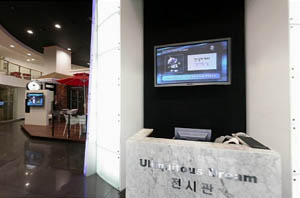
Over the next couple of weeks I will be traveling in South Korea, the land that invented moveable type (1234), and which to this day is cooking up the future of the book on a high flame: from massivly multiplayer online games, to Samsung's Ubiquitous Dream Hall, to the massively multiplayer citizen journalism site OhmyNews. It will take me about 20 hours to get there but I feel I'll be stepping a few years into the future. I expect... well, I have no idea what to expect. And all this futurama is only the tip of the iceberg. I have a camera and it shouldn't be too hard to find an internet connection, so expect a few postcards.
Posted by ben vershbow at 07:02 AM
| Comments (1)
tags: MMOG , citizen_journalism , conferences_and_excursions , future , korea , samsung , seoul , travel , video_games
copyright lawyers remain richest professionals
09.20.2005, 12:50 PM
Or so is the case in Korea, where the custodians of intellectual property law ranked first (apparently for the sixth straight year) in a recent personal income survey. An interesting nugget blown down the pipeline from Korean newspaper Chosun Ilbo, in an article barely longer than its headline. Though I am only able to explore the English-language edition, it seems to be a newspaper with no end of information, but little in the way of analysis. One has the feeling of reading oil, a lubricant for the economic wheels that have delivered a war-torn and psychologically divided nation into material prosperity. Korea is now a major regional power of the so-called global information economy.
The Chosun trifle nicely animates the highly abstract, but fascinating "A Hacker Manifesto" by McKenzie Wark, which I recently began reading. The manifesto is a Marxist tract for the information age, redefining the eternal class struggle in terms of intellectual property - the post-capital form of property - which is controlled by a new ruling class, the "vectoralists." The vectoralists - Bill Gates, Rupert Murdoch, or the big pharmaceutical companies would be the most obvious examples - control the vectors, or channels, of communication, and seek to subjugate the "hackers," who Wark defines as a newly coherent class of idea makers - programmers, inventors, artists and philosophers. It's an important book, and convincingly argues why the intellectual property debate is central in the struggle for liberty.
That the vectoralist class has replaced capital as the dominant exploiting class can be seen in the form that the leading corporations take. These firms divest themselves of their productive capacity, as this is no longer a source of power. They rely on a competing mass of capitalist contractors for the manufacture of their products. Their power lies in monopolizing intellectual property -- patents, copyrights and trademarks -- and the means of reproducing their value -- the vectors of communication. The privatization of information becomes the dominant, rather than a subsidiary, aspect of commodified life.
He goes on to quote from Naomi Klein:
"There is a certain logic to this progression: first, a select group of manufacturers transcend their connection to earthbound products, then, with marketing elevated as the pinnacle of their business, they attempt to alter marketing's social status as a commercial interruption and replace it with seamless integration."
Posted by ben vershbow at 12:50 PM
| Comments (1)
tags: Copyright and Copyleft , IT , capitalism , class , communism , copyleft , copyright , hacker , hacking , intellectualproperty , korea , law , lawyer , manifesto , marxism , naomiklein , patent , seoul , vector , vectoralist , wark
flash memory: "the digital paper age"?
09.13.2005, 3:47 PM
Heads are spinning in response to Samsung's planned release of a 16 gigabyte flash drive - a string of eight 2GB flash memory cards. Flash memory is solid state data storage, as opposed to the conventional hard drive, which contains spinning mechanical parts. The implication is that the price of memory for computers will soon drop dramatically, as will the amount of energy used to power them. Moreover, you will be able to carry millions upon millions of pages on something the size of a keychain (people will probably start using smaller ones as business cards before too long). There's definitely something reassuring about the solidity - to rely entirely on a single, rickety hard drive, or a network, to store documents is incredibly risky and unreliable. Plus, these cards are far more tolerant of shocks, bad weather and all around abuse.
Chosun Ilbo describes the remarks of Hwang Chang-gyu, Samsung's chief executive, who said:
...the development signaled the opening of the “digital paper age.” “In the same way that civilization rapidly progressed after paper was invented 2,000 years ago, flash memory will serve as the ‘digital paper’ to store all kind of information from documents to photos and videos in the future. Mobile storage devices like CDs and hard disks will gradually disappear over the next two or three years, and flash memory will dominate the information age.”
Posted by ben vershbow at 03:47 PM
| Comments (3)
tags: The Ideal Device? , computer , data , datastorage , flash , flashmemory , gadgets , gigabyte , harddrive , korea , memory , paper , paperless , samsung , technology