Listing entries tagged with ebooks
subtitles and the future of reading
02.22.2006, 6:57 PM
After enduring a weeks-long PR pummeling for its dealings in China, Google is hard at work to improve its image in the world, racking up some points for good after slipping briefly into evil. Recently they launched Google.org: a website for the Google Foundation, the corporation's philanthropic arm and central office of evil mitigation. Paying a visit to the site, the disillusioned among us will be pleased to find that the foundation is already sponsoring a handful of worthy initiatives, along with a grants program that donates free web advertising to nonprofit organizations. And just in case we were concerned that Google might not apply its techno-capitalist wizardry to altruism as zealously as to making profit, they just announced today they've named a new director for the foundation by the name of -- no joke -- Dr. Brilliant. So it seems the world is in capable hands.
One project in particular caught my eye in light of recent discussions about screen-based reading and genre-blending visions of the book. Planet Read is an organization that promotes literacy in India through Same Language Subtitling -- a simple but apparently effective technique for building basic reading skills, taking popular visual entertainment like Bollywood movies and adding subtitles in English and Hindi along the bottom of the screen. A number of samples (sadly no Bollywood, just videos or photo montages set to Indian folk songs) can be found on Google Video. Here's one that I particularly liked:
Watching the video -- managing the interplay between moving text and moving pictures -- I began to wonder whether there are possibly some clues to be mined here about the future of reading. Yes, Planet Read is designed first and foremost to train basic alphabetic literacy, turning a captive audience into a captive classroom. But in doing so, might it not also be nurturing another kind of literacy?
The problem with contemporary discussions about the future of the book is that they are mired -- for cultural and economic reasons -- in a highly inflexible conception of what a book can be. People who grew up with print tend to assume that going digital is simply a matter of switching containers (with a few enhancements thrown in the mix), failing to consider how the actual content of books might change, or how the act of reading -- which increasingly takes place in a dyanamic visual context -- may eventually demand a more dynamic kind of text.
Blurring the lines between text and visual media naturally makes us uneasy because it points to a future that quite literally (for us dinosaurs at least) could be unreadable. But kids growing up today, in India or here in the States, are already highly accustomed to reading in screen-based environments, and so they probably have a somewhat different idea of what reading is. For them, text is likely just one ingredient in a complex combinatory medium.
Another example: Nochnoi Dozor (translated "Night Watch") is a film that has widely been credited as the first Russian blockbuster of the post-Soviet era -- an adrenaline-pumping, special effects-infused, sci-fi vampire epic made entirely by Russians, on Russian soil and on Russian themes (it's based on a popular trilogy of novels). When it was released about a year and a half ago it shattered domestic box office records previously held by Western hits like Titanic and Lord of the Rings. Just about a month ago, the sequel "Day Watch" shattered the records set by "Night Watch."
While highly derivative of western action movies, Nochnoi Dozor is moody, raucous and darkly gorgeous, giving a good, gritty feel of contemporary Moscow. Its plot grows rickety in places, and sometimes things are downright incomprehensible (even, I'm told, with fluent Russian), so I'm skeptical about its prospects on this side of the globe. But goshdarnit, Russians can't seem to get enough of it -- so in an effort to lure American audiences over to this uniquely Russian gothic thriller, start building a brand out of the projected trilogy (and presumably pave the way for the eventual crossover to Hollywood of director Timur Bekmambetov), Fox Searchlight just last week rolled the film out in the U.S. on a very limited release.
What could this possibly have to do with the future of reading? Well, naturally the film is subtitled, and we all know how subtitles are the kiss of death for a film in the U.S. market (Passion of the Christ notwithstanding). But the marketers at Fox are trying something new with Nochnoi Dozor. No, they weren't foolish enough to dub it, which would have robbed the film of the scratchy, smoke-scarred Moscow voices that give it so much of its texture. What they've done is played with the subtitles themselves, making them more active and responsive to the action in the film (sounds like some Flash programmer had a field day...). Here's a description from an article in the NY Times (unfortunately now behind pay wall):
...[the words] change color and position on the screen, simulate dripping blood, stutter in emulation of a fearful query, or dissolve into red vapor to emulate a character's gasping breaths.
And this from Anthony Lane's review in the latest New Yorker:
...the subtitles, for instance, are the best I have encountered. Far from palely loitering at the foot of the screen, they lurk in odd corners of the frame and, at one point, glow scarlet and then spool away, like blood in water. I trust that this will start a technical trend and that, from here on, no respectable French actress will dream of removing her clothes unless at least three lines of dialogue can be made to unwind across her midriff.
It might seem strange to think of subtitling of foreign films as a harbinger of future reading practices. But then, with the increasing popularity of Asian cinema, and continued cross-pollination between comics and film, it's not crazy to suspect that we'll be seeing more of this kind of textual-visual fusion in the future.
Most significant is the idea that the text can itself be an actor in a perfomance: a frontier that has only barely been explored -- though typography enthusiasts will likely pillory me for saying so.
Posted by ben vershbow at 06:57 PM
| Comments (6)
| TrackBack
tags: animation , books , cinema , digital_literature , ebooks , film , flash , google , google_video , india , language , literacy , reading , russia , subtitles , translation , typography , video
the bible on dvd: another weird embodiment of the book on screen
02.19.2006, 5:50 PM
The bible has long been a driver of innovation in book design, and this latest is no exception: an ad I saw today on TV for the complete King James Bible on DVD. Not a film, mind you, but an interactive edition of the old and new testaments built around a graphical rendering of an old bible open on a lectern that the reader, uh viewer, uh... reader controls. Each page is synched up to a full-text narration in the "crystal clear, mellow baritone" of Emmy-winning Bible reader Stephen Johnston, along with assorted other actors and dramatic sound effects bringing the stories to life.
There's the ad to the right (though when I saw it on BET the family was black). You can also download an actual demo (Real format) here. It's interesting to see the interactivity of the DVD used to mimic a physical book -- even the package is designed to suggest the embossed leather of an old bible, opening up to the incongruous sight of a pair of shiny CDs. More than a few analogies could be drawn to the British Library's manuscript-mimicking "Turning the Pages," which Sally profiled here last week, though here the pages replace each other with much less fidelity to the real.
There's no shortage of movie dramatizations aimed at making the bible more accessible to churchgoers and families in the age of TV and the net. What the makers of this DVD seem to have figured out is how to combine the couch potato ritual of television with the much older practice of group scriptural reading. Whether or not you'd prefer to read the bible in this way, with remote control in hand, you can't deny that it keeps the focus on the text.
Last week, Jesse argued that it's not technology that's causing a decline in book-reading, but rather a lack of new technologies that make books readable in the new communications environment. He was talking about books online, but the DVD bible serves just as well to illustrate how a text (a text that, to say the least, is still in high demand) might be repurposed in the context of newer media.
Another great driver of innovation in DVDs: pornography. No other genre has made more creative use of the multiple camera views options that can be offered simulataneously on a single film in the DVD format (I don't have to spell out what for). They say that necessity is the mother of invention, and what greater necessities than sex and god? You won't necessarily find the world's most elegant design, but it's good to keep track of these uniquely high-demand areas as they are consistently ahead of the curve.
Posted by ben vershbow at 05:50 PM
| Comments (11)
tags: DVD , The Performing Book , bible , books , christianity , ebook , ebooks , god , interface , literacy , porn , pornography , reading , religion , scripture , television
reading fewer books
02.13.2006, 11:04 AM
We've been working on our mission statement (another draft to be posted soon), and it's given me a chance to reconsider what being part of the Institute for the Future of the Book means. Then, last week, I saw this: a Jupiter Research report claims that people are spending more time in front of the screen than with a book in their hand.

"the average online consumer spends 14 hours a week online, which is the same amount of time they watch TV."
That is some 28 hours in front of a screen. Other analysts would say it's higher, because this seems to only include non-work time. Of course, since we have limited time, all this screen time must be taking away from something else.
The idea that the Internet would displace other discretionary leisure activities isn't new. Another report (pdf) from the Stanford Institute for the Quantitative Study of Society suggests that Internet usage replaces all sorts of things, including sleep time, social activities, and television watching. Most controversial was this report's claim that internet use reduces sociability, solely on the basis that it reduces face-to-face time. Other reports suggest that sociability isn’t affected. (disclaimer - we're affiliated with the Annenberg Center, the source of the latter report).
Regardless of time spent alone vs. the time spent face-to-face with people, the Stanford study is not taking into account the reason people are online. To quote David Weinberger:
"The real world presents all sorts of barriers that prevent us from connecting as fully as we'd like to. The Web releases us from that. If connection is our nature, and if we're at our best when we're fully engaged with others, then the Web is both an enabler and a reflection of our best nature." --Fast Company
Hold onto that thought and let's bring this back around to the Jupiter report. People use to think that it was just TV that was under attack. Magazines and newspapers, maybe, suffered too; their formats are similar to the type of content that flourishes online in blog and written-for-the-web article format. But books, it was thought, were safe because they are fundamentally different, a special object worthy of veneration.
"In addition to matching the time spent watching TV, the Internet is displacing the use of other media such as radio, magazines and books. Books are suffering the most; 37% of all online users report that they spend less time reading books because of their online activities."
The Internet is acting as a new distribution channel for traditional media. We've got podcasts, streaming radio, blogs, online versions of everything. Why, then, is it a surprise that we're spending more time online, reading more online, and enjoying fewer books? Here's the dilemma: we're not reading books on screens either. They just haven't made the jump to digital.
While there has been a general decrease in book reading over the years, such a decline may come as a shocking statistic. (Yes, all statistics should be taken with a grain of salt). But I think that in some ways this is the knock of opportunity rather than the death knell for book reading.
…intensive online users are the most likely demographic to use advanced Internet technology, such as streaming radio and RSS.
So it is 'technology' that is keeping people from reading books online, but rather the lack of it. There is something about the current digital reading environment that isn't suitable for continuous, lengthy monographs. But as we consider books that are born digital and take advantage of the networked environment, we will start to see a book that is shaped by its presentation format and its connections. It will be a book that is tailored for the online environment, in a way that promotes the interlinking of the digital realm, and incorporates feedback and conversation.
At that point we'll have to deal with the transition. I found an illustrative quote, referring to reading comic books:
"You have to be able to read and look at the same time, a trick not easily mastered, especially if you're someone who is used to reading fast. Graphic novels, or the good ones anyway, are virtually unskimmable. And until you get the hang of their particular rhythm and way of storytelling, they may require more, not less, concentration than traditional books." --Charles McGrath, NY Times Magazine
We’ve entered a time when the Internet’s importance is shaping the rhythms of our work and entertainment. It’s time that books were created with an awareness of the ebb and flow of this new ecology—and that’s what we’re doing at the Institute.
Posted by jesse wilbur at 11:04 AM
| Comments (1)
tags: Jupiter_Reports , NYTimes , RSS , TV , demographics , ebooks , magazines , media_consumption , radio , reading , report , sociability
harper-collins half-heartedly puts a book online
02.07.2006, 8:09 AM
As noted in The New York Times, Harper-Collins has put the text of Bruce Judson's Go It Alone: The Secret to Building a Successful Business on Your Own online; ostensibly this is a pilot for more books to come.
Harper-Collins isn't doing this out of the goodness of their hearts: it's an ad-supported project. Every page of the book (it's paginated in exactly the same way as the print edition) bears five Google ads, a banner ad, and a prominent link to buy the book at Amazon. Visiting Amazon suggests other motives for Harper-Collins's experiment: new copies are selling for $5.95 and there are no reader reviews of the book, suggesting that, despite what the press would have you believe, Judson's book hasn't attracted much attention in print format. Putting it online might not be so much of a brave pilot program as an attempt to staunch the losses for a failed book.
Certainly H-C hasn't gone to a great deal of trouble to make the project look nice. As mentioned, the pagination is exactly the same as the print version; that means that you get pages like this, which start mid-sentence and end mid-sentence. While this is exactly what print books do, it's more of a problem on the web: with so much extraneous material around it, it's more difficult for the reader to remember where they were. It wouldn't have been that hard to rebreak the book: on page 8, they could have left the first line on the previous page with the paragraph it belongs too while moving the last line to the next page.
It is useful to have a book that can be searched by Google. One suspects, however, that Google would have done a better job with this.
Posted by dan visel at 08:09 AM
| Comments (6)
tags: Publishing, Broadcast, and the Press , ads , design_curmudgeonry , ebooks , harper-collins , judson , publishing
DRM and the damage done to libraries
02.06.2006, 7:51 AM
A recent BBC article draws attention to widespread concerns among UK librarians (concerns I know are shared by librarians and educators on this side of the Atlantic) regarding the potentially disastrous impact of digital rights management on the long-term viability of electronic collections. At present, when downloads represent only a tiny fraction of most libraries' circulation, DRM is more of a nuisance than a threat. At the New York Public library, for instance, only one "copy" of each downloadable ebook or audio book title can be "checked out" at a time -- a frustrating policy that all but cancels out the value of its modest digital collection. But the implications further down the road, when an increasing portion of library holdings will be non-physical, are far more grave.
What these restrictions in effect do is place locks on books, journals and other publications -- locks for which there are generally no keys. What happens, for example, when a work passes into the public domain but its code restrictions remain intact? Or when materials must be converted to newer formats but can't be extracted from their original files? The question we must ask is: how can librarians, now or in the future, be expected to effectively manage, preserve and update their collections in such straightjacketed conditions?
This is another example of how the prevailing copyright fundamentalism threatens to constrict the flow and preservation of knowledge for future generations. I say "fundamentalism" because the current copyright regime in this country is radical and unprecedented in its scope, yet traces its roots back to the initially sound concept of limited intellectual property rights as an incentive to production, which, in turn, stemmed from the Enlightenment idea of an author's natural rights. What was originally granted (hesitantly) as a temporary, statutory limitation on the public domain has spun out of control into a full-blown culture of intellectual control that chokes the flow of ideas through society -- the very thing copyright was supposed to promote in the first place.
If we don't come to our senses, we seem destined for a new dark age where every utterance must be sanctioned by some rights holder or licensing agent. Free thought isn't possible, after all, when every thought is taxed. In his "An Answer to the Question: What is Enlightenment?" Kant condemns as criminal any contract that compromises the potential of future generations to advance their knowledge. He's talking about the church, but this can just as easily be applied to the information monopolists of our times and their new tool, DRM, which, in its insidious way, is a kind of contract (though one that is by definition non-negotiable since enforced by a machine):
But would a society of pastors, perhaps a church assembly or venerable presbytery (as those among the Dutch call themselves), not be justified in binding itself by oath to a certain unalterable symbol in order to secure a constant guardianship over each of its members and through them over the people, and this for all time: I say that this is wholly impossible. Such a contract, whose intention is to preclude forever all further enlightenment of the human race, is absolutely null and void, even if it should be ratified by the supreme power, by parliaments, and by the most solemn peace treaties. One age cannot bind itself, and thus conspire, to place a succeeding one in a condition whereby it would be impossible for the later age to expand its knowledge (particularly where it is so very important), to rid itself of errors, and generally to increase its enlightenment. That would be a crime against human nature, whose essential destiny lies precisely in such progress; subsequent generations are thus completely justified in dismissing such agreements as unauthorized and criminal.
We can only hope that subsequent generations prove more enlightened than those presently in charge.
Posted by ben vershbow at 07:51 AM
| Comments (4)
tags: Copyright and Copyleft , DRM , IP , Libraries, Search and the Web , books , copyright , digital , digitization , ebooks , enlightenment , fundamentalism , intellectual_property , kant , libraries , library , philosophy , public_domain , scholarship
the book is reading you
01.19.2006, 1:42 PM
I just noticed that Google Book Search requires users to be logged in on a Google account to view pages of copyrighted works.
They provide the following explanation:
Why do I have to log in to see certain pages?Because many of the books in Google Book Search are still under copyright, we limit the amount of a book that a user can see. In order to enforce these limits, we make some pages available only after you log in to an existing Google Account (such as a Gmail account) or create a new one. The aim of Google Book Search is to help you discover books, not read them cover to cover, so you may not be able to see every page you're interested in.
So they're tracking how much we've looked at and capping our number of page views. Presumably a bone tossed to publishers, who I'm sure will continue suing Google all the same (more on this here). There's also the possibility that publishers have requested information on who's looking at their books -- geographical breakdowns and stats on click-throughs to retailers and libraries. I doubt, though, that Google would share this sort of user data. Substantial privacy issues aside, that's valuable information they want to keep for themselves.
That's because "the aim of Google Book Search" is also to discover who you are. It's capturing your clickstreams, analyzing what you've searched and the terms you've used to get there. The book is reading you. Substantial privacy issues aside, (it seems more and more that's where we'll be leaving them) Google will use this data to refine Google's search algorithms and, who knows, might even develop some sort of personalized recommendation system similar to Amazon's -- you know, where the computer lists other titles that might interest you based on what you've read, bought or browsed in the past (a system that works only if you are logged in). It's possible Google is thinking of Book Search as the cornerstone of a larger venture that could compete with Amazon.
There are many ways Google could eventually capitalize on its books database -- that is, beyond the contextual advertising that is currently its main source of revenue. It might turn the scanned texts into readable editions, hammer out licensing agreements with publishers, and become the world's biggest ebook store. It could start a print-on-demand service -- a Xerox machine on steroids (and the return of Google Print?). It could work out deals with publishers to sell access to complete online editions -- a searchable text to go along with the physical book -- as Amazon announced it will do with its Upgrade service. Or it could start selling sections of books -- individual pages, chapters etc. -- as Amazon has also planned to do with its Pages program.
Amazon has long served as a valuable research tool for books in print, so much so that some university library systems are now emulating it. Recent additions to the Search Inside the Book program such as concordances, interlinked citations, and statistically improbable phrases (where distinctive terms in the book act as machine-generated tags) are especially fun to play with. Although first and foremost a retailer, Amazon feels more and more like a search system every day (and its A9 engine, though seemingly always on the back burner, is also developing some interesting features). On the flip side Google, though a search system, could start feeling more like a retailer. In either case, you'll have to log in first.
Posted by ben vershbow at 01:42 PM
| Comments (5)
tags: Copyright and Copyleft , Libraries, Search and the Web , POD , amazon , books , e-commerce , e-publishing , ebooks , google , google_book_search , google_print , internet , print_on_demand , privacy , publishing , search , web
ESBNs and more thoughts on the end of cyberspace
01.12.2006, 7:31 AM
Anyone who's ever seen a book has seen ISBNs, or International Standard Book Numbers -- that string of ten digits, right above the bar code, that uniquely identifies a given title. Now come ESBNs, or Electronic Standard Book Numbers, which you'd expect would be just like ISBNs, only for electronic books. And you'd be right, but only partly.
ESBNs, which just came into existence this year, uniquely identify not only an electronic title, but each individual copy, stream, or download of that title -- little tracking devices that publishers can embed in their content. And not just books, but music, video or any other discrete media form -- ESBNs are media-agnostic.
"It's all part of the attempt to impose the restrictions of the physical on the digital, enforcing scarcity where there is none," David Weinberger rightly observes. On the net, it's not so much a matter of who has the book, but who is reading the book -- who is at the book. It's not a copy, it's more like a place. But cyberspace blurs that distinction. As Alex Pang explains, cyberspace is still a place to which we must travel. Going there has become much easier and much faster, but we are still visitors, not natives. We begin and end in the physical world, at a concrete terminal.
When I snap shut my laptop, I disconnect. I am back in the world. And it is that instantaneous moment of travel, that light-speed jump, that has unleashed the reams and decibels of anguished debate over intellectual property in the digital era. A sort of conceptual jetlag. Culture shock. The travel metaphors begin to falter, but the point is that we are talking about things confused during travel from one world to another. Discombobulation.
This jetlag creates a schism in how we treat and consume media. When we're connected to the net, we're not concerned with copies we may or may not own. What matters is access to the material. The copy is immaterial. It's here, there, and everywhere, as the poet said. But when you're offline, physical possession of copies, digital or otherwise, becomes important again. If you don't have it in your hand, or a local copy on your desktop then you cannot experience it. It's as simple as that. ESBNs are a byproduct of this jetlag. They seek to carry the guarantees of the physical world like luggage into the virtual world of cyberspace.
But when that distinction is erased, when connection to the network becomes ubiquitous and constant (as is generally predicted), a pervasive layer over all private and public space, keeping pace with all our movements, then the idea of digital "copies" will be effectively dead. As will the idea of cyberspace. The virtual world and the actual world will be one.
For publishers and IP lawyers, this will simplify matters greatly. Take, for example, webmail. For the past few years, I have relied exclusively on webmail with no local client on my machine. This means that when I'm offline, I have no mail (unless I go to the trouble of making copies of individual messages or printouts). As a consequence, I've stopped thinking of my correspondence in terms of copies. I think of it in terms of being there, of being "on my email" -- or not. Soon that will be the way I think of most, if not all, digital media -- in terms of access and services, not copies.
But in terms of perception, the end of cyberspace is not so simple. When the last actual-to-virtual transport service officially shuts down -- when the line between worlds is completely erased -- we will still be left, as human beings, with a desire to travel to places beyond our immediate perception. As Sol Gaitan describes it in a brilliant comment to yesterday's "end of cyberspace" post:
In the West, the desire to blur the line, the need to access the "other side," took artists to try opium, absinth, kef, and peyote. The symbolists crossed the line and brought back dada, surrealism, and other manifestations of worlds that until then had been held at bay but that were all there. The virtual is part of the actual, "we, or objects acting on our behalf are online all the time." Never though of that in such terms, but it's true, and very exciting. It potentially enriches my reality. As with a book, contents become alive through the reader/user, otherwise the book is a dead, or dormant, object. So, my e-mail, the blogs I read, the Web, are online all the time, but it's through me that they become concrete, a perceived reality. Yes, we read differently because texts grow, move, and evolve, while we are away and "the object" is closed. But, we still need to read them. Esse rerum est percipi.
Just the other night I saw a fantastic performance of Allen Ginsberg's Howl that took the poem -- which I'd always found alluring but ultimately remote on the page -- and, through the conjury of five actors, made it concrete, a perceived reality. I dug Ginsburg's words. I downloaded them, as if across time. I was in cyberspace, but with sweat and pheremones. The Beats, too, sought sublimity -- transport to a virtual world. So, too, did the cyberpunks in the net's early days. So, too, did early Christian monastics, an analogy that Pang draws:
...cyberspace expresses a desire to transcend the world; Web 2.0 is about engaging with it. The early inhabitants of cyberspace were like the early Church monastics, who sought to serve God by going into the desert and escaping the temptations and distractions of the world and the flesh. The vision of Web 2.0, in contrast, is more Franciscan: one of engagement with and improvement of the world, not escape from it.
The end of cyberspace may mean the fusion of real and virtual worlds, another layer of a massively mediated existence. And this raises many questions about what is real and how, or if, that matters. But the end of cyberspace, despite all the sweeping gospel of Web 2.0, continuous computing, urban computing etc., also signals the beginning of something terribly mundane. Networks of fiber and digits are still human networks, prone to corruption and virtue alike. A virtual environment is still a natural environment. The extraordinary, in time, becomes ordinary. And undoubtedly we will still search for lines to cross.
Posted by ben vershbow at 07:31 AM
| Comments (1)
tags: Copyright and Copyleft , DRM , ESBN , ISBN , Mediated Existence , Publishing, Broadcast, and the Press , Web2.0 , copyright , cyberspace , ebooks , ginsberg , media_consumption , poetry , publishing , reality
if:book's first year
12.31.2005, 3:16 PM
I spent several hours last night and this morning looking over all the posts since we started if:book last december. It's been a remarkably interesting experience working with my colleagues, exploring and defining the boundaries of our interests and effort. Here are a few posts i picked out for one reason or another. On monday we'll post a new revised mission statement for the institute .
1. Three Books That Influenced Your Worldview: The List
we launched the site with the results of our first though experiment in which we asked people to name the three books that most influenced their world view. the results were very interesting. check out the exchange with Alan Kay too.
2. networked book/book as network
kim wrote this first if:book post which mentioned the concept of a "networked book" — a subject that we keep coming back to and find increasingly exciting.
3. genre-busting books
sol gaitan was our most frequent guest blogger. the breadth of her cultural knowledge and her constant reminder that the boundaries of our world extend beyond the hyper-connected coasts of the U.S. are a crucial and welcome contribution.
4. from the nouveau roman to the nouveau romance
one of a dozen or so long posts from Dan who took a seemingly obscure subject and wove it into a deliciously interesting discussion completely relevant to our effort to understand the shifting landscape of intellectual discourse. a more recent one
5. contagious media: symptom of what's to come?
first time we experimented with making our work open and transparent. this idea grew over time and is now in the draft of our new mission statement which says, Academic institutes arose in the age of print, which informed the structure and rhythm of their work. The Institute for the Future of the Book was born in the digital era, and we seek to conduct our work in ways appropriate to the emerging modes of communication and rhythms of the networked world. Freed from the traditional print publishing cycles and hierarchies of authority, the Institute seeks to conduct its activities as much as possible in the open and in real time.
6. ted nelson & the ideologies of documents
a brilliant post by Dan about the importance of (much-maligned visionary) Ted Nelson's views on the way we choose to structure and represent knowledge.
7. it seems to be happening before our eyes, Pt 1 and Pt2
2005 is likely to be remembered as the year that we started to pay more attention to individual voices in the blogosphere than the mainstream media. The NY Times and Washington Post may never recover from the exposures that showed they were in cahoots with the Bush administration over Plamegate and the admission of wholesale unauthorized wire-tapping.
8. blog reading: what's left behind
dan wrote this post about the deficiencies of the structure of blogs. it's a recurring theme at the institute and you'll see a lot more about it in the coming year.
9. transliteracies: research in the technological, social, & cultural practices of online reading
ben re-posted this interesting discussion by Alan Liu on the changing nature of reading and browsing in an online context.
10. flushing the net down the tubes
ben's first post on the crucial subject of the coming battle in which the telcos and cable companies will try to turn the web into a broadcast medium favoring the big media companies over individual voices.
11. sober thoughts on google: privatization and privacy
thanks to ben's thougtful posts, the institute has gained a reputation for developing an even-handed view of Google book scanning and searching project.
12. the "talk to me" crew talks with the institute
now that we've got our cool new offices in williamsburg (brooklyn), we've been inviting an interesting group of folks to lunch. Liz and Bill were two of our favorite visitors, written up in a nice post by Ray. Other interesting visitors were Ken Wark, Tom De Zengotita and Mitchelll Stephens.
13. the future of the book: korea, 13th century
couldn't resist including ben's write-up to a buddhist monastery in korea — both because it has the most beautiful photo that appeared in the blog and for one of my favorite images . . . the whole monastery a kind of computer, the monks running routines to and from the database.
Posted by bob stein at 03:16 PM
| Comments (1)
tags: 2005 , Blogosphere , blogging , books , ebooks
google book search debated at american bar association
12.15.2005, 3:50 PM
Last night I attended a fascinating panel discussion at the American Bar Association on the legality of Google Book Search. In many ways, this was the debate made flesh. Making the case against Google were high-level representatives from the two entities that have brought suit, the Authors' Guild (Executive Director Paul Aiken) and the Association of American Publishers (VP for legal counsel Allan Adler). It would have been exciting if Google, in turn, had sent representatives to make their case, but instead we had two independent commentators, law professor and blogger Susan Crawford and Cameron Stracher, also a law professor and writer. The discussion was vigorous, at times heated -- in many ways a preview of arguments that could eventually be aired (albeit under a much stricter clock) in front of federal judges.
The lawsuits in question center around whether Google's scanning of books and presenting tiny snippet quotations online for keyword searches is, as they claim, fair use. As I understand it, the use in question is the initial scanning of full texts of copyrighted books held in the collections of partner libraries. The fair use defense hinges on this initial full scan being the necessary first step before the "transformative" use of the texts, namely unbundling the book into snippets generated on the fly in response to user search queries.

...in case you were wondering what snippets look like
At first, the conversation remained focused on this question, and during that time it seemed that Google was winning the debate. The plaintiffs' arguments seemed weak and a little desperate. Aiken used carefully scripted language about not being against online book search, just wanting it to be licensed, quipping "we're just throwing a little gravel in the gearbox of progress." Adler was a little more strident, calling Google "the master of misdirection," using the promise of technological dazzlement to turn public opinion against the legitimate grievances of publishers (of course, this will be settled by judges, not by public opinion). He did score one good point, though, saying Google has betrayed the weakness of its fair use claim in the way it has continually revised its description of the program.
Almost exactly one year ago, Google unveiled its "library initiative" only to re-brand it several months later as a "publisher program" following a wave of negative press. This, however, did little to ease tensions and eventually Google decided to halt all book scanning (until this past November) while they tried to smooth things over with the publishers. Even so, lawsuits were filed, despite Google's offer of an "opt-out" option for publishers, allowing them to request that certain titles not be included in the search index. This more or less created an analog to the "implied consent" principle that legitimates search engines caching web pages with "spider" programs that crawl the net looking for new material.
In that case, there is a machine-to-machine communication taking place and web page owners are free to insert programs that instruct spiders not to cache, or can simply place certain content behind a firewall. By offering an "opt-out" option to publishers, Google enables essentially the same sort of communication. Adler's point (and this was echoed more succinctly by a smart question from the audience) was that if Google's fair use claim is so air-tight, then why offer this middle ground? Why all these efforts to mollify publishers without actually negotiating a license? (I am definitely concerned that Google's efforts to quell what probably should have been an anticipated negative reaction from the publishing industry will end up undercutting its legal position.)
Crawford came back with some nice points, most significantly that the publishers were trying to make a pretty egregious "double dip" into the value of their books. Google, by creating a searchable digital index of book texts -- "a card catalogue on steroids," as she put it -- and even generating revenue by placing ads alongside search results, is making a transformative use of the published material and should not have to seek permission. Google had a good idea. And it is an eminently fair use.
And it's not Google's idea alone, they just had it first and are using it to gain a competitive advantage over their search engine rivals, who in their turn, have tried to get in on the game with the Open Content Alliance (which, incidentally, has decided not to make a stand on fair use as Google has, and are doing all their scanning and indexing in the context of license agreements). Publishers, too, are welcome to build their own databases and to make them crawl-able by search engines. Earlier this week, Harper Collins announced it would be doing exactly that with about 20,000 of its titles. Aiken and Adler say that if anyone can scan books and make a search engine, then all hell will break loose and millions of digital copies will be leaked into the web. Crawford shot back that this lawsuit is not about net security issues, it is about fair use.
But once the security cat was let out of the bag, the room turned noticeably against Google (perhaps due to a preponderance of publishing lawyers in the audience). Aiken and Adler worked hard to stir up anxiety about rampant ebook piracy, even as Crawford repeatedly tried to keep the discussion on course. It was very interesting to hear, right from the horse's mouth, that the Authors' Guild and AAP both are convinced that the ebook market, tiny as it currently is, is within a few years of exploding, pending the release of some sort of ipod-like gadget for text. At that point, they say, Google will have gained a huge strategic advantage off the back of appropriated content.
Their argument hinges on the fourth determining factor in the fair use exception, which evaluates "the effect of the use upon the potential market for or value of the copyrighted work." So the publishers are suing because Google might be cornering a potential market!!! (Crawford goes further into this in her wrap-up) Of course, if Google wanted to go into the ebook business using the material in their database, there would have to be a licensing agreement, otherwise they really would be pirating. But the suits are not about a future market, they are about creating a search service, which should be ruled fair use. If publishers are so worried about the future ebook market, then they should start planning for business.
To echo Crawford, I sincerely hope these cases reach the court and are not settled beforehand. Larger concerns about Google's expansionist program aside, I think they have made a very brave stand on the principle of fair use, the essential breathing space carved out within our over-extended copyright laws. Crawford reminded the room that intellectual property is NOT like physical property, over which the owner has nearly unlimited rights. Copyright is a "temporary statutory monopoly" originally granted ("with hesitation," Crawford adds) in order to incentivize creative expression and the production of ideas. The internet scares the old-guard publishing industry because it poses so many threats to the security of their product. These threats are certainly significant, but they are not the subject of these lawsuits, nor are they Google's, or any search engine's, fault. The rise of the net should not become a pretext for limiting or abolishing fair use.
Posted by ben vershbow at 03:50 PM
| Comments (2)
tags: Copyright and Copyleft , Libraries, Search and the Web , copyright , ebooks , fair_use , google , google_book_search , publishing
ElectraPress
12.12.2005, 2:36 AM
Kathleen Fitzpatrick has put forth a very exciting proposal calling for the formation of an electronic academic press. Recognizing the crisis in academic publishing, particularly with the humanities, Fitzpatrick argues that:
The choice that we in the humanities are left with is to remain tethered to a dying system or to move forward into a mode of publishing and distribution that will remain economically and intellectually supportable into the future.
i've got my fingers crossed that Kathleen and her future colleagues have the courage to go way beyond PDF and print-on-demand; the more Electrapress embraces new forms of born-digital documents especially in an open-access pubishing environment, the more interesting the new enterprise will be.
Posted by bob stein at 02:36 AM
| Comments (1)
tags: Publishing, Broadcast, and the Press , academia , e-publishing , ebooks , peer_review , publishing , university
interview with cory doctorow in openbusiness
12.06.2005, 10:10 AM
There's an interview with Cory Doctorow in Openbusiness this morning. Doctorow, who distributes his books for free on the internet, envisions a future in which writers see free electronic distibution as a valuable component of their writing and publishing process. This means, in turn, that writers and publishers need to realize that ebooks and paper books have distinct differences:
Ebooks need to embrace their nature. The distinctive value of ebooks is orthogonal to the value of paper books, and it revolves around the mix-ability and send-ability of electronic text. The more you constrain an ebook’s distinctive value propositions — that is, the more you restrict a reader’s ability to copy, transport or transform an ebook — the more it has to be valued on the same axes as a paper-book. Ebooks *fail* on those axes.
On first read, I thought that Doctorow, much like Julia Keller in her Nov. 27 Chicago Tribune article, wanted to have it both ways: he acknowledges that, in some ways, ebooks challenge the idea of the paper books, but he also suggests that the paper book will remain unaffected by these challenges. But then I read more of Doctorow's ideas about writing, and realized that, for Doctorow, the malleability of the digital format only draws attention to the fact that books are not always as "congealed" as their material nature suggests:
I take the view that the book is a "practice" -- a collection of social and economic and artistic activities -- and not an "object." Viewing the book as a "practice" instead of an object is a pretty radical notion, and it begs the question: just what the hell is a book?
I like this idea of the book as practice, though I don't think it's an idea that would, or could, be embraced by all writers. It's interesting to ponder the ways in which some writers are much more invested in the "thingness" of books than others — usually, I find myself thinking about the kinds of readers who tend to be more invested in the idea of books as objects.
Posted by lisa lynch at 10:10 AM
| Comments (3)
tags: Publishing, Broadcast, and the Press , doctorow , ebooks , publishing
transliterature: can humanism transform the web?
10.25.2005, 3:03 PM
For decades now, hypertext guru Ted Nelson has slipped in and out of public awareness, often left for dead or permanently exiled in Xanadu, only to re-emerge suddenly in a wonderful burst of curmudgeonly dissent. A recent Slashdot thread discusses his latest project, or more accurately, the latest stage in his ongoing quest: transliterature, "a humanist format for re-usable documents and media," or, an alternative to the constricting protocols of the world wide web. What exactly will this new format entail? It's hard to tell. But Nelson's plea is worth heeding:
The tekkies have hijacked literature- with the best intentions, of course!-) - but now the humanists have to get it back. Nearly every form of electronic document- Word, Acrobat, HTML, XML- represents some business or ideological agenda. Many believe Word and Acrobat are out to entrap users; HTML and XML enact a very limited kind of hypertext with great internal complexity. All imitate paper and (internally) hierarchy. I propose a different document agenda: I believe we need new electronic documents which are transparent, public, principled, and freed from the traditions of hierarchy and paper. In that case they can be far more powerful, with deep and rich new interconnections and properties- able to quote dynamically from other documents and buckle sideways to other documents, such as comments or successive versions; able to present third-party links; and much more. Most urgently: if we have different document structures we can build a new copyright realm, where everything can be freely and legally quoted and remixed in any amount without negotiation.
Nelson is always given a nod as the coiner of "hypertext", but his other concepts -- "transclusion", "virtual rearrangement", "clinks," for example -- are largely dismissed, or simply unknown to most people. But elements of his thinking can be observed far and wide in some of the emerging practices -- blogging, wikis, APIs -- of what people are calling "Web 2.0", or, the web as operating system. Over the past few years, the web has transformed from an interlinked series of brochures into a massive hypertext conversation, a platform in which we are increasingly able to weave, quote and track back to other documents. This is at least in the neighborhood of what Nelson is talking about.
Granted, the microeconomy of quotation (transclusion) that Nelson envisions has not yet materialized, but that may only be because he is thinking so far ahead of his time. Staying focused on the present, it's worth taking a look at what is developing with online advertising. Keyword ads, Google's "AdSense", Amazon's web services, and even voluntary donation models like PayPal tip jars -- couldn't you say these are the humble foundations of an online micropayment economy? The explosion of electronic self-publishing has not as yet produced an equivelant commercial rigging, but with blogging now accepted as an important medium, that could soon change.
The next generation of publishing software may include a more robust infrastructure that could support some kind of quotation or cross-referencing economy. Right now, the few blogs that make money do so by encrusting themselves with ads. Advertisers will buy space if the site can demonstrate impressive traffic stats. But doesn't this all sort of skirt around the edge of what makes blogging exciting and influential? What if talented bloggers could earn money when significant portions of their writing were quoted?
You can already quote images, video and sound in the way Nelson dreams of quoting text: by loading it remotely, i.e. from another location on the internet. Of course, there is no microtransaction infrastructure in place. It's much more roughshod than that. You simply pull html from the source site, or embed the file's address in a media player, and plug it in your page. That's how I've transcluded John Ashbery reading his poem "The Tennis Court Oath" (source - ubuweb):
There's still a long way to go, but the points of contact with Nelson's theories are many. For me, it's his humanist philosophy, more than the fuzzy mechanics of his proposed system, that is most inspiring. There's a generosity, an understanding of the interdependency of form and content, that is conspicuously absent in the prevailing tekkie culture. Perhaps the thinker closest of kin to Nelson was Jef Raskin, whose work on the humane interface is founded on many of the same convictions about usability and connectedness. I also find there's a kind of poetry in Nelson's dream of a literary hypertext economy, captured not only in his writings but in his frayed, manic illustrations (transquoted here):

I think he's a kindred spirit of the institute too. Here's Nelson on electronic literature (sadly, not transquoted, just cut-and-paste):
What is literature? Literature is (among other things) the study and design of documents, their structure and connections. Therefore today's electronic documents are literature, electronic literature, and the question is what electronic literature people really need.Electronic literature should belong to all the world, not just be hoarded by a priesthood, and it should do what people need in order to organize and present human ideas with the least difficulty in the richest possible form.
A document is not necessarily a simulation of paper. In the most general sense, a document is a package of ideas created by human minds and addressed to human minds, intended for the furtherance of those ideas and those minds. Human ideas manifest as text, connections, diagrams and more: thus how to store them and present them is a crucial issue for civilization.
The furtherance of the ideas, and the furtherance of the minds that present them and take them in, are the real objectives. And so what is important in documents is the expression, reception and re-use of ideas. Connections, annotations, and most especially re-use-- the traceable flow of content among documents and their versions-- must be our central objectives, not the simulation of paper.
Posted by ben vershbow at 03:03 PM
| Comments (2)
tags: Transliteracies , design_curmudgeonry , digital_literature , ebooks , history_of_interactive_media , html , hypertext , internet , literature , ted_nelson , transclusion , transliterature , web , web_2.0 , xanadu
an ipod for text
10.13.2005, 9:26 AM

When I ride the subway, I see a mix of paper and plastic. Invariably several passengers are lost in their ipods (there must be a higher ipod-per-square-meter concentration in New York than anywhere else). One or two are playing a video game of some kind. Many just sit quietly with their thoughts. A few are conversing. More than a few are reading. The subway is enormously literate. A book, a magazine, The Times, The Post, The Daily News, AM New York, Metro, or just the ads that blanket the car interior. I may spend a lot of time online at home or at work, but on the subway, out in the city, paper is going strong.
Before long, they'll be watching television on the subway too, seeing as the latest ipod now plays video. But rewind to Monday, when David Carr wrote in the NY Times about another kind of ipod -- one that would totally change the way people read newspapers. He suggests that to bounce back from these troubled times (sagging print circulation, no reliable business model for their websites), newspapers need a new gadget to appear on the market: a light-weight, highly portable device, easy on the eyes, easy on the batteries, that uploads articles from the web so you can read them anywhere. An ipod for text.
This raises an important question: is it all just a matter of the reading device? Once there are sufficient advances in display technology, and a hot new gadget to incorporate them, will we see a rapid, decisive shift away from paper toward portable electronic text, just as we have witnessed a widespread migration to digital music and digital photography? Carr points to a recent study that found that in every age bracket below 65, a majority of reading is already now done online. This is mostly desktop reading, stationary reading. But if the greater part of the population is already sold on web-based reading, perhaps it's not too techno-deterministic to suppose that an ipod-like device would in fact bring sweeping change for portable reading, at least periodicals.
But the thing is, online reading is quite different from print reading. There's a lot of hopping around, a lot of digression. Any new hardware that would seek to tempt people to convert from paper would have to be able to surf the web. With mobile web, and wireless networks spreading, people would expect nothing less (even the new Sony PSP portable gaming device has a web browser). But is there a good way to read online text when you're offline? Should we be concerned with this? Until wi-fi is ubiquitous and we're online all the time (a frightening thought), the answer is yes.
We're talking about a device that you plug into your computer that automatically pulls articles from pre-selected sources, presumably via RSS feeds. This is more or less how podcasting works. But for this to have an appeal with text, it will have to go further. What if in addition to uploading new articles in your feed list, it also pulled every document that those articles linked to, so you could click through to referenced sites just as you would if you were online?
It would be a bounded hypertext system. You could do all the hopping around you like within the cosmos of that day's feeds, and not beyond -- you would have the feeling of the network without actually being hooked in. Text does not take up a lot of hard drive space, and with the way flash memory is advancing, building a device with this capacity would not be hard to achieve. Of course, uploading link upon link could lead down an infinite paper trail. So a limit could be imposed, say, a 15-step cap -- a limit that few are likely to brush up against.
So where does the money come in? If you want an ipod for text, you're going to need an itunes for text. The "portable, bounded hypertext RSS reader" (they'd have to come up with a catchier name --the tpod, or some such techno-cuteness) would be keyed in to a subscription service. It would not be publication-specific, because then you'd have to tediously sign up with dozens of sites, and no reasonable person would do this.
So newspapers, magazines, blogs, whoever, will sign licensing agreements with the tpod folks and get their corresponding slice of the profits based on the success of their feeds. There's a site called KeepMedia that is experimenting with such a model on the web, though not with any specific device in mind (and it only includes mainstream media, no blogs). That would be the next step. Premium papers like the Times or The Washington Post might become the HBOs and Showtimes of this text-ripping scheme -- pay a little extra and you get the entire electronic edition uploaded daily to your tpod.
As for the device, well, the Sony Librie has had reasonable success in Japan and will soon be released in the States. The Librie is incredibly light and uses an "e-ink" display that is reflective like paper (i.e. it can be read in bright sunlight), and can run through 10,000 page views on four triple-A batteries.
The disadvantages: it's only black-and-white and has no internet connectivity. It also doesn't seem to be geared for pulling syndicated text. Bob brought one back from Japan. It's nice and light, and the e-ink screen is surprisingly sharp. But all in all, it's not quite there yet.
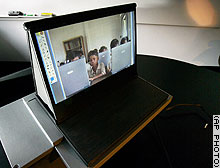
There's always the do-it-yourself approach. The Voyager Company in Japan has developed a program called T-Time (the image at the top is from their site) that helps you drag and drop text from the web into an elegant ebook format configureable for a wide range of mobile devices: phones, PDAs, ipods, handheld video games, camcorders, you name it. This demo (in Japanese, but you'll get the idea) demonstrates how it works.
Presumably, you would also read novels on your text pod. I personally would be loathe to give up paper here, unless it was a novel that had to be read electronically because it was multimedia, or networked, or something like that. But for syndicated text -- periodicals, serials, essays -- I can definitely see the appeal of this theoretical device. I think it's something people would use.
Posted by ben vershbow at 09:26 AM
| Comments (2)
tags: Online , Publishing, Broadcast, and the Press , RSS , The Ideal Device? , apple , book , books , e-ink , e_ink , ebook , ebooks , gadget , internet , ipod , japan , journalism , librie , media , news , newspaper , paper , paperless , podcast , podcasting , print , publishing , reader , reading , sony , syndication , technology , web
the future is not here
09.21.2005, 9:51 AM
"Don't let anyone tell you different: the future is not here. Our cars? Not flying. Our food? Not in pill form. Our books? Not electronic." An article by Joshua Fruhlinger in IBM's developerWorks addresses the ebook problem. Nothing new here; but he does give an entertaining summary of the troubles with and the aspirations for future books.
Posted by Kim White at 09:51 AM
| Comments (0)
tags: IBM , JoshuaFrulinger , books , ebooks , electronicpaper , future
books behind bars - the Google library project
12.14.2004, 4:34 PM
How useful will this service be for in-depth research when copyrighted books (which will account for a huge percentage of searchable texts) cannot be fully accessed? In such cases, a person will be able to view only a selection of pages (depending on agreements with publishers), and will find themselves bombarded with a variety of retail options. On a positive note, the search will be able to refer the user to any local libraries where the desired book is available, but still, the focus here remains squarely on digital texts as simply a means of getting to print texts.
Absent a major paradigm shift with regard to the accessibility and inherent virtue of electronic texts, this ambitious project will never achieve its full potential. For someone searching outside the public domain, the Google library project may amount to nothing more than a guided tour through a prison of incarcerated texts. I've found this to be true so far with Google Scholar - it turned up a lot of interesting stuff, but much of it was password protected or required purchase.
article in Filter: Google -- 21st Century Dewey Decimal System (washingtonpost.com)
Posted by ben vershbow at 04:34 PM
| Comments (0)
tags: Libraries, Search and the Web , books , copyright , digitization , ebooks , google , google_book_search , google_print , google_scholar , libraries , library
NYPL ebook collection leaves much to be desired
12.10.2004, 1:51 PM
I just checked out two titles from the New York Public Library's ebook catalog, only to learn, to my great astonishment, that those books are now effectively "checked out," and cannot be downloaded again by anyone else until my copies time out.
It boggles the mind that NYPL would go to the trouble of establishing a collection of electronic titles, only to wipe out every advantage offered by digital texts. In fact, they do more than simply keep the ebooks on the level of print, they limit them further than that, since there are generally multiple copies of most print titles in the NYPL system.
The people responsible for this catalog have either entirely failed to grasp the concept of infinitely accessible, screen-based books, or they grasp it all too well and are trying to stunt it at its inception, perhaps out of fear of extinction of the print librarian. More likely, they are under heavy pressure by a paranoid copyright regime. Whatever the reason, the new ebook catalog shows a total lack of imagination and offers nearly no tangible benefit for the reader.
Beyond that, the books themselves are poorly designed and unpleasant to read. My downloaded copy of Conrad's Heart of Darkness (which, by the way, I found in the "Romance" section) evidences no more than ten minutes worth of design work, and appears to be simply a cut-and-pasted ASCII file from Gutenberg with a garish graphic slapped on the cover. My copy of Chain of Command by Seymour Hersh was a bit more respectable – more or less a pdf facsimile of the print edition.
On an amusing note, the "literary criticism" section is populated almost entirely by Cliff's Notes.
Posted by ben vershbow at 01:51 PM
| Comments (0)
tags: DRM , Libraries, Search and the Web , books , copyright , design , e-publishing , ebook , ebooks , internet , libraries , library , manhattan , new_york , publishing
3,000 electronic titles at new york public library
12.09.2004, 2:26 AM
This is the third Times article this week on e-books. What's happening?
No Need to Click Here - we're just claiming our feed at Feedster
Posted by ben vershbow at 02:26 AM
| Comments (0)
tags: Libraries, Search and the Web , books , ebook , ebooks , library , new_york
microlit looms large
12.08.2004, 8:28 AM

We've been hearing more and more about the phenomenon of books downloaded to a cell phone screen, so much so that even the mainstream press has been talking about a resurgence of e-books - a topic they almost entirely dropped after the efforts of Microsoft and Gemstar failed to take off a couple years back. And people are doing more than simply reading books on their phones - they can surf the web, watch soap operas and, of course, play video games as they throttle through the subway or break for lunch.
Perhaps most interesting is that while many cell phone readers are downloading conventional print texts - novels, popular nonfiction etc. - there are many more, especially in Asia, who are downloading literature that is being written exclusively for this new medium, particularly serialized novels. These stories are intended for bite-sized consumption, peppered throughout the day, week or month. And they often employ the new technology as literary device - SMS romances, mysteries spun from a single errant text message. Once again, the medium proves to be the message..
It's hard to tell where this is going, but it's certainly more interesting than the prefab model promoted in the first generation of e-books. There is something totally original, totally native, about this new wave of digital reading.
Take a look at this piece from yesterday's New York Times...
Posted by ben vershbow at 08:28 AM
| Comments (1)
tags: Microlit , SMS , cellphone , e-publishing , ebook , ebooks , keitai , publishing , reading , social_software , technology
Three Books That Influenced Your Worldview: The List
12.07.2004, 5:06 PM
Yesterday I was thinking about the fact that books were the crucial element in the formation of my world view and wondered if that is the case with younger people. My guess yesterday morning was that people over 40 would easily come up with a list of books that influenced their way of looking at the world. Also - and this was probably the key idea I was testing - I assumed that when baby boomers came of age, specifc books (let's say a dozen titles) were a crucial element in a shared cultural zeitgeist. By contrast, today I don't see particular titles dominating the scene as they did 35 years ago.
Well . . . turns out I was pretty much wrong, at least as far as the 100+ people in my 40+ and 35- sample groups were concerned. Very few titles made it on to more than one list and I don't see dramatic differences in the lists based on age.
One remarkable fact which you'll notice when you look at the lists is the fantastic diversity in print culture. One can only dream that we will one day have such rich variety among works which are born digital.
This experiment of course hints at the bigger question: are books as important today in terms of forming world view as they were 35-40 years ago, and if not, what is taking their place? Most importantly: if not, what effect does the shift in dominant media have on the creation of world view?
If this gets anyone's juices flowing, we'd love to have suggestions about how to explore these questions further.
Continue reading for the list...
THE LIST:
Anne Moody, Coming of Age in Mississippi
Anne Frank, The Diary of a Young Girl
Leo Tolstoy, Anna Karenina
•
Norman O. Brown Life Against Death
Paul Goodman Growing Up Absurd
Jack Kerouac On The Road
•
The Universal Traveler, Koberg and Bagnall
Summerhill, A.S. Neill
The Whole Earth Catalog
•
1. Ayn Rand's _Anthem_ (I know, I know...liberal me shouldn't like such
things; but it came to me in a period that I needed to hear it was OK to
stand up to evil things going on all around me).
2. Mark Twain's _Letters from the Earth_ (his very dark, late writings that
completely transformed how I looked upon human belief and action)
3. Kenneth Burke's _Language as Symbolic Action_ (I didn't encounter this
one until graduate school, but his definition of man--"the symbol-using &
symbol-misusing animal"--has been indespensible on understanding things like
the latest election...).
•
merleau-ponty 'the visible and the invisible'
william mc donnaugh and michael baumgarten's 'cradle to cradle'
simon critchley 'on humour'
tho i might say that william gibson's 'neuromancer' ranks closely as
formative through being what i resist rather than embrace
•
1984, George Orwell
Independence Day, Richard Ford
The Marketing Imagination, Theodore Levitt
•
Communist Manifesto
Story of O
Masterpieces of French Cooking
•
Mysterious Island, Jules Verne
Invisible Man, Ralph Ellison
Candy, Terry Southern
•
Language, Thought, and Reality
(Selected writings of Benjamin Lee Whorf, Psycholinguist)
The Tao Te Ching
The Unknown Craftsman: A Japanese Insight into Beauty Soetsu Yanagi
•
here are three that come to mind, for different reasons, in the order I
read them:
Boris Vian, L'Écume des jours
Jean-Paul Sartre, Les Chemins de la Liberté
Joseph Schumpeter, Capitalism, Socialism, and Democracy
•
In Dubious Battle/John Steinbeck
Feeling & Form/Susanne K. Langer
The Art of memory/Frances B. Yates
•
beckett waiting for godot
kuhn structure of scientific revolutions
wallace stevens the necessary angel
•
Life After God - Douglas Coupland
Mists of Avalon - Marion Zimmer Bradley
The Rebel - Albert Camus
•
early books would be People's History of the united states and the underside of american history collection and probably some literary work like Arthur Rimbaud's Illuminations.
•
Catcher in the Rye, Salinger
To Kill a Mockingbird, Harper Lee
Katie John-- Mary Calhoun, A book for adolescents about a tomgirl who lived in a brick house in Mississippi and was a bit of a female Huck Finn.
•
books I read young enough that they may actually have had an impact on my
world view:
Little Women
Bridge to Terabithia (Katherine Paterson)
Portrait of the Artist as a Young Man (well, the early parts) (James Joyce)
books that were crucial in forming my world view because they led to a
violent rejection, at least at first:
S/Z (Roland Barthes)
House of Mirth (Edith Wharton)
poets who helped to form my sensibility:
Rilke (Duino Elegies)
Shakespeare (Hamlet)
Milton (Paradise Lost)
Christopher Smart
Lucie Brock-Broido
books that had a big impact but partly because I spent time learning about
them:
the dictionary / the OED / History of the English Language
the works of Anna Trapnel (obscure 17th c. prophet)
Vas de Caminha
•
Thomas Kuhn, The Structure of Scientific Revolutions
Kenneth Burke, Counter-Statement
Robert Pirsig, Zen and the Art of Motorcycle Maintenance
•
To Kill A Mockingbird
Catcher in the Rye
Beloved
•
1. Karl Marx - Capital (honest!)
2. Georges Bataille - Visions of Excess
3. Howard Zinn - A People's History of the United States
bonus two:
4. David Harvey - The Condition of Postmodernity
5. Mike Davis - City of Quartz
•
Female Man by Joanna Russ
Synners by Pat Cadigan
The Social Construction of Reality by Berger and Luckman
•
Hegel, Phenomenology of MInd
Virginia Woolf, Waves
Rilke, Duino Elegies
•
100 Years of Solitude
Executioner's Song
Howard's End
•
A Tree Grows in Brooklyn
Zen and the Art of Motorcyle Maintenance
When God Was a Woman
i'll bet all of the men list Catcher in the Rye. ;-)
•
with apologies...
The Fountainhead by Ayn Rand (probably the same for architects but who would ever admit it?)
Catch 22 by Kurt Vonnegut (which is why i understood that i could put the Fountainhead first)
The Hidden Persuaders by Vance Packard (which took me to structuralism and politics before I knew it)
•
Franny & Zooey - Salinger
Catch 22 - Joseph Heller
Be Here Now - Ram Dasst
•
to kill a mockingbird
the sun also rises
a doll's house (okay, it's a play, but still...)
•
all of Plato
Magic Mountain
Birth of Tragedy
•
Rem Koolhaas's DELIRIOUS NEW YORK
Elaine Scarry's THE BODY IN PAIN
Joyce's PORTRAIT OF AN ARTIST...
•
Genet by Edmund White
Heretics of Dune by Frank Herbert
The Persian Boy by Mary Renault
•
Against Nature - Huysmans
Morris's Disappearing Bag - Rosemary Wells
Universe - Freedman & Kaufmann
•
Darkness at Noon (Arthur Koestler)
The Long-Distance Runner (Michael Harrington)
Don Quixote (Cervantes)
•
The Golden Notebook, Doris Lessing
WCWilliams' Paterson
Stephen Greenblatt, Renaissance Self-Fashioning
•
Ulysses, James Joyce
Behavior in Public Places, Erving Goffman
The Communist Manifesto, Marx & Engels
•
Camus, The Rebel & L'etranger (count as one book ... read in Jr. High)
Old Testament, New Testament, Koran, Gita (count as one book ... read in High School)
Falukner, Yoknapatawpha Co novels ... read in HS & college (actually lots of different books could have gone in this slot ... Blake, Ginsberg, Kesey, Hemingway, Hesse, etc. come to mind ....)
•
Zorba the Greek
Call It Sleep
Crime and Punishment
•
D'Aulaire's Book of Greek Myths
The Book of Genesis
William Butler Yeats: Collected Poems (specific ones: Leda and the Swan, The Second Coming, A Prayer For My Daughtar, The Collar-Bone of a Hare, Under Ben Bulben,Lapis Lazuli, The Circus Animals' Desertion, and so many others).
•
I've listed three books that had, shall we say, an "early" influence and then three books that have been part of a more "mid-life" re-arrangement of this world view:
Three formative books:
1. Freud's Interpretation of Dreams
2. Tristan Tzara, "Dadaist Manifesto" (not a book) along with Lao Tze, Way of the Tao
3. Nabokov's Pale Fire
Three RE-formative books:
1. Wolfgang Schivelbusch, The Railway Journey
2. Hardt & Negri, Empire
3. Virilio, War and Cinema
•
Charlotte's Web
Summerhill
The Book of Laughter and Forgetting
•
The Big 3 books:
-- In college years, Jack Kerouac, beginning with "On the Road" and moving to " Dharma Bums," "Visions of Cody," "Big Sur," and "Dr. Sax." The whole beat category had the greatest single impact on me in the pre-Vietnam years. But if a single book of the batch has to be named, it's "On the Road." Not the best, but the one that put the rest on the map.
— young adult, Thoreau's "Walden Pond," "Civil Disobedience," and essays
— after 40, Jerry Mander's "In the Absence of the Sacred"
•
Thomas Mann's " The Magic Mountain
Arthur Koestler's The Ghost in the Machine,
Thomas Kuhn's "Scientific Paradigm"
•
Ishmael by Daniel Quinn
Woman by Natalie Angiers
Slapstick by Kurt Vonnegut
•
Birdsong, Sebastian Faulks
The Killer Angels, Michael Schaara
Nory Ryan's Song, Patricia Reilly Giff
•
the truly disadvantaged by william julius Wilson
my varian microeconomics textbook
catcher in the rye.
•
Forming my world view huh?
Well, just to warn you, you're not going to get my favorite books or one's that I would necessarily recommend to others,
Respond back if you meant novels, more contemporary works, or were looking for an answer with greater utility. I can make lists all day.
but answering the question as literally as possible...
Friedrich Nietzsche - Beyond Good and Evil
Gottlieb Frege - The Foundations of Arithmetic
Emile Durkheim - The Elementary Forms of the Religious Life
•
HARD QUESTION, perhaps:
El Quijote
Proust's In Search of Lost Time
Neruda's Canto general.
However
Dostoevsky's Crime and Punishment
The Arabian Nights
Mann's The Magic Mountain
Plato's Dialogues
Hesse's Siddartha
and much more. Take your pick, I can't.
•
nikos kazanzakis, Report to Greco
tolstoy, war and peace
michel foucault, the birth of the clinic
•
Camus The Stranger (big bang in high school, not sure how i came across it but remember my father recommending i put it aside and read augustine instead)
Aristotle Poetics along with Pre-Socratic fragments (freshman year, raptured by how the ancients put the world together)
Henry James Portrait of a Lady (while hitchhiking through europe and sleeping in train stations, it emboldened me to think i could put my own life together how i pleased. tho, when i reread it in my 40's it was an entirely different book)
•
Malcolm X Speaks (the first book I ever read that talked about a world as I saw it—found it when I was about 18)
Mao Tse Tung Talks at the Yenan Forum on Literature and Art (actually the book is Mao on Lit and Art. But the essay was most important. It spoke to questions I was trying to solve within my art as a young artist. Then I began to get into how he is really exploring questions of work in a united front under the leadership of the proletariat. I literally read the cover off the book I read it so many times)
Dictatorship and Democracy and the Socialist Transition to Communism by Bob Avakian. Though this is a very recent book it is quit challenging and it encouraged me to deeply question some fundamental assumptions that I had held about Marxist theory and practice.
Because I have trouble counting, I want to put Beloved by Toni Morrison on the list. It is the most amazing piece of literature ever written. It doesn’t form worldview in quite the same way as “political theory” but I wouldn’t be the same person without having read this book.
•
geneaology of morals -- nietzsche
epitaph of a small winner -- machado de assis
birds of america -- lorrie moore
•
The Second Sex, Simone de Beauvoir
Fanshen, William Hinton
Constantine Cavafy, Poems
•
It's tough to narrow it down, of course. I guess The Invisible Man, The Bright Shining Lie (Neal Sheehan as I recall) and A Room of One's Own. As achild I read everything James Thurber wrote several times over. So I guess that would count for the absurdist streak that still reigns over all --but the formative stuff was all about injustice and deception.
•
The Iliad/The Odyssey
The Book of Job
At 42, Jane Jacobs, Systems of Survival
When I was 17, Joseph Conrad, Victory
When I was 27, Kingsley Amis, Lucky Jim
•
this is a difficult request. my list isn't very stable. three books i keep returning to are,
society of the spectacle by guy debord
illuminations by walter benjamin
and lastly the publications of semiotext(e), particularlly the foreign agents series. these little books are wonderful. favorite titles include, speed and politics by paul virilio, nomadology by deleuze and guattari, communiist like us by negri and guattari. if i had to reduce this down to one book it would be the recently published hatred of capitalism/a semiotext(e) reader, edited by chris kraus and sylvere lotringer.
a bonus pick hit just for the pleasure of the rant is t.a.z. the temporary autonomous zone, ontological anarchy, poetic terrorism by hakim bey
•
the Torah
The writings of Rumi
plays of Shakespeare
most recently -
Golas' The Lazy Man's Guide to Enlightenment
a while ago
Watzlawick, Weakland, Fisch - CHANGE
and a long time ago
The Wind and the Willows
•
samule beckett murphy, molloy, waiting for godot
•
Richard Dawkins- The blind watchmaker
Edward O. Wilson- On human nature
Steven Pinker- The language instinct
•
A New Kind of Science by Stephen Wolfram
Ceremony by Leslie Marmon Silko
The Soong Dynasty, by Sterling Seagrave
•
I guess I'd really have to say that the Lord of the Rings trilogy was huge for me. I know that's not massively intellectual but it was the first time I cut class (stayed in the dorm 3 days and devoured the whole thing). It shaped my views about courage, among other things. It's so pop now that it may not count.
More seriously speaking, you are probably going to chuckle, but Alan Watts' The Book on the Taboo against Knowing Who You Are was seriously formative. Going back earlier still, Stranger in a Strange Land was a huge deal when I was a teenager, and I've re-read it several times since. Finally, Virginia Woolf, To the Lighthouse.
I could go on and on about formative fiction but somehow I suspect that's not where you're going with this. Discovering magical realism as a genre was almost as important to me as discovering science fiction. My favorite fiction authors are Louise Erdrich, Charles De Lint, and Sue Miller at the moment.
As a reader of plays it's hard to separate books out.
•
Hmmmmm, that's tough, but this morning I'll go for
1. Ulysses, Joyce: made me realize how vast eternity is if one day can be so large
2. St Joseph Sunday Missal, the standard Amercican Catholic prayer book of the 50s and 60s and likely still. Catholics didnt read the Bible as such, so the Sunday Gospels and Epistles (Latin facing English) are all upbeat New Testament stuff and I was largely unaware of the violent, vengeful, nasty God of the Old Testament. Jesus still sounds good, if you actually look at what he says.
3. Lolita, Nabokov. At 20 I was only dimly aware of the scandal of older Hum with teenie Lo: the fun of the language and dark hilarity of the hero were enough to tip me permanently into life as satire.
•
Bible
Invisible Man
One Hundred Years of Solitude
•
Thought and Action by Stuart Hampshire
The Hidden INjuries of Class by Sennet and Cobb
Capital by Karl Marx
The Informed Heart by Bruno Bettelheim,
oops over already and that does not include fiction and works about love, sex and etc.
•
I guess Operating Manual for Spaceship Earth qualifies.
That's one.
Discovering Paul Valery's notebooks and M. Teste was monumental.
That's two.
In lieu of a third, you get the list including authors that were more affirmative than formative:
Borges (Labyrinth, Fictions)
Diderot (Jaques Le Fatalist)
Didion (everything, but especially White Album) and
Nabokov (Speak Memory if I had to pick)
Cortazar (Hopscotch)
wait, I forgot an entire category:
the classic dystopias I read in junior high:
Animal Farm
1984
Lord of the Flies
not to mention The Diary of Anne Frank ...
one more category:
the civil rights lit from the 60's:
Black Like Me (no one reads that or even knows about it any more)
Soul on Ice
Autobiography of Macolm X
They qualify as formative, but they never come to mind when I get these questions.
•
Crime and Punishment: the complexity of ethics
Anna Karenina: how tragic love is
Marjorie Morningstar: how not to marry a boring guy
•
off the top of my head i can think of john berger's ways of seeing. parts of the old testament are also pretty powerful to me. as are many companion books of feminist theology... i could say 'standing again at sinai' by plaskow.. and there were years of holocaust related books which informed my world view alot. it's hard to narrow it down... of course.. just here to help!
•
Fear of Freedom by Erich Fromm
Don Quijote de la Mancha by Cervantez
The Prince by Machiavelli
The Odyseey by Homer
•
"Sex, Time and Power" by Leonard Shlain
"Constantine's Sword" by James Carroll
"The Origins of Consciousness in The Breakdown of the Bicameral Mind" by
Julian Jaynes
"The Tao of Physics" by Fritjof Capra
"The Spell of the Sensuous" by David Abram
"The Holgraphic Universe" by Michael Talbot
•
The Count of Monte Cristo
A History of the 20th Century (still reading)
The Stranger
•
Michael Strogoff (Jules Verne)
Niels Holgerson's Wonderful Journey (Selma Lagerlof)
The Red and the Black (Stendhal)
•
As a child, I was mesmerized by fairy tales, Aesoph's ables and Greek mysthology, loved Tom Sawyer and the Wizard of Oz, books by Erich Kaestner, as well as a
bunch of Croatian books.
As a teenager, up to my mid twenties I was very drawn to dark, existentialist literature. My favorite book of all times is "The Return of Filip Latinovicz," a
brilliant Croatian book by Miroslav Krleza, the best author we ever had. Also, I was extremely shaken up by "Kinder von dem Banhoff Zoo" by Christianne F. And
for good reason.
Then much later the Tao Te Ching came my way and I immediately connected on it very deeply. Never been the same since. Guess Hesse's books also had a pretty
deep influence on my, particularly since my father was very fond of them too.
•
William James, The Varieties of Religious Experience.
Chogyam Trungpa Rinpoche, Shambhala: Sacred Path of the Warrior.
Isaiah Berlin, The Crooked Timber of Humanity
•
Gulliver's Travels
Don Quixote
Candide
•
"nine stories," j.d. salinger
"self help," lorrie moore
"the portable dorothy parker" (her fiction is grievously underknown and
under-read; focus is placed on her poetry, which indeed was witty and clever, but her fiction was so much more than that ˜hugely sensitive and insightful, as well as angry and politically/socially astute)
is it strange that these 3 "world-view forming" books are works of fiction? and not overtly political? nowadays, i'm reading more nonfiction than fiction, and almost everything i'm reading is politically oriented. but when i was a teenager/ college student, my leisure reading was fiction mostly.
when does a world view form, anyway? when are we officially finished forming one? i was fairly politically active in college; then i basically slept through the entire clinton administration, and through most of bush the elder, too; but in recent years i've read more and done more, in terms of politics and activism, than i ever had before. and i'd say i'm more to the left than i used to be˜or maybe it's that the democrats, in whom i used to place a decent amount of faith, are more to the right than they used to be. ˜when i went to sleepaway camp at age 12, there was a vegetarian meal-plan option, and i picked it. i'd never been a vegetarian before and hadn't realized i was about to become one. but when presented with the choice of a good diet with meat or a good diet without meat, there was, for me, no question. i've been a vegetarian ever since. you could say that the meal-plan option changed my world view by showing me that if i did not have to eat meat if i didn't want to, an idea that, at 12, i hadn't yet grasped on my own.
"fear of flying" was one more world-view-shaping book for me, when i was 17 or so. seriously. it's known for the sex but honestly it is not very sexy, in my opinion: it is an honest, well-written, well-woven story of family, partnership, religion, autonomy, monogamy, ambition, and how to survive these things.
•
Society of the Spectacle by Guy Debord
Circles of Confusion by Hollis Frampton
The Divine Comedy by Dante
Though the early Marx, Benjamin's essays and he Structure of Scientific Revolutions by Thomas H. Kuhn would be contenders as well.
•
I picked these because I was totally immersed in them (read them over and over and over) when I was very young. (I have a few books that I do that with as an adult too, but I don't think it's the same.) I actually don't know if these had any particular effect on my world view, but I figure they must have, because the exposure was constant and intense.
•
Before I could read: Goodnight Moon
Right after I learned how: a beautiful, large-format, illustrated Cinderella (I know. Yikes.) I don't know who the illustrator was or what the edition was. I could probably find out from my mother.
A couple of years after that: Mad magazine, supplied by my older brother
•
Narcissus and Goldmund
The Bible
A Soldier of the Great War
•
1. "A Pattern Language", Christopher Alexander et. al.
2. "On Growth and Form", D'Arcy Thompson
3. "Codex Seraphinianus", Luigi Serafini
•
it sort of depends on what stage of develoment of that view you are getting at. like the lion the which and the wardrobe has always been on my bookshelf since I was a kid. marshall mcluhan got me interested in what i do today . . . but now i don't find his books really relevant or even interesting. so i am not even sure how to answer this one, but here's a shot. i'm giving
1. The Clock of the Long Now: Time and Responsibility: The Ideas Behind the
World's Slowest Computer, Stewart Brand
2. The Society of the Spectacle, Guy Debord
3. Silence, John Cage
4. it's not a book but was like a book on tape for me - Laurie Anderson's box set
5. Andy Warhol Diaries
•
The Communist Manifesto _ Karl Marx and Friedrich Engels
Corazón de Piedra Verde_Salvador de Madariaga
Bersonism _ Guilles Deleuze
•
Doris Lessing, Golden Noteook
Jean Genet, Our Lady of the Flowers
Carl Schorske, Fin-De-Siecle Vienna
•
grimus by salman rushdie
the bluest eye by toni morrison
a people's history of the united states by howard zinn
•
mont st. michele and chartres adams first edition (the book)
a timeless way of building christopher alexander
essentials in education rudolf steiner
medium is the massage mcluhan
the idea of / lovers discourse roland barthes
•
Brave New World
Catch –22
A Portrait of a Marriage
•
Film as a Subversive Art-- Amos Vogel
The Origin of the Family, private property and the state-Fred Engels
Amazon Odyssey--Ti-Grace Atkinson
•
Fanshen by William Hinton
Black Like Me, John Howard Griffith
Trotsky (3 volumes) by Isaac Deutcher
Summa Theologica, Thomas Aquinas (sad but true--but it was a way of getting to Aristotle)
•
Hard to remember back to when my world-view was forming, but
here's some things that had some influence (in all cases there were probably several books by the same author involved, I've picked one)
Abbie Hoffman: Revolution for the Hell of it
Hunter Thompson: Fear and Loathing on the Campaign Trail
Noam Chomsky: The Chomsky Reader
Then there's the books that started my obsession with quantum mechanics,
like Werner Heisenberg's "Physics and Beyond", but that's kind of a different story...
•
A Tale of Two Cities, Charles Dickens
Blood Meridian, Cormac McCarthy
The Electronic Word, by Richard Lanham.
•
Baghavad Gita
Stranger in a Strange Land (but only until I reached the age of 25)
100 Years of Solitude
•
Turning The Tide, Noam Chomsky
The Selfish Gene, Richard Dawkins
Homage To Catalonia, George Orwell
•
A Heartbreaking Work of a Staggering Genius by Dave Eggars
Multiple Intelligences by Howard Gardner
Son Rise by Barry Kaufman
•
The Grapes of Wrath
The Diary of Anne Frank
Great Expectations
•
Walden (pond) h.d.thoreau
Lipstick Traces, greil marcus
Max Jamison wilford sheed
•
Melville, Moby-Dick (the power of metaphor/ambiguity)
Gaddis, The Recognitions (the place of artistic creation w/r/t forgery)
Joyce, Ulysses (structure & style, design)
•
Taylor Caldwell's Captains and Kings
Leon Uris's QB7
Orwell's Animal Farm
•
The Iliad by Homer
War and Peace by Tolstoy
The General in His Labyrinth by Gabriel García Márquez,
all because they take the long view on human nature.
•
Lao Tzu, Tao Te Ching
Albert Camus, The Outsider
Donna Haraway, Simians,


