
We were recently alerted, via Grand Text Auto, to a new hypertext fiction environment on the Web called Hypertextopia:
Hypertextopia is a space where you can read and write stories for the internet. On the surface, it looks like a mind-map, but it embeds a word-processor, and allows you to publish your stories like a blog.
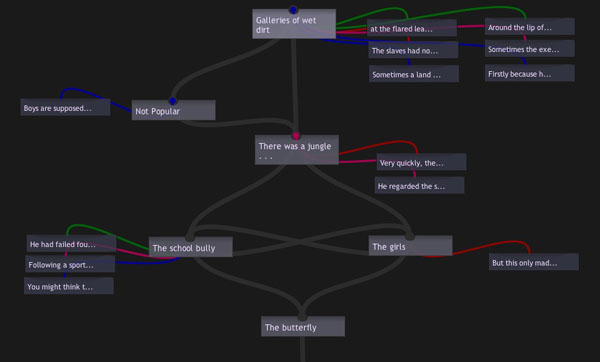
The site is gorgeously done, applying a fresh coat of Web 2.0 paint to the creaky concepts of classical hypertext. I find myself strangely conflicted, though, as I browse through it. Design-wise, it is a triumph, and really gets my wheels spinning w/r/t the possibilities of online writing systems. The authoring tools they’ve developed are simple and elegant, allowing you to write “axial hypertexts”: narratives with a clear beginning and end but with multiple pathways and digressions in between. You read them as a series of textual screens, which can include beautiful fold-out boxes for annotations and illustrations, and various color-coded links (the colors denote different types of internal links, which the author describes). You also have the option of viewing stories as nodal maps, which show the story’s underlying structure. This is part of the map of “The Butterfly Boy” by William Vollmann (by all indications, the William Vollmann):
Lovely as it all is though, it doesn’t convince me that hypertext is any more viable a literary form now, on the Web, than it was back in the heyday of Eastgate and Storyspace. Outside its inner circle of devotees, hypertext has always been more interesting in concept than in practice. A necessary thought experiment on narrative’s deconstruction in a post-book future, but not the sort of thing you’d want to read for pleasure.
It’s always felt to me like a too-literal reenactment of Jorge Luis Borges’ explosion of narrative in The Garden of Forking Paths. In the story, the central character, a Chinese double agent in WWI being pursued by a British assassin who has learned of his treachery, recalls a lost, unfinished novel written by a distant ancestor. It is an infinte story that encompasses every possible event and outcome for its characters: a labyrinth, not in space but in time. Borges meant the novel not as a prescription for a new literary form but as a metaphor of parallel worlds, yet many have cited this story as among the conceptual forebears of hypertext fiction, and Borges is much revered generally among technophiles for writing fables that eerily prefigure the digital age.
I’ve always found it odd how people (techies especially) seem to get romantic (perhaps fetishistic is the better word) about Borges. Prophetic he no doubt was, but his tidings are dark ones. Tales like “Forking Paths,” Funes the Memorious and The Library of Babel are ideas taken to a frightening extreme, certainly not things we would wish to come true. There are days when the Internet does indeed feel a bit like the Library of Babel, a place where an infinity of information has led to the death of meaning. But those are the days I wish we could put the net back in the box and forget it ever happened. I get a bit of that feeling with literary hypertext -? insofar as it reifies the theoretical notion of the death of the author, it is not necessarily doing the reader any favors.
Hypertext’s main offense is that it is boring, in the same way that Choose Your Own Adventure stories are fundamentally boring. I know that I’m meant to feel liberated by my increased agency as reader, but instead I feel burdened. What are offered as choices -? possible pathways though the maze -? soon start to weigh like chores. It feels like a gimmick, a cheap trick, like it doesn’t really matter which way you go (that the prose tends to be poor doesn’t help). There’s a reason hypertext never found an audience.
I can, however, see the appeal of hypertext fictions as puzzles or games. In fact, this may be their true significance in the evolution of storytelling (and perhaps why I don’t get them, because I’m not a gamer). Thought of this way, it’s more about the experience of navigating a narrative landscape than the narrative itself. The story is a sort of alibi, a pretext, for engaging with a particular kind of form, a form which bears far more resemblance to a game than to any kind of prose fiction predecessor. That, at any rate, is how I’ve chosen to situate hypertext. To me, it’s a napkin sketch of a genuinely new form -? video games -? that has little directly to do with writing or reading in the traditional sense. Hypertext was not the true garden of forking paths (which we would never truly want anyway), but a small box of finite options. To sift through them dutifully was about as fun as the lab rat’s journey through the maze. You need a bigger algorithmic engine and the sensory fascinations of graphics (and probably a larger pool of authors and co-creators too) to generate a topography vast enough to hide, at least for a while, its finiteness -? long enough to feel mysterious. That’s what games do, and do well.
I’m sure this isn’t an original observation, but it’s baggage I felt like unloading since classical hypertext is a topic we’ve largely skirted around here at the Institute. Grumbling aside though, Hypertextopia offers much to ponder. Recontextualizing a pre-Web form in the Web is a worthwhile experiment and is bound to shed some light. I’m thinking about how we might play around in it…
I too found Hypertextopia via Grand Text Auto just late last week and have almost completed a story written into it for experimentation. It is different than Storyspace in concept, and as the creator of the site suggests, it does not mean to offer various paths from A to B, but rather how I would put it as the no-frills versus the enhanced version. It is indeed a more linear–axial structure is what the creator claims, and this is something that appealed to me. I still am not nuts about handing the reader the responsibility of writing a story, preferring rather insolently to believe that I wrote it in the best version possible.
But it’s all a lot of fun, and, it’s all a case of rediscovering hypertext decades later so that it can regroup and grow.
I came across this via GTA too and had some similar reactions. I enjoyed my time exploring the texts, but wasn’t compelled to return to any of them. When I thought of using it for myself – it was mostly the idea of exploring nonfiction ideas in this way that was exciting, but that somehow didn’t seem to fit with the project’s mission.
On the other hand, Choose Your Own Adventure doesn’t work for me either but it is a sure-fire ticket to Librarians Are Cool when I show them to the pre-teens – which suggests to me there’s something here I’m just not getting, or that I don’t need anymore in my reading – not that the idea isn’t cognitively and creatively important to some?
I find your observations right on the mark. I’m hoping that “web 2.0” will not revive the (as you put it) “burdensome” and “boring” cheap-trick of the hypertext story. I can think of no other postmodern annoyance that would be more irritating in the post/911 world, both to readers and to writers.
Ouch. As someone who writes hypertext and still believes in it, I’ll pretend my feelings aren’t hurt.
I think to talk about it in terms of agency and “liberating the reader” misses the point. The reader was never trapped by linear fiction in the first place. Likewise I don’t think that successful hypertext steals away authorial responsibility and gives it to the reader — if an author abdicates his or her role, then sure, that leads to a listless plotline.
I think hypertext can succeed in two ways. First, when it offers a meaningful, difficult choice to the reader, just as linear fiction succeeds when it does the same for its characters. That choice must be carefully designed by the author — and I think this difficulty is why there aren’t very many successful hypertext fictions.
Secondly, I think the flexibility of a hypertext’s structure can better represent the nature of our memories, and perhaps even our lives in general. In this way I think you can have a successful hypertext nonfiction… something you don’t really consider in your post. In this kind of story, the reader would have almost no agency at all — no way to change what has already happened. But they’re still exploring the text in a nonlinear way.
I agree with you that many hypertexts fall into the trap of form-over-content — but then so did House of Leaves. It’s a problem whenever you write something that does something unusual in terms of form.
brilliant piece ben. thank you.
I do think that the ability the web gives to click on a word to reveal another layer of text underneath still seems like it ought to be significant and eventually fruitful for storytellers and readers seeking new kinds of literature, though I quite agree that the multiple choice narrative doesn’t hack it for me but do agree with the other Chris above (not me) that memory works much more like hypertext than those corny cinematic flashbacks.
I’ll bet there were people who thought writing on pages not scrolls was “bo-ring” and would never provide anything worth reading. An institute devoted to explorations of the creative potential of the web needs to keep an open mind to all kinds of experiments and assume they may take time to get into their stride and produce their gems.
Let’s say this is a form which may still be more interesting to write than to read – for now – and wait to see what grows out of it. Actually Hypertextopia looks really rather elegant and more tempting than most such sites…I’m going to go back and explore.
I think that the point made by Chris is vital: “An institute devoted to explorations of the creative potential of the web needs to keep an open mind to all kinds of experiments…”
To dismiss something as “boring” is a rather odd take on a very intricate and planned-out form of narrative. Some will love it, some will hate it, but to call it boring is a strange reaction.
“To dismiss something as “boring” is a rather odd take on a very intricate and planned-out form of narrative. Some will love it, some will hate it, but to call it boring is a strange reaction.”
would you say the same if the topic was choose your own adventure novels? they are intericate, planned out, etc. and i would still probably not bother reading any at this point in my career. dont choose your own adventure books provide such a complex level of interactivity, textual layers, etc?
has anyone else never much been a fan of borges cheap tricks? (not to say he doesnt have some good work, just focusing on his silly cheap tricks).
Ben -? thanks for the fantastic writeup. I’m the maker (creator? coder? designer?) of Hypertextopia, and I’m working on it as a part of a final project for my undergraduate degree.
I agree with all too much of what you say in your article. Hypertextopia was born as a reaction *against* much of the critical theory and “Hypertext” theory that surrounded the golden age of hypertext. It deliberately lacks a tool for linking from words inside the text to different fragments -? making it impossible to use in the classically hypertextual way -? Ted Nelson would loathe it as a betrayal of the old ideas.
Instead, it looks to the structure of writing on the web, as it exists today, and asks how our practice of linking can be used as a rhetorical form to help strengthen our arguments (or our plotlines). Your article above uses a handful of links, mostly of the “Citation” type — in this sense it is an axial hypertext. Hypertextopia encourages the writer to think of the sort of rhetorical forms that they’d like their links to embody; it starts you off with the four link types that I’ve found to be most prevalent in web writing: “Expansion”, “Description”, “Response”, and “Citation”. But you can define your own as your see fit.
The ability to rearrange and link between the fragments, is more for sketching and planning and composing your argument, first as a back-of-the-napkin sketch of connecting ideas, then as a network of complete thoughts, and then, ideally, hopefully, the author organizes her story into a linear (yes, linear) narrative that has enriching shards hanging off the sides. Think of them as being potentially like David Foster Wallace’s footnotes.
If it is working for you, it should help you ask yourself as you write: “Is this essential to what I’m trying to say? Or could it be left as an extra bit, a shard?” The continued tension between essential and enriching, when you have to think about it for every paragraph that you write, has been a productive force for my own writing, and an aid to keeping the core of it spare and powerful.
If anyone has critiques that they’d like to see influence the development of the site, I’d love to hear about them: jashkenas (@at@) hypertextopia (.dot.) com
And may all our writing tools continue to grow and prosper.
There are a lot of places to jump in here – I find it really interesting, for example, that Hypertextopia is a single-user writing environment when it seems like such a branching design would lend itself to multiple writers – but I think the question of boringness is interesting.
I think it’s an entirely valid question wondering whether classical hypertext is boring. Like Ben, I tend to find this sort of writing uninteresting; I don’t think this is an uncommon response, though certainly there are those who do like it. I’m curious why I find this boring, and I think that’s worth looking into when we consider how we read.
I don’t know that my reaction against hypertext is specifically a reaction to new forms: simply talking about fiction, I like plenty of avant-garde work. Listing things à propos: one of my favorite novels is Michel Butor’s La modification, which is told entirely in the second person; I’ve written about novels-in-boxes, which certainly play with the same idea; I also like Cortázar’s Hopscotch, Milorad Pavi?’s Dictionary of the Khazars, which are both in the same ballpark. (Both of those two could stand to be examined here in some depth, some day.) And Borges, and of course dear old Tristram Shandy. There are plenty of illustrious forebears that hypertext could claim; all of these works are formally innovative and demand something out of the reader.
But it’s worth considering that in each of these works the content demands the form. Take Dictionary of the Khazars: Pavi? is taking as his subject the history of the Khazars and their religion; three different (and mutually exclusive) narratives exist if you’re looking at their story through Jewish, Christian, or Muslim eyes. A linked tripartite dictionary is a valid form for discussing the nebulosity of history seen through different eyes; every reader follows a different path through the book and comes to a different conclusion, just as any observer of history will have their own view. (Could this have been done with a traditional novel? I suspect the answer is yes, though the result might not have been quite so compelling.) Similar, B. S. Johnson’s novel-in-a-box The Unfortunates works (in as much as it does) because Johnson is trying to represent a number of discrete moments of consciousness (not quite a stream of consciousness) which add up to a whole impression. A series of pamphlets drawn from a box present a way to achieve the aspect of chance which is part of memory. Marc Saporta’s Composition No. 1, a police procedural cut into pages, doesn’t work quite so well: it feels like a story that’s been cut up and shuffled at random. It’s a device, but not a device that the reader finds compelling: the content of the puzzle doesn’t feel quite significant enough for the reader to necessarily bother with it. Actually, I’m restating Umberto Eco here; it’s worth quoting because it feels germane to the subject:
(The Open Work, trans. Anna Cancogni, p. 170.) The “contemporary narrative” that Eco refers to in the last paragraph is probably Borges; Calvino and Pirandello could answer to that description as well. I think Eco’s getting at the same problem Ben was in the original post: the conceptual works of Borges tend to be more interesting than actual executions of the same.
Literary hypertext is boring, in exactly the way James Joyce and Samuel Beckett and all the rest of those dusty old moderns and postmoderns are boring. Who would read them for pleasure? Who would read them at all?
I suppose the most disturbing aspect of the whole thing is Bob Stein’s “attaboy”. Stein and I have disagreed on lots of things over the years, technical and artistic. He’s said in public that some of the titles I published were “arty”, and I’ve said that some of the titles he published were a bit too fond of visual gimmicks. But I’ve never denied the tremendous contribution and importance of Voyager, or the find design of Night Kitchen. And I’ve never before thought him opposed to the hard work of thinking and reading.
And I don’t really think it now. C’mon guys: this is a pose, right? A tactic? A bit of positioning, just in case Mr. Ashkenas is poised to become a competitor?
Can’t we leave the yahoo anti-intellectual pose to the gamerz?
Thanks to everyone for their excellent comments here. I’ll admit I was being deliberately provocative with “boring” in order to see what responses might come out. Clearly I’ve touched some nerves. But I think it’s a legitimate issue to raise, and one which Umberto Eco articulates far better in the passage Dan quotes above: “…the book had exhausted all its possible reading in the very enunciation of its constructive idea.”
To respond specifically to Mark Bernstein, this post was in no way a response to some perceived competition with Mr. Ashkenas. I wrote it simply because Jeremy’s site got me thinking, and have no hesitation in saying flat-out that Hypertextopia far surpasses in elegance any online tools we’ve ever developed. I’m eager to play around in the Hypertextopia universe and to learn from it, and perhaps, as Jeremy suggests, to join some of the discussions around its future development. I really truly applaud what he’s doing.
You mention gamerz with a sarcastic ‘z’, and yet don’t respond to my suggestion that hypertext fiction is itself a game, that in the search for a new kind of reader, you discovered the gamer. That’s not an anti-intellectual diss of hypertext, rather an attempt to view it in a larger context. I’m curious to hear your thoughts on that.
And speaking of context, that raises another issue. Hypertext has been in its own little preserve for far too long, both as a specialized subculture and, quite literally, in the technology it employs. Many of the classic hypertext fiction works are for all intents and purposes inaccessible today, locked in old formats or available only on CDs. What would you say to putting classics like “Afternoon,” “Victory Garden” and “Patchwork Girl” up on the Web for free? For hypertext to reach a wider audience it needs to be made accessible. This is another thing that Jeremy is trying to address with Hypertextopia: “…it looks to the structure of writing on the web, as it exists today…”
Going back a bit, I agree with the first Chris’s comment about the possibility of hypertext nonfiction and the connection to memory structures (or, I might add, to conversational structures). Taking a non-linear, improvisational route through texts seems to come more naturally to the reader when the form is more topographical and less narrative-based. But isn’t this is already happening (albeit in a primitive, early form) on the Web? The Web made hypertext commonplace, and over the past decade-plus we’ve to a large extent internalized its basic logics -? so much so that to give them special emphasis, as hypertext advocates still do, seems a bit dated. Hypertext is a fact of life. It’s in everything now.
That’s not to say there shouldn’t be specialized terms for talking and thinking about it. We still have a ways to go in understanding how these nonlinear forms of reading and writing reshape our understanding (of knowledge, of each other), so analytical frameworks and experimental tools like Jeremy’s are no doubt needed. I certainly don’t mean to suggest that the crude version of hypertext we employ on the Web today realizes the full potential of the form. Also, I agree with Jeremy’s point that heightened mindfulness of the purpose of linking, of “the continued tension between essential and enriching,” can lead to more rigorous writing, which is another reason I’m curious to play around with his system.
Looking through Hypertextopia, I wondered (like Dan) how it might be reconceptualized as a multi-authored or networked environment, or whether its tools and concepts could be applied more broadly to the Web. Take the gorgeous maps, for example. An interesting experiment would be to extend them as a visualization tool for all online reading, or, say, specifically for reading within Wikipedia. We might learn a lot from visual browsing histories.
At any rate, I’ve said enough. I’m glad this provoked some spirited and thoughtful responses.
This might sound ridiculous, or it might make no sense at all, but why in the world are we still talking like this about hypertext?
Not to say there aren’t other ways to talk, or other things to talk about — but just to point out that, from here anyway, it sounds like the same old, same old. Why keep chewing this old bone?
The old bone is this: Either hypertext is something from which one must, at all costs, differentiate oneself, or it is something to which one must commit oneself fully, without reservation.
I want to point out the grandiosity here, the extremism.
Expressions of the first type, of differentiation, come loaded with contempt, itself an extreme response. For instance, there is the idea that hypertext is “boring.” Or that it is a “cheap trick.” Even though, heaven knows, it is not “free” or “cheap.” Perhaps it is even “worthless” because it does not have a “wide audience.” In which case “free” is exactly the right “price” for it, being something no one values. Usw.
Expressions of affiliation are also not innocent. Hypertext’s defenders sound defensive — a position that is often enough justified, I would say — but the defensiveness does not go toward articulating anything more useful. For instance, defensive responses do not tell us anything about why hypertext is worth defending in the first place.
Like adolescents with their parents, it seems like we can only cling to hypertext or violently reject it; our only options are anxious identification or phobic dissociation. But surely there are more options available to us than these two unsatisfactory ones. Everyone has to grow up sometime; we learn to separate from our parents while keeping them in our lives. Why can’t we talk in some other way — any other way — about hypertext?
To my mind, hypertext does have legitimate claims to our attention — but the claims are neither less nor more legitimate than claims made by other art forms.
The problem is articulating these claims, which is to say, fully exploring the nature of the demands that hypertext writing makes on us, much as we would explore the nature of the claims other “difficult” art forms make.
it doesn’t convince me that hypertext is [a] viable … literary form
Hypertext may not be a viable literary form, but “hyperlinking” as a navigational technique is enormously successful, so much so that we take it for granted in our daily use of the Web, and forget how much of a debt it owes to the thinking of the “inner circle of [hypertext] devotees.”
It is possible to say that any work of fiction or nonfiction that invites non-linear access, has hypertextual elements. When viewed this way, it’s easier to see that there’s no shortage of “viable” examples of enormously successful “hypertextual”-style works. Dan V. starts on this approach when he brings up Khazars or The Unfortunates, but I’d go further, including key texts of human civilization like the dictionary, the World Almanac, Mao’s Little Red Book, The Common Sense Book of Baby and Child Care, and the Koran, Bible, and (especially!) the Torah. (It’s possible to read any of these books in linear order, but I’m going to argue that most people don’t.)
(Full disclosure: if I overreach, it is possibly because I spent five years of my life working on a piece of serialized Web fiction that is essentially a linear narrative, but which contains hypertextual navigational elements, so the distinction between “hypertext as form” and “hypertext as technique” feels pretty deeply-grained to me.)
One notes, however, that all of these are what would be termed non-fiction: they’re not generally being read for a linear narrative in the sense that we generally read fiction. (Religious texts can be read for narrative or as fiction, but that kind of reading generally doesn’t involve skipping around.) I’ll completely agree that hypertext makes sense for non-fiction; I’m much less convinced when we’re talking about narrative-based fiction. It’s also probably worth making a distinction between author-demarcated paths through a work and those made by the reader: I don’t think these are the same thing at all.
Marc Bernstein says:
Literary hypertext is boring, in exactly the way James Joyce and Samuel Beckett and all the rest of those dusty old moderns and postmoderns are boring. Who would read them for pleasure? Who would read them at all?
Lots of people do, and read them with awe and pleasure. On the other hand, hypertext fictions, if done as gimmick, remain on the surface, their beauty only accidental, as Eco says in the passage that Dan quotes. Their validity no longer residing in their contents, in their conception as books, but in their construction. Writing that forces the reader to be something that he is not, a gamer for instance, might be ludic for some, interesting for others, boring for many, but Ben is giving it a chance. So much that Hypertextopia’s creator is moved to explain that, in fact, he purposefully made it impossible for it to be used in the classically hypertextual way. He brings the old form to the “structure of writing on the web, as it exists today”, in order to achieve a linear narrative that has been purged of excess, but whose enriching details are left as sharp edges.
The search is not only for writing in the future, but for a re-thinking of all the parts involved in the act, and lets don’t forget that when Barthes says that the birth of the reader must be at the cost of the death of the Author, he is referring to a notion born in the Middle Ages. When Borges writes, he always departs from fiction, his stories deeply rooted in contextuality. That is why it is possible for Pierre Menard, a minor French symbolist poet, to write word-for-word a segment of El Quijote that is absolutely a different one. Borges’s intellectual games have an echo now, because of that. It is worth to pause and think why and how we read in order to discern what we are looking for.
What Ben presents here is the Institute’s at its finest, inviting, incisive, and yes, intellectually promising. Dan offers a glance to something in line with the constant search here, the future of the book and its possible, multiple manifestations. As he says, how peculiar that “Hypertextopia is a single-user writing environment when it seems like such a branching design would lend itself to multiple writers”. This quest is not Ben’s, Bob’s, Dan’s, or Jeremy’s alone, it’s ours. Far from anti-intellectual, I find this utterly stimulating.
This thread is quickly turning into an invaluable resource.
If the future of the book is to be explored in earnest, we need to think about what our current writing practices are doing for our rhetoric today. The best theoretical thinking comes from an examination of the state of affairs, not from talking about what you have not experienced, and certainly not from reifying old theories into new systems. We need to take a deep look at how links are being used, not at how they might be used. Study the best essays and blog posts and stories available online — hopefully written by those young enough to write unconscious of the hypertext theory that gave them the notion of links in the first place — to try and discover what rhetorical purpose links can serve. There’s this notion in linguistics that while the parents, who are the first to partially speak the foreign language, can do no better than to use a pidgin, an incomplete, hacked-together language; that the children, who are born knowing nothing else, will turn it into a creole, a fully-formed, developed and linguistically complete language of its own. We would do well to look for the creole of the web, from kids who have grown up writing in it more than anywhere else.
Hypertextopia, at its heart, is two simple things beyond what writing on the web usually offers. It provides shards along the side of the main text, so that the navigational-disorientation problem, which is so prevalent in hypertext, is softened. And it provides link-types, which (I hope), will help make clear the sorts of rhetorical purposes that people have for links. All the rest, the maps and the gloss and the interface design, is just in the service of making those two things accessible. The map view wasn’t even available to anyone besides the author until a week ago. I’m still conflicted about putting it in — it brings too many of the old spatial navigation ideas with it, when I’d rather that people just read the damn text — but it does provide the best “Table of Contents” that you could ever hope to get, and gives repeat-visitors a way to access the part of the story that they want to find.
I agree with Sol, that this has been utterly stimulating. And if hypertext is ever going to become a more prevalent way of reading — which I have my doubts about — then we’re going to need this sort of knives-out critique to help us shape our tools.
One last thing … I’m working on PDF export for Hypertextopia, so that after the author finishes composing her story she might be able to publish it as a Lulu book, or something along those lines. Is that treason against the hypertextual ideal? The shards would be colored margin-notes, and if the narrative happened to branch, the relevant page numbers for continuation would be printed at the bottom of the page. We really don’t have to choose between web-writing or print: we can choose both.
ben said:
> I’ll admit I was being
> deliberately provocative with “boring”
those of us who use strong words because they
are the _right_ words to express what we _mean_
will appreciate it if you stop toying with them.
please pardon this sidenote. thank you.
-bowerbird
It’s very interesting discussion. Just know only some info about mapping in/of Wikipedia. WikiMindMap is some proposition.
speaking of hypertext . . . .
as Jeremy and Sol have pointed out, this is one of the most interesting discussions we’ve ever had on if:book, but my frustration with the simplistic chronological order of comments is inversely proportionate to the importance and complexity of the conversation. jeremy . . . what would happen if we tried to move this to hypertextopia?
Great idea. Map could show as how discussion is growing. And I suppose that the most “hot problems” will sketch biggest tree, so we could use map for viewing “what is really about” this whole (BTW linear) discussion.
Dan wrote: It’s also probably worth making a distinction between author-demarcated paths through a work and those made by the reader: I don’t think these are the same thing at all.
I don’t disagree; I think your point is roughly akin to my distinction between “hypertext as form” and “hypertext as technique.” I’m just suggesting that the scope of the discussion changes if we talk less about texts that have a variety of distinct, mappable, “author-demarcated paths” of the link/node variety, and more about texts that encourage / reward / insist upon non-linear navigation, what Espen Aarseth would call “ergodic” texts.
Dan also noted astutely that my examples are all non-fictional, a little bit of a cheat on my part given that this whole thread got started discussing the merits (or lack thereof) of hypertext as a literary / fictional form. I’ll grant that most fiction is designed to be read sequentially, although I’d point to the existence of a “scene selection” menu on nearly every DVD out there as evidence that people value and appreciate non-linear ways of navigating narrative as well. (I can only think of one filmmaker who has successfully resisted the popular pressure to segment the DVD release of their movies this way: David Lynch.)
This also gets a little trickier when moving out from the level of the individual text into a “mega-corpus” of related stories, or a storytelling ecology. If we were Star Wars fans, we might read Star Wars tie-in novels in the order of their publication, or in the chronological order that continuity prescribes, or just randomly: each contributes another puzzle-piece to the overall Star Wars mega-corpus in a way that traditional hypertext theory very tidily provides a framework for describing. Comics continuity works similarly: only the most hard-core X-Men collector(s) can even begin to make an attempt to read the overall “story” of the X-Men in the order in which it occurred: the vast majority of readers are instead navigating the mega-corpus in partial, fragmentary ways, assembling the logic of it as they go. Again, hypertext theory provides a very handy way of thinking about this kind of reading.
Mythic narrative systems work similarly: Dan observes that “[r]eligious texts can be read for narrative or as fiction, but that kind of reading generally doesn’t involve skipping around.” That’s definitely true for the Old and New Testament, but less true for the heavily-annotated Torah, and even less true for pre-book mythic systems like the Greek, Egyptian, or African myths, which can be appreciated as fiction or narrative but have no coherent sequential order.
Like Voyager’s Expanded Books, Eastgate’s hypertexts were/are a historical phenomenon. That is to say, the electronic word is not what it was in 1991 when the first Eastgate edition of Michael Joyce’s afternoon was published; the appropriate analog for this work is *not* Joyce (the other one) or Barth or Derrida, but, in the accelerated aging of internet time, Fielding or Richardson. It’s true that some small number of people now read those authors for pure pleasure, hefting their Nortons with unsuspecting innocence, but more often those authors are read critically, in terms of their significance to the art of the novel. That is not to diminish their talent or undercut the impact of their genre-defining prose; it *is* to acknowledge the reasons we read what writers write change over time.
There is no reason why the Eastgate hypertexts should be any different.
And Hypertextopia, for its part, can never produce “golden age” hypertexts; not because of any lack of industry or creativity on the part of its users, and not because of any technical constraints that the code cannot overcome, but because the golden age, to the extent it ever existed at all, was of a moment and that moment is not now.
Which is not to say there’s anything boring about Hypertextopia. Not anything at all.
The problem with Professor Kirschenbaum’s approach, I think, is twofold.
First, it can be used to reach the same conclusion about nearly any art movement at any moment in time. Once you have enough good work to say, “there is something here”, the archivists will be delighted to tell you that there WAS something here, that it is (of course) firmly embedded in the moment, and that moment (like all moments) has fled.
Second, it’s bad history. Lots of old art remains interesting for reasons that have nothing to do with its antiquity, and it is demonstrably possible for art to move us when its historical moment is not merely passed but so completely lost to us (Mimbres, Chaco, Moque, the Cyclades) that we have no idea at all what the artist had in mind beyond a presumed shared humanity.
If people don’t often read Richardson for pleasure, they certainly do sing to Handel’s Messiah for fun; it was published two years after Pamela. And people think Faneuil Hall is a fun place to go in Boston; it was built in 1740. Both Messiah and Faneuil Hall have been fundamentally divorced from their original context, but they’re still fine art — and you could most certainly sit down today and build a better public space than Faneuil Hall, or write a better collection of songs than Messiah.
The problem with Mark Bernstein’s approach, however, is that very few now read the literary hypertexts of decades past out of any motivation that might be described as pure “fun” (his word). Much more often, these works are assigned reading on undergraduate or graduate syllabi, or dissected in books and articles written by people like me in the service of a critical agenda.
Contrast this with the legacy of ADVENTURE, or the other interactive fiction which precedes Eastgate’s work by almost a decade. Or early arcade or console games. This material still enjoys a very active fan community, who read (or play) the work and keep it alive. That’s your Faneuil Hall.
Sorry, ADVENTURE actually isn’t my Faneuil Hall, though it may well be someone else’s.
What we’re talking about, I think, is appreciation. All I can add to this is my personal appreciation of so-called classic hypertext. I spent some years deeply involved with it, so I’m probably dismissable on that basis alone. Nonetheless, the stuff’s stuck with me, the way literature just does stick, sometimes. When it’s good.
An long, sentimental example: After my daughter was born, during a time when I was feeling very inside-out, I went to the mountains with my fledgling family, and all weekend I was thinking, on one hand, about how unsettled I was by my new role, by mothering, and, on the other hand, wistfully, of this line from Michael Joyce’s Twilight: Mountain the first home.
The line was my refrain for the weekend: it soothed me like little else did at the time, and as I reflected on it, I found that I had deepened my sense of what we, as a family, were all doing out there in the middle of the woods, trying to make ourselves a home in the world in more ways than one.
I returned to New York to find Mark
had linked to David Ciccoricco’s dazzling essay (no longer available, it seems) onTwilight. The essay contained the whole lovely quotation (“Atom recalling granule, granule stone, stone the great
mountain, mountain the first home”), and also drew a fascinating connection between the pile of stones that, for better or worse, is Eastgate’s logo, and a different pile on Michael Joyce’s home page, which was, and still is, like a lot of homes, abandoned.
And then, writing all of this down, I found,
for the first time in a decade, that I could not remember the first lines of Joyce’s afternoon, a story, except for the words “beset by fear” and “echoing off far ice,” even though I had heard the words in my head — all of them, very clearly — for years and years. (I even heard them when I was pregnant, and I forgot lots and lots of things then!) At last the line came to me, and when it did I recognized that it was (of course) about memory, or more precisely the loss thereof (“I try to remember winter” “As if it were yesterday?”). And then I remembered that the word is not “remember” but “recall,” and the difference had to do with hearing things, with echoes, which don’t usually sound the same as the original anyway. (To make the doublings even more elaborate, in afternoon, there is also the matter of the two beginnings, true and false.) So: mountains, stones, homes, abandonments, forgetting, misremembering, beginning and beginning again. Story of my life, in other words, at that moment.
When people ask me why I “do” hypertext, or (alas) sneer at my involvement in it, and I reply that the stuff speaks to me, this is what I mean. It inhabits me. When I read the stuff, I’m amazed at how quickly the associations pile up, and how relevant, how apposite everything having to do with hypertext suddenly seems; I rediscover, through the experience of reading, say, Twilight or afternoon, a vital sense of how interconnected we all are, or might be, and how personal such associations are, how intimate.
Maybe it’s just me. Or maybe readers who resist hypertext are resisting this. If it is, that’s just too bad, I suppose. I really don’t know how other people feel about hypertext (it seems like mostly people don’t feel the way I do, or if they do, they’re not talking about it.) In this stuff, like so much else, it’s all YMMV. I’ve only got my own experience to go on. I’m not an academic, I don’t have a critical agenda. I’m just a reader of the stuff.
Is it true that “few people now read the literary hypertexts of decades past” for fun? How, precisely, would we know?
I’m not entirely sure how we could know this. But I gather that *you* find them interesting, and I *know* that your audience at MLA did find your commentary on _afternoon_ to be engaging and entertaining, because they told me so, and because having read your remarks in what I hope is a sympathetic and liberal spirit, I myself found them engaging and entertaining and can readily see why others would feel similarly.
De gustibus non disputandum. Some people find partial differential equations to be dull and difficult. They study them in classes if they must. Others find them full of life and excitement. If someone finds “Space Invaders” to better repay his or her time more amply than “Lust” or “Victory Garden”, that is their your choice.
De gustibus non disputandum indeed, but don’t you think the comparison with Space Invaders is a bit of a red herring?
If you’re talking games vs hypertexts, Zork would be a fairer comparison: It’s a multidirectional story, it was written by more than one person, it had a huge cultural impact on a whole geek generation (ok, so did Space Invaders, but not in the same way) and it and its ilk have even spawned their own literary references, for instance in Richard Powers’ Plowing The Dark.
I have argued elsewhere (e.g. in “Patterns Of Hypertext”, HT98) that Crowther and Woods’ _Adventure_ is a hypertext. As I was replying to Kirschenbaum, and as I know that Kirschenbaum has read those papers, I didn’t think it best to belabor the point.
I think that “Space Invaders” is a reasonable metonym for the “console games” of the mid-1970’s to which Matt Kirschenbaum alluded.
But, while we’re on the subject, which work do you think to have more interesting (less boring) characters: _afternoon, a story_ or Zork_?
Clearly, no-one can say that a sinister grue is a particularly sophisticated narrative device. But ‘interesting’, with its rather academic connotations of analytical detachment, is itself an interesting word to oppose to ‘boring’.
I had coffee yesterday with James Wallis, a long-time writer of interactive fiction (his generative Baron Munchausen game was republished by MIT Press last year) currently working on a number of ARG projects with UK ARG studio SixToStart. I mentioned this debate to him, and he pointed out: “But there’s a difference. In Zork, the main character is you.”
It struck me that this is a qualitatively different kind of engagement, and indeed character development, to witnessing the development of a third-party character. You can’t not identify with the central character. The grues are beside the point: watching you, the central character, develop (even if that just means leveling up) is emotionally absorbing.
Then what about becoming emotionally engaged with other characters in the game? James mentioned 1983 text-based adventure game Planetfall, in which your lovable robot sidekick Floyd sacrifices himself so that you can progress. This is widely credited as the first moment in gaming history where an interactive narrative has moved many of its players to tears. Another tearjerking moment mentioned by many is the death of Aeris in Final Fantasy VII (1997).
So what about opposing ‘boring’ with ’emotionally absorbing’ rather than ‘interesting’? Formal experiments are interesting, but passionate involvement in a narrative and fictional characters is emotionally absorbing. And the latter is what makes us want to read on. I’m aware that tearjerking potential can be contested as a criterion for artistic success, but it’s a pretty reliable benchmark of emotional engagement. So I’d be, um, interested to hear further reports of any digital narrative – hypertext, game or other – that is widely credited with moving its readers to tears.
There’s a great article and intriguing comments on gaming and tears here: http://blogs.guardian.co.uk/games/archives/2005/09/19/im_crying_here.html
“So what about opposing ‘boring’ with ’emotionally absorbing’ rather than ‘interesting’?”
Throw me into that briar patch again, Mr. Rabbit!
http://markbernstein.org/Mar0801/HypertextTears.html
I’m aware that tearjerking potential can be contested as a criterion for artistic success, but it’s a pretty reliable benchmark of emotional engagement.
Tears are a red herring. Elsewhere on this site I’ve cribbed from Will Wright, who mentioned (in his 2006 SXSW keynote) that the emotions really engaged by interactive experiences are “pride, accomplishment, and guilt.” This seems fair and true to me, Floyd notwithstanding.
Thanks Diane for daring to talk about hypertext writing that you like and how it ‘inhabits you’.Appreciation of some real writing is refreshing. We could do with more clues as to what might deserve concerted attention in a space where all agree that commodity is in short supply.
Indeed – it would be valuable to hear more from people who have experiences of powerful and absorbing texts written in hypertext form.
Perhaps the problem with hypertext is that – like so many Web subcultures – it rapidly becomes the treasured purview of a self-selecting few, which in turn creates an intimidating sense of ground to be covered for anyone new to the topic. While most gaming communities have at least some structures for welcoming and acclimatizing n00bs, there seems little such support available outside academia for those interested in finding value in hypertext fiction.
With that in mind, and in the interests of a broad discussion, we would welcome a guest post at if:book from someone willing to give an exposition for an interested but non-‘insider’ audience – someone who doesn’t ‘know the canon’ – of where to start, what to read, and what to look for in appreciating this form.
Mark, Diane, would you be interested?
We have mechanisms in literature for welcoming and acclimatizing n00bs. They include high schools, colleges, bookstores, reading groups, journals, weblogs, conferences, and publishers…..
There are some fine books, if you like to read. Landow, Gaggi, Hayles, Douglas, Joyce. Plenty more, including a promising new book by David Ciccoricco just out from Alabama. The two Coover articles remain quite valuable.
There’s an entire ACM conference if you prefer to go listen to talks. This year, the Hypertext conference has an entire workshop for writers. Good sessions can usually be found at MLA and ACW as well. Eastgate has eNarrative meetings from time to time.
Want to take a course? Hypertext fiction is widely taught.
Personally, I think nothing beats broad and sympathetic reading.
http://www.eastgate.com/catalog/Fiction.html
Man. I very rarely find myself agreeing with Mark Bernstein, but I can’t find fault with much in Mark’s response to this. Using the word “boring” is, like, deeply offensive, man. It’s the sort of thing a particularly lazy student might say about, say “reading books.” Reading? Don’t do that much. Why? Because reading is boring. This post falls under the category of gross generalization. Hypertext is a strange, foreign, unfamiliar reading medium. Some hypertexts are pretentious. Some are frustrating. Some are modernist, some are post. Some are a freaking laugh riot. Some seem old-fashioned, some still ahead of their time. Boring? Sure, sometimes. Like this blog (or any other) is always packed with endless thrills. Like every page of The Brothers Karamazov had me on the edge of my seat. I think it’s a mistake to equate the value of literary experiences with entertainment value, or with familiarity. Life is also boring sometimes. That doesn’t make it innately meaningless. Very few things, outside of certain office jobs, are fundamentally boring, and I would never assert that any particular literary form is innately uninteresting. (Sonnets–won’t touch those, man– boring! Haiku? Forget about it! Novels? Too long–make me snooze!) I think that a lot of new media reading activities are what Espen Aarseth calls “ergodic.” They involve some extra work. They involve for instance, an activity of discovering plot and character and poetic sensibility in ways which we are not accustomed to from most of our experiences of book-reading. I was recently trying to remember the details of a multiple-person email exchange from a few years back, and tried to find the emails in my archives by doing various searches. It was a weird way to read. It involved some work. It wasn’t like running my fingers through a neatly ordered files of letters. That made it somewhat frustrating, but not necessarily boring. I think the fact that the new media offer us so many different forms of reading experiences, and particularly literary reading experiences, is, well, interesting, and hypertext remains one of its more interesting forms, provided you are willing to get past that stage of “reading is boring.” And I’ll just come right out admit it — Choose Your Own Adventure Books — when I was a kid I loved ’em! I read those things before I ever fell for Vonnegut, or Pynchon, or Delillo, or Gaddis. Different types of reader agency, different narrative forms are not, in themselves, boring. Even oatmeal, man, if you add enough brown sugar or maybe some raisins . . .
This spring Susan Ettenheim and I began experimenting with Hypertextopia. We have just begun to explore with our secondary students how writing changes in this online environment.
To learn more, we invited Mark Bernstein and Jeremy Ashkenas to have a conversation with us, and we recorded this live webcast as a podcast:
http://teachersteachingteachers.org/?p=163
We were inspired to invite the spunky programmer/publisher to talk with the upstart literature/computer undergrad after reading through this thread on if:Book.
Thanks!
Digital literature is not developed in fact. Authors have basically confused the significant with the significance. They (we) have developed the container and focused on it. But links are nothing if they don’t lead to a good appealing story. Not controlled links drive us to usually boring stories because zapping is not literature. But I trust a Shakespeare in digital will appear sooner or later.
My place with essays and thoughts about digital literature (but in Spanish) is
http://biblumliteraria.blogspot.com