Listing entries tagged with ebooks


1 | 2 | 3 | 4 | 5 | 6 | 7 | 8 | 9 | 10 | 11

printable mini-books revisit eighteenth-century pamphleteers Post date  06.11.2008, 12:17 PM

London-based creative studio and social think-tank Proboscis has put impressive effort into thinking through the incarnations and reincarnations of written material between printed and digitized forms. Diffusion, one of Proboscis' recent-ish ventures, is a technology that lays out short texts in a form that enables them to be printed off and turned, with a few cuts and folds, into easily-portable pamphlets.

For now, it's still in beta, though I hear from Proboscis founder Giles Lane that they're aiming to make this technology more widely available. Meanwhile, Proboscis is using Diffusion to produce Short Work, a series of downloadable public-domain texts selected and introduced by guests. Works so far include three essays by Samuel Johnson, selected by technology critic and journalist Bill Thompson; Common Sense by Thomas Paine, selected by Worldchanging editor Alex Steffen; and Alexander Pope's Essay on Criticism, selected by myself.

Though the Short Work pieces are not exclusively from the same period, it's interesting to note that all these guest selections date from the eighteenth century. It can't be simply that these texts are most likely to be a) short, and b) in the public domain (though this no doubt has something to do with it). But the eighteenth century saw an explosion in printing, outdone only by the new textual explosion of the Web, and the political, intellectual and critical voices that emerged from that Babel of print raise many questions about the ongoing evolution of our current digital discourse.

Posted by sebastian mary at 12:17 PM | Comments (4)
tags: diffusion , ebooks , pope , print_on_demand , proboscis , short_work

fight path Post date  02.28.2008, 10:47 AM

"Writers of the world arise! It's time to throw off the shackles of traditional publishing contracts and face a brand new digital future with a brand new set of priorities." So starts an article on the Guardian 'Comment Is Free' blogs by Kate Pullinger, writer of fictions in media old and new. Kate argues forcefully that authors are in danger of being short changed by publishers as they rush to secure digital rights before anyone susses how different the dissemination of a digital text is to publishing the printed word.

Posted by chris meade at 10:47 AM | Comments (2)
tags: ebooks , publishing , uk

student designer envisions a more credible kindle Post date  02.27.2008, 6:02 PM

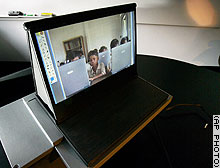
Engagdet points to an award winning Australian student design for an e-book reader that combines the gesture-based "multi-touch" interface of the iPhone with the e-ink display of the Kindle.

rsz_1livre.jpg
LIVRE design concept — Nedzad Mujcinovic, Monash University

"Interaction happens via a thin capacitive touch screen mounted on top of an electronic paper screen ('eINK'). Browsing pages happens by striking the screen from right bottom corner towards the centre of page to go forward or from the left hand corner to go backwards. Doing that using one finger will browse one page, two will browse ten pages and three will browse fifty pages at a time."

If simple reenactment of basic black-and-white, illustration-light print reading is your goal, I'd say that this is a far more viable proposition than Amazon's clunky gadget. (Thanks, Peter Brantley, for the link!)

Posted by ben vershbow at 06:02 PM | Comments (1)
tags: design , ebooks , hardware , kindle , reading , screenreading

e-read all about it Post date  02.15.2008, 5:14 AM

An article in Publishing News this week suggests that UK publishers are bracing themselves for the arrival on these shores of the Kindle or a rival to it soon. Much discussion of e-royalties is going on; HarperCollins and Random House US are putting some whole works on line for free; meanwhile Francis Bennett, the consultant who has been gazing into the crystal ball for the booktrade re digitisation, admits to being "baffled by Amazon - they never do what you expect them to."

Consultant (and ex-Penguin boss) Anthony Forbes Watson is more definite (maybe): “The competition will be between the best of the closed networks. Perhaps Amazon will rope in Abebooks. Perhaps Barnes & Noble will join up with a partner to combat Amazon, perhaps Amazon will develop something with Apple. But I don't think the market will be that big. I'd be surprised if it goes above 3%, or 10% tops.”

Well, nothing to worry about there then. Meanwhile we've been talking to friends in the booktrade who point out how little publishers will do for their huge slice of the cake these digital days, once printing and physical distribution are out of the picture. Do the e-royalties being offered reflect these changes? Do they hell.

Posted by chris meade at 05:14 AM | Comments (5)
tags: ebooks , publishing , uk

harpercollins offers free ebooks Post date  02.11.2008, 9:20 AM

The New York Times:

In an attempt to increase book sales, HarperCollins Publishers will begin offering free electronic editions of some of its books on its Web site, including a novel by Paulo Coelho and a cookbook by the Food Network star Robert Irvine.

The idea is to give readers the opportunity to sample the books online in the same way that prospective buyers can flip through books in a bookstore.

Posted by ben vershbow at 09:20 AM | Comments (1)
tags: ebooks , harpercollins , openaccess , publishing

nominate the best tech writing of 2007 Post date  01.15.2008, 8:44 AM

digitalculturebooks, a collaborative imprint of the University of Michigan press and library, publishes an annual anthology of the year's best technology writing. The nominating process is open to the public and they're giving people until January 31st to suggest exemplary articles on "any and every technology topic--biotech, information technology, gadgetry, tech policy, Silicon Valley, and software engineering" etc.

The 2007 collection is being edited by Clive Thompson. Last year's was Steven Levy. When complete, the collection is published as a trade paperback and put in its entirety online in clean, fully searchable HTML editions, so head over and help build what will become a terrific open access resource.

Posted by ben vershbow at 08:44 AM | Comments (0)
tags: academic , books , ebooks , journalism , library , openaccess , publishing

the future of the sustainable book Post date  01.02.2008, 10:59 PM

On New Year's Eve, I got lost in Yonkers trying to take my son's gently-used toys to the Salvation Army. The Yonkers store was the only one I could find willing to take them. The guy on the phone hesitated, "Are they in good condition?" he asked, clearly unhappy about my impending donation. I assured him they were, and he sighed and told me to come on over.

On principle, I try (really hard) to give away anything that is not completely worn out. But it is getting harder and harder to do. Nobody wants my old furniture or clothes or books. And they especially don't want used children's toys. My attempt to give them away was ill-fated. A police barricade stopped me at Nepperhan Avenue (a construction site disaster). Then I drove around for forty minutes until I found an alternate route but was twarted at Ashburton Ave (building on fire, streets blocked). I gave up and went home. With stomach full of guilt, I put the plastic toys in the dumpster. My son didn't mind because he had a brand new pile of toys in his playroom, Christmas gifts from relatives and friends who couldn't be dissuaded.

Point is, it seems increasingly difficult to opt out of the cycle of waste-creation. Plastic kids' toys are just one example. I'm also guilty of consuming and transforming lots of other things into waste: clothes, computers, cell phones, magazines, all sorts of complicatedly-packaged food and beverage items, etc… So yesterday, when I contemplated how best to spend 2008, I decided to focus on figuring out how to create a more sustainable lifestyle. And since I work in book publishing, job one is to figure out what it means to create a sustainable book. Lots of models come to mind. Good ones like Wikipedia (device-neutral and always in the latest, free, edition) and bad ones like the Kindle, (which tries to create a market for an ebook reader with designed obsolescence).

Anyway, I thought it might be useful to weave the sustainability discussion into if:book's ongoing consideration of networked ebooks, because at this stage in their developement, networked books could be shaped with sustainability in mind. So, I'm hoping to stir up some interesting discussion and serious contemplation of the perfectly sustainable book: one that is constantly revised, but never needs to be reprinted (or repurchased); one that is lean and simple and doesn't require a small server farm or a special device; one that makes an enormous impact, but leaves a teeny tiny carbon footprint; one we can live with for ever and ever without getting bored or satiated.

Posted by kim white at 10:59 PM | Comments (10)
tags: ebooks , environment , kindle , sustainability , the_networked_book , wikipedia

kindle maths 101 Post date  12.07.2007, 9:19 AM

Chatting with someone from Random House's digital division on the day of the Kindle release, I suggested that dramatic price cuts on e-editions — in other words, finally acknowledging that digital copies aren't worth as much (especially when they come corseted in DRM) as physical hard copies — might be the crucial adjustment needed to at last blow open the digital book market. It seemed like a no-brainer to me that Amazon was charging way too much for its e-books (not to mention the Kindle itself). But upon closer inspection, it clearly doesn't add up that way. Tim O'Reilly explains why:

...the idea that there's sufficient unmet demand to justify radical price cuts is totally wrongheaded. Unlike music, which is quickly consumed (a song takes 3 to 4 minutes to listen to, and price elasticity does have an impact on whether you try a new song or listen to an old one again), many types of books require a substantial time commitment, and having more books available more cheaply doesn't mean any more books read. Regular readers already often have huge piles of unread books, as we end up buying more than we have time for. Time, not price, is the limiting factor.

Even assuming the rosiest of scenarios, Kindle readers are going to be a subset of an already limited audience for books. Unless some hitherto untapped reader demographic comes out of the woodwork, gets excited about e-books, buys Kindles, and then significantly surpasses the average human capacity for book consumption, I fail to see how enough books could be sold to recoup costs and still keep prices low. And without lower prices, I don't see a huge number of people going the Kindle route in the first place. And there's the rub.

Even if you were to go as far as selling books like songs on iTunes at 99 cents a pop, it seems highly unlikely that people would be induced to buy a significantly greater number of books than they already are. There's only so much a person can read. The iPod solved a problem for music listeners: carrying around all that music to play on your Disc or Walkman was a major pain. So a hard drive with earphones made a great deal of sense. It shouldn't be assumed that readers have the same problem (spine-crushing textbook-stuffed backpacks notwithstanding). Do we really need an iPod for books?

UPDATE: Through subsequent discussion both here and off the blog, I've since come around 360 back to my original hunch. See comment.

We might, maybe (putting aside for the moment objections to the ultra-proprietary nature of the Kindle), if Amazon were to abandon the per copy idea altogether and go for a subscription model. (I'm just thinking out loud here — tell me how you'd adjust this.) Let's say 40 bucks a month for full online access to the entire Amazon digital library, along with every major newspaper, magazine and blog. You'd have the basic cable option: all books accessible and searchable in full, as well as popular feedback functions like reviews and Listmania. If you want to mark a book up, share notes with other readers, clip quotes, save an offline copy, you could go "premium" for a buck or two per title (not unlike the current Upgrade option, although cheaper). Certain blockbuster titles or fancy multimedia pieces (once the Kindle's screen improves) might be premium access only — like HBO or Showtime. Amazon could market other services such as book groups, networked classroom editions, book disaggregation for custom assembled print-on-demand editions or course packs.

This approach reconceives books as services, or channels, rather than as objects. The Kindle would be a gateway into a vast library that you can roam about freely, with access not only to books but to all the useful contextual material contributed by readers. Piracy isn't a problem since the system is totally locked down and you can only access it on a Kindle through Amazon's Whispernet. Revenues could be shared with publishers proportionately to traffic on individual titles. DRM and all the other insults that go hand in hand with trying to manage digital media like physical objects simply melt away.

*     *     *     *     *

On a related note, Nick Carr talks about how the Kindle, despite its many flaws, suggests a post-Web2.0 paradigm for hardware:

If the Kindle is flawed as a window onto literature, it offers a pretty clear view onto the future of appliances. It shows that we're rapidly approaching the time when centrally stored and managed software and data are seamlessly integrated into consumer appliances - all sorts of appliances.

The problem with "Web 2.0," as a concept, is that it constrains innovation by perpetuating the assumption that the web is accessed through computing devices, whether PCs or smartphones or game consoles. As broadband, storage, and computing get ever cheaper, that assumption will be rendered obsolete. The internet won't be so much a destination as a feature, incorporated into all sorts of different goods in all sorts of different ways. The next great wave in internet innovation, in other words, won't be about creating sites on the World Wide Web; it will be about figuring out creative ways to deploy the capabilities of the World Wide Computer through both traditional and new physical products, with, from the user's point of view, "no computer or special software required."

That the Kindle even suggests these ideas signals a major advance over its competitors — the doomed Sony Reader and the parade of failed devices that came before. What Amazon ought to be shooting for, however, (and almost is) is not an iPod for reading — a digital knapsack stuffed with individual e-books — but rather an interface to a networked library.

Posted by ben vershbow at 09:19 AM | Comments (17)
tags: DRM , amazon , books , copyright , ebooks , kindle , library , publishing , reading , textbook , the_networked_book

amazon raises paperback prices Post date  11.27.2007, 1:01 AM

An interesting twist in the Kindle story reported at Dear Author:

Amazon’s pricing for mass market books has suddenly gone full retail, no discount since the release of the Kindle. When questioned in Newsweek about the low pricing, Bezos said “low-margin and high-volume sale—you just have to make sure the mix [between discounted and higher-priced items] works.” It looks like Bezos is hoping to make more money off the high volume of sales from those mass market purchasers.

...I guess this is one way of forcing readers to purchase the Kindle. If Kindle success rises or falls on the backs of the mass market purchasers, this is going to be ugly because I see a whole bunch of Amazon purchasers being pretty upset about this turn of events.

Thanks to Peter Brantley for the link.

Posted by ben vershbow at 01:01 AM | Comments (0)
tags: amazon , books , ebooks , kindle , publishing

siva on kindle Post date  11.23.2007, 1:23 PM

Thoughtful comments from Siva Vaidhyanathan on the Kindle:

As far as the dream of textual connectivity and annotations -- making books more "Webby" -- we don't need new devices to do that. Nor do we need different social processes. But we do need better copyright laws to facilitate such remixes and critical engagement.

So consider this $400 device from Amazon. Once you drop that cash, you still can't get books for the $9 cost of writing, editing, and formating. You still pay close to the $30 physical cost that includes all the transportation, warehousing, taxes, returns, and shoplifting built into the price. You can only use Amazon to get texts, thus locking you into a service that might not be best or cheapest. You can only use Sprint to download texts or get Web information. You can't transfer all you linking and annotating to another machine or network your work. If the DRM fails, you are out of luck. If the device fails, you might not be able to put your library on a new device.

All the highfallutin' talk about a new way of reading leading to a new way of writing ignores some basic hard problems: the companies involved in this effort do not share goals. And they do not respect readers or writers.

I say we route around them and use these here devices -- personal computers -- to forge better reading and writing processes.

Posted by ben vershbow at 01:23 PM | Comments (5)
tags: amazon , books , copyright , ebooks , googlization , publishing , reading , the_networked_book , writing

of razors and blades Post date  11.19.2007, 4:06 PM

A flurry of reactions to the Amazon Kindle release, much of it tipping negative (though interestingly largely by folks who haven't yet handled the thing).

David Rothman exhaustively covers the DRM/e-book standards angle and is generally displeased:

I think publishers should lay down the law and threaten Amazon CEO Jeff Bezos with slow dismemberment if he fails to promise immediately that the Kindle will do .epub [the International Digital Publishing Forum's new standard format] in the next six months or so. Epub, epub, epub, Jeff. Publishers still remember how you forced them to abandon PDF in favor of your proprietary Mobi format, at least in Amazon-related deals. You owe 'em one.

Dear Author also laments the DRM situation as well as the jacked-up price:

Here’s the one way I think the Kindle will succeed with consumers (non business consumers). It chooses to employ a subscription program whereby you agree to buy x amount of books at Amazon in exchange for getting the Kindle at some reduced price. Another way to drive ereading traffic to Amazon would be to sell books without DRM. Jeff Bezos was convinced that DRM free music was imperative. Why not DRM free ebooks?

There are also, as of this writing, 128 customer reviews on the actual Amazon site. One of the top-rated ones makes a clever, if obvious, remark on Amazon's misguided pricing:

The product is interesting but extremely overpriced, especially considering that I still have to pay for books. Amazon needs to discover what Gillette figured out decades ago: Give away the razor, charge for the razor blades. In this model, every Joe gets a razor because he has nothing to lose. Then he discovers that he LOVES the razor, and to continue loving it he needs to buy razors for it. The rest is history.

This e-book device should be almost free, like $30. If that were the case I'd have one tomorrow. Then I'd buy a book for it and see how I like it. If I fall in love with it, then I'll continue buying books, to Amazon's benefit.

There is no way I'm taking a chance on a $400 dedicated e-book reader. That puts WAY too much risk on my side of the equation.

Posted by ben vershbow at 04:06 PM | Comments (1)
tags: amazon , books , ebooks , kindle , publishing , reading

newsweek covers the future of reading Post date  11.19.2007, 9:21 AM

6032-newsweekkindle.jpg Steven Levy's Newsweek cover story, "The Future of Reading," is pegged to the much anticipated release of the Kindle, Amazon's new e-book reader. While covering a lot of ground, from publishing industry anxieties, to mass digitization, Google, and speculations on longer-term changes to the nature of reading and writing (including a few remarks from us), the bulk of the article is spent pondering the implications of this latest entrant to the charred battlefield of ill-conceived gadgetry which has tried and failed for more than a decade to beat the paper book at its own game. The Kindle has a few very significant new things going for it, mainly an Internet connection and integration with the world's largest online bookseller, and Jeff Bezos is betting that it might finally strike the balance required to attract larger numbers of readers: doing a respectable job of recreating the print experience while opening up a wide range of digital affordances.

Speaking of that elusive balance, the bit of the article that most stood out for me was this decidely ambivalent passage on losing the "boundedness" of books:

Though the Kindle is at heart a reading machine made by a bookseller—and works most impressively when you are buying a book or reading it—it is also something more: a perpetually connected Internet device. A few twitches of the fingers and that zoned-in connection between your mind and an author's machinations can be interrupted—or enhanced—by an avalanche of data. Therein lies the disruptive nature of the Amazon Kindle. It's the first "always-on" book.

Posted by ben vershbow at 09:21 AM | Comments (2)
tags: amazon , books , ebooks , kindle , publishing , reading

amazon kindle due out monday Post date  11.16.2007, 3:54 PM

In CNET news: "Amazon to debut Kindle e-book reader Monday."

While it's got more going for it than any of its predecessors or present competitors — wi-fi connection, seamless integration with the biggest online store in the world, access to dozens of periodicals, keyword search for crying out loud, which the Sony Reader still bafflingly lacks — I'm skeptical about the Kindle. If the device ($399) and individual electronic titles (barely marked down from print) weren't so absurdly overpriced, it might make more sense to readers. Over at Teleread, David Rothman wonders about the solidity of Jeff Bezos' long-term commitment to books.

Posted by ben vershbow at 03:54 PM | Comments (1)
tags: amazon , books , ebooks , publishing , screenreading

unbound reader Post date  10.29.2007, 11:04 AM

CommentPress, be it remembered, is a blog hack. A fairly robust one to be sure, and one which we expect to get significant near-term mileage out of, but still an adaptation of a relatively brittle publishing architecture. BookGlutton—a new community reading site that goes public beta next month—takes a shot at building social reading tools from scratch, and the first glimpses look promising. I'm still awaiting my beta tester account so it's hard to say how well this actually works (and whether it's Flash-based or Ajax-driven etc.), but a demo on their development blog walks through most of the social features of their browser-based "Unbound Reader." They seem to have gotten a lot right, but I'm still curious to see how, if at all, they handle multimedia and interlinking between and within books. We'll be watching this one closely.....Also, below the video, check out some explanatory material by BookGlutton's creators, Aaron Miller and Travis Alber, that was forwarded to us the other day.

The first, the main BookGlutton website, is a catalog and community where users can upload work or select a piece of public domain writing, create reading groups and tag literature. The second part of the site - its centerpiece - is the Unbound Reader. It has a web-based format where users can read and discuss the book right inside the text. The Unbound Reader uses "proximity chat," which allows users to discuss the book with other readers close to them in the text (thus focusing discussion, and, as an added benefit, keeping people from hearing about the end). It also has shared annotations, so people can leave a comment on any paragraph and other readers can respond. By encouraging users to talk in a context-specific way about what they're reading, Bookglutton hopes to help those who want to talk about books (or original writing) with their friends (across cities, for example), students who want to discuss classic works (perhaps for a class), or writers who want to get feedback on their own pieces. Naturally, when the conversation becomes distracting, a user can close off the discussion without exiting the Reader.

Additionally, BookGlutton is working to facilitate adoption of on-line reading. Book design is an important aspect of the reader, and it incorporates design elements, like dynamic dropcaps. Moreover, the works presented in the catalog are standards-based (BookGlutton is an early adopter of the International Digital Publishing Forum's .epub format for ebooks), and allows users to download a copy of anything they upload in this format for use elsewhere.

Posted by ben vershbow at 11:04 AM | Comments (0)
tags: books , commentpress , ebooks , reading , social_software

booker shortlist set free Post date  10.23.2007, 5:53 PM

CORRECTION: a commenter kindly points out that the Times jumped the gun on this one. What follows is in fact not true. Further clarification here.

The Times of London reports that the Man Booker Prize soon will make the full text of its winning and shortlisted novels free online. Sounds as though this will be downloads only, not Web texts. Unclear whether this will be in perpetuity or a limited-time offer.

Negotiations are under way with the British Council and publishers over digitising the novels and reaching parts - particularly in Africa and Asia - that the actual books would not otherwise reach.

Jonathan Taylor, chairman of The Booker Prize Foundation, said that the initiative was well advanced, although details were still being thrashed out.

The downloads will not impact on sales, it is thought. If readers like a novel tasted on the internet, they may just be inspired to buy the actual book.

Posted by ben vershbow at 05:53 PM | Comments (4)
tags: books , ebooks , fiction , publishing , reading
