open peer review Post date  08.25.2010, 11:58 AM

posted by bob stein

The New York Times ran a front-page story yesterday about open peer review, featuring an experiment conducted by MediaCommons for The Shakespeare Quarterly using CommentPress. The article is here and the experiment itself is here. Both MediaCommons and CommentPress were born at the institute; it's exciting to see our efforts get such prominent notice.

PermalinkComments (2)
tags:

hospice for publishers Post date  08.19.2010, 2:49 PM

posted by bob stein

One of my best friends' parents both became very ill this year. Her mother, 87, elected to have a feeding tube inserted permanently. She is confined to her bed, alone much of the time, and in constant pain, waiting for the inevitable end, which thanks to the feeding tube may be many miserable months ahead. Her father, 90, elected to enter a hospice facility where he spent his last three weeks eating yogurt, sipping the occasional last whiskey, and having long wonderful visits with his three children, their spouses and his beloved grown grandchildren. By all accounts it was a very good death.

Thinking about my friend's parents makes we wonder why their couldn't be a "hospice" option for publishers, many of whom -- my low-end guess is at least 50% -- won't survive the transition from print to networked screens.   If a publisher doesn't have the requisite vision, desire and resources to embrace digital, what's wrong with saying, "Gee, it's been a great 25, 50, 100-year run. Instead of beating our heads against a wall and dying an ugly death, why don't we go out in style." Once this difficult decision is arrived at, it would be a matter of selling the assets that can be sold, providing staff with generous severance and really helping them to find new jobs, and then at the very end giving some wonderful parties, celebrating the end of an era. A death with integrity and dignity intact.

Please understand that I make this suggestion with huge love and respect for publishers. At their best they have played a crucial role in the complex discourse that moves society forward. Like a beloved parent, there's no reason why they should suffer more than necessary at the end of a full and productive life.

PermalinkComments (5)
tags:

the future of the app Post date  08.02.2010, 10:37 AM

posted by bob stein

Assuming that whatever replaces the book in the futurist landscape to come will not be called "a book," people often ask me why I named our group The Institute for the Future of the Book. My answer has consistently been a variant of the following: while it's true that whatever replaces the book as a crucial mechanism for moving ideas around time and space is not likely to be called "a book," since we don't have that word yet, "book" works better than "institute for the future of discourse" or "institute for thinking about what comes after the book." I end my answer by suggesting that one day we'll realize that a word describing a new-fangled object, or perhaps a word referring to a range of behaviors has come to signify the dominant media form which has in fact supplanted the book.

I've always assumed that day would be years or even decades off. But recently, while listening to the Flux Quartet play Morton Feldman's First Quartet on a gently swaying barge in the east river, i suddenly recognized our first candidate -- "app." It's not the pretty or expressive word I was hoping for, but it feels right.

The aha moment went like this . . . . while zoning in and out of the Feldman piece I started to think about the iPad that I'd been using for the past six weeks -- not only for most of my reading, but for playing expressive games like my current favorite, SoundDrop, answering email, surfing the web, watching videos, and listening to music. The iPad has become the center of my media universe, much more than my computer, iPod, or iPhone have ever been. My text used to come in an object we called a book; movies came on tapes, laserdisc, and DVDs, music on records and CDs and games on cartridges and CDs. Now they are all appearing as apps of one sort or another on my iPad.

The distinction between media types was a lot more important during the analog era of the mid-twentieth cenury. In 1950 no one would confuse a novel with a movie or a song with a TV show. But today we have e-books with video sequences, and movies published with extensive text-based supplements. Is Lady Gaga a music star or video star?

While I think it will take some time to deeply understand the long-term implications of this flattening of all media types and experiences into varieties of apps, i don't think it's too early to suggest that "app" is on its way to linguistic hegemony.

In the past we had books, movies and songs. now they're all being bundled into one category -- apps -- to be further delineated by a descriptive prefix. It's easy to imagine today that movies will have back stories and fan elaborations available on the web and new fiction forms will explore and make use of a complex almagam of media types. the categories- books, songs, movies- meant something in the past that loses specific meaning in this fluid digital domain where each can incorproate aspects of the other. In its media agnosticism and inclusive fluidity, "app" already describes this landscape.

Consider the word "book." On its own, "book" usually refers to a minimally defined material object, a generic container. It's not until there's a qualifier that we know much about what's inside: fiction or non-fiction book, cookbook, textbook, art book, children's book, how-to book, illustrated book, history book, religious book, and so on.

From this perspective, "app" has already arrived. Book apps, cooking apps, movie apps, game apps, productivity apps, how-to-apps, children's apps, music apps, photography apps etc. are all available. And of course we already have the App Store which is rapidly gaining a place in public parlance.

And yes . . . . I have now gone and registered futureoftheapp.org

PermalinkComments (12)
tags:

an interview with bob stein Post date  07.28.2010, 9:56 AM

posted by dan visel

Just a quick note to say that a condensed version of an interview that I did with Bob Stein back in March for The Public School NYC is now online at Triple Canopy as part of their ninth issue, which has several really interesting articles online so far and more to come. Most of what we talked about has been discussed at one point or another here; but there is a fair amount covered about the early history of electronic books that has never really been documented in detail. Should anyone want a full-length recording of the interview, email me.

PermalinkComments (2)
tags:

On The Media (NPR) -- Interview with Bob Stein Post date  07.06.2010, 5:26 AM

posted by bob stein

thanks to a number of people who wrote to say they had heard this on NPR over the weekend.

PermalinkComments (3)
tags:

out of the past Post date  06.17.2010, 8:26 PM

posted by dan visel

Feed magazine, edited by Steven Johnson and Stefanie Syman, started publishing online in 1995 as a "webzine". They've been gone for a long time: they stopped publishing after the first dot-com boom, in the summer of 2001. It's exciting to see that they've just put their online archives back up (at www.feedmag.com: a huge number of interesting critics got their start at Feed, and I expect I'll be spending a lot of time digging through pieces that I only half-remember.

One thing worth pointing out is from very early in their tenure – it's dated May 1, 1995. Editor Steven Johnson (of Everything Bad is Good for You etc.) convened Bob Stein, Sven Birkerts, Carolyn Guyer, and Michael Joyce to discuss reading electronically. The Gutenberg Elegies had recently been published, and Birkerts was the go-to critic for electronic media; Michael Joyce is still remembered for afternoon, a story; and Carolyn Guyer was another hypertext author, though I have to confess that I've never seen her work. It's an interesting conversation: in some ways, the same conversation that we're still having fifteen years later, though the discussion is almost never as wide-ranging as this one.

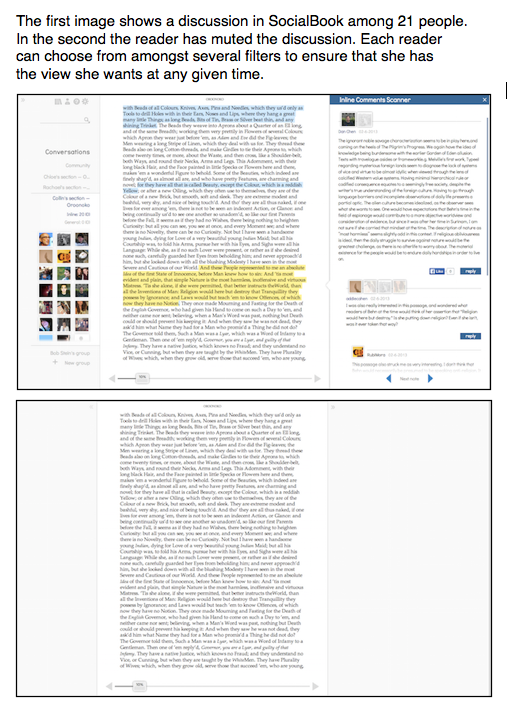
It's hard to tell – I certainly don't remember, though maybe Bob will – how different the current presentation is from the original. Navigation is a bit confusing: there are four main pages, but you need to click the button labeled "This way for the next object" to get to following pages. There's a very interesting sort of hypertext linking going on: links in the main text link to comments by other participants, who are sometimes, but not always, identified in the left margin. The design doesn't always work: but the pixelated graphics and complicated structure beckon us back to a time when the web was pure potential.

PermalinkComments (2)
tags:

iBooks wishlist Post date  06.16.2010, 9:04 PM

posted by bob stein

a fairly smart wishlist for iPad's iBooks -- including two features that are directly related to social-reading.

PermalinkComments (7)
tags:

cheap editions past & present Post date  04.28.2010, 1:50 PM

posted by dan visel

I've been reading Homer lately, particularly The Odyssey. Obviously, I should have read him a long time ago, probably in high school: I remember, vaguely, extracts from the book, but nobody ever made me read the whole thing. To a certain extent, it's a book that you don't have to read any more because everybody's already read it for you. But it's worth going back to read things for yourself, so I've been having a small project, picking my way through the various English translations.

While on a visit home, looking for something to read, I picked up the Great Books edition of Homer, volume IV in that series. This edition of the Great Books of the Western World, edited by Robert Maynard Hutchins and published by the Encyclopaedia Britannica in 1952, was my family's one real pretension to intellectualism. I am not entirely sure how it got into the house; it was never really read, because, as, my mother explained, the type was too small. It was also vexingly incomplete, as some religion-crazed relative had made off with Volume II of Thomas Aquinas, which bothered me immensely as a youth. I don't think anyone actually read any of these; I'd periodically pick up one volume or another ("Darwin" or "Swift/Sterne") with intent, but I don't remember how far I would get. Looking at the list of authors now, it seems decidedly weird: Plotinus gets a whole volume? Is it really worth reading Lavoisier or Fourier or Faraday now? The English-language novelists consist entirely of the aforementioned Swift & Sterne, followed by Fielding (Tom Jones), then a big jump to land on Moby-Dick. The ending sequence, volumes 49 through 54, seems particularly ominous: Darwin, Marx & Engels, Tolstoy, Dostoevsky, William James, Freud. Presumably there's a good history of the Great Books project, though I haven't seen anything other than Wikipedia's entry, which points out that ours was the first edition of the Great Books of the Western World, and that Sterne and Fielding were dropped in the second.

But picking up their Homer, it turned out that the translations being used are by Samuel Butler. His is a translation that I'm particularly interested in because it's the one that James Joyce used as the background for Ulysses. It's a decidedly idiosyncratic translation: most prominently, names are given their Roman rather than Greek version, so Odysseus is Ulysses. Butler famously decided that Telemachus' room must have been in a tower, which is why Joyce's novel begins in one. Butler's version is also prose. It's an odd choice, really, for a version to include as one of the Great Books: while it's eminently readable, Butler's ideas about Homer and how he should be translated were very much his own, and his introduction and footnotes explain his view that the Odyssey was written by a woman (probably Nausicaa) and ferret out details in the text that support this view; Butler had first advanced this view in The Authoress of the Odyssey (1897), and came at his translation with an argument, albeit one argued in a way that leaves much to be desired. (This note on III.266 might be taken as typical: "The writer – ever jealous for the honour of women – extenuates Clytemnestra's guilt as far as possible, and explains it as due to her having been left unprotected, and fallen into the hands of a wicked man."

What I like about the Butler translation (there's an online edition at the Internet Archive) is precisely how idiosyncratic it is: his Nabokovian concern for how Ulysses' house was laid out led him to include his photographs of houses that he'd seen in Sicily which, he supposed, might be similar to the Greeks'. In his introduction, he apologizes that a man and a dog appear in one of the pictures: this, he says, was "accidental, and was not observed by me till I developed the negative". Looking at the illustration in question, one notes that there's also a person in the lower illustration; this person is not apologized for, and one wonders who he might be. But the reader is reassured that they are safely in the hands of a kook; Butler clearly had no interest in academic rigor, which is what makes it more interesting that his would be the translation selected to go into the Great Books. Maybe that's why Joyce liked him: Butler's ideas about Homer are wildly divergent from what everyone else thinks, but his prose is always entertaining.

What's weirdly interesting about the Great Books edition, however, is that the editors have swept away Butler's introduction and notes. Not, however, particularly well: consider the start of Book IV, which starts, in Butler's original, in mid-sentence, the sentence having been started at the end of Book III. While the Great Books Book III ends in a comma ("Now when the sun had set and darkness was over the land,"), Book IV starts, in house style, with a drop-cap, capitalized, of course: "They reached the low lying city of Lacedæmon, where they drove straight to the abode of Menelaus". The next phrase starts with a bracket: "[and found him in his own house, feasting with his many clansmen"; at the end of the next paragraph, we find the end bracket. No explanation, in the Great Books edition, is given for these brackets; however, turning to the scan in the Internet Archive, we find an interesting note:

The lines which I have enclosed in brackets are evidently an afterthought – added probably by the writer herself – for they evince the same instinctively greater interest in anything that may concern a woman, which is so noticeable throughout the poem. There is no further sign of any special festivities nor of any other guests than Telemachus and Pisistratus . . .

One wonders, really, how many people ever actually read Homer in the Great Books edition: did the editor? Butler's ghost brackets, for what it's worth, don't end in 1952; the online edition at MIT's Internet Classics Archives also has them and no notes; the Project Gutenberg edition, from 1999, includes Butler's notes, but in unwieldy fashion (they are numbered, at the end, and don't include his frequent use of Greek), and, inevitably, a huge number of people have issued cheap print-on-demand & Kindle versions of Butler's Odyssey; looking inside one revealed it to be lacking notes though it did have brackets. Others can't be inspected, and one has to assume the worst. (My favorite of Amazon's lot is the nicely titled The Odyssey B utler – one hopes the extra space is significant – an unknown new work by Samuel Butler.) One knows, of course, that the people creating these POD and Kindle editions are hacks, if they're even people at all and not a batch script running on the Gutenberg library. This isn't, of course, a problem specific to Amazon: the same seems to be true with most of the easily accessible versions on the iPhone. It's odd to realize, though, that the editors of the Great Books seem to have had the same hackish tendencies. The reason for the choice of the Butler translation for inclusion is almost certainly not because they thought Butler's was the best (or because they realized the importance of this translation to Ulysses); rather, Butler's was probably the most recent translation out of copyright in 1952. I wonder again about the ending sequence of the original edition of the Great Books: did the Great Books series come to that conclusion because copyright gets in the way?

PermalinkComments (4)
tags:

alain pierrot on time chunks in books Post date  04.26.2010, 7:25 PM

posted by alain pierrot

Alain Pierrot gave us permission to repost this:

Martyn Daniel's remark about Ether Books' move into the digital short story, which can be "read as installments" (thanks to Virginie Clayssen for the link) rang a bell for me about the way many kinds of readings compete for chunks of my attention.

Can I read the next chapter of this essay, study or novel before I'm called to board the plane, before my train comes to the station, or should I pick a shorter magazine article or a short story from Ether Books, etc.?

On a more professional field, can I spare the time to read the full version of the report, or should I restrain to the executive summary, plus the most relevant divisions of the report before the meeting?  

Or in academic situations, what amount of reading time should I plan to spend on the textbook, on the recommended readings and extra relevant titles before I sit term/final examinations?

Cross this with the last remarks in the excellent post from Information Architects, about their work on Average Reading Time (ART): 

Imagine, when you read a book, it doesn't show you how many pages are left or how many words you have read, but how far into the text you are time wise and how much reading time is still ahead of you. Imagine that, when you write a text it doesn't count words but the right column tells you:
  1. how much time you spent to read your text until the cursor position (top number)
  2. the total reading time (bottom number)

iPad-time-counter-ART.jpg

And they prepare to manage calibration, which should allow to match individual skills, reading situations, with different texts – I don't read Joyce's Ulysses at the same rate as the last issue of Wired !

Wouldn't it be a good idea to leverage all the occasions where digital texts are chunked in relevant spans to store their ART into metadata, made available to apps that would sort timewise what I'm proposed to read? Social media and relevant storage solutions might host measured ARTs at convenience.
XML structured editing affords many solutions for identifying the relevant sections of texts, and storing their length, timewise. I would love to see the feature embedded into a next version of ePub, or at least recommended as best practice.

Would that make sense for Google Books, Amazon, iBooks, publishers, librarians?
PermalinkComments (0)
tags:

very interesting piece on the state of e-reading Post date  04.22.2010, 7:22 PM

posted by bob stein

Embracing the Digital Book, by Craig Mod

PermalinkComments (1)
tags:

slow reading Post date  04.08.2010, 12:40 AM

posted by dan visel

Roger Ebert's blog brings news of a very slow viewing of a movie – Werner Herzog's Aguirre, the Wrath of God. Ebert is in Boulder for the Conference on World Affairs; what's going on is a shot-by-shot viewing of one of Herzog's masterpieces, a process that Ebert calls Cinema Interruptus. Herzog and another director, Ramin Bahrani, watch the film together in front of an audience, stopping after every shot and discussing what's on the screen. The audience – an ample one, from Ebert's description – shouts out questions as well. Herzog's director's commentaries, of course, are some of the best exemplars of the genre: what was happening behind the scenes in his movies is almost always as interesting as the indelible images that appear before the lens. There are no end of things to talk about; and the shot-by-shot method takes a long time, eight hours in total, so the viewing is broken up over nights.

aguirre_monkey.jpg

This is a fantastic idea, which makes me wish I were in Boulder to be part of it. I like the idea of this kind of slow and detailed "reading": to take a work of art & to lavish time on it. It seems, in our age of media overload, almost luxurious: this idea of devoting so much time to one text. In eight hours, we can see four movies. To give that much time to one seems decadent. But maybe this is what works of art deserve; maybe this is how we should be reading. The problem of availability is something that seems increasingly to have been solved. To view or to read well is another kind of problem. In the past, when there was an economy based on scarcity, this might not have been as much of an issue: whatever was available was watched or read. Now we need to think about how we want to watch: we need to become better readers.


PermalinkComments (10)
tags:

the iPad is more a re-invention of the book than the computer Post date  04.03.2010, 12:14 PM

posted by bob stein

As readers of if:book know, i've often referred to books as the principal vehicle humans have used to move ideas around time and space. Thanks in large part to the internet, over the past fifteen years that function is increasingly being supplanted by the internet/computer/screen combo. I know many people are disappointed in the iPad because they see it as a crippled computer (e.g. Cory Doctorow's recent rant in Boing Boing). Perhaps, if Cory and other critics would stop thinking of the iPad as a computer, but rather think of it as the container for a new kind of book, they might see its potential in a different light. Although a book (in technology terms) is a closed system and certainly not a platform for creativity in the sense that a computer (or a typewriter is), that hasn't stopped books from being invaluable to humanity. For me, the iPad is a an exciting baby step on the way to realizing Neal Stephenson's astonishing conception of the future of the book as described in Diamond Age: Or a Young Lady's Illustrated Primer. Well worth the read.

[NOTE: Having said all this, I am still very disappointed in all the ways that Apple limits that potential by insisting that the iPad live within the tightly controlled garden walls it has constructed.]

PermalinkComments (11)
tags:

future of publishing? -- not really Post date  04.01.2010, 4:12 PM

posted by bob stein

People keep sending me links to this Dorling Kindersley video expecting I'll love it. Actually, although i find it cute in its construction, i think it's fundamentally inaccurate in both directions. Young people are not as vacuous as portrayed in the "forward" direction. "Reverse" is even worse, as it suggests that no real cultural change is underway. Frankly i see this video as a dream piece constructed to reassure middle-aged intellectuals that the seismic shifts which are upending life as we know it are not really happening.

PermalinkComments (7)
tags:

Margaret Atwood in the twittersphere Post date  03.31.2010, 6:54 AM

posted by bob stein

Recent piece by Margaret Atwood in the New York Review of Books. Posting this mostly because it's a lovely read. One question it raises though is whether the Twitterverse that Atwood describes is more a broadcast medium than a mechanism for many-to-many communication?

PermalinkComments (1)
tags:

The New Everyday Post date  03.30.2010, 12:08 PM

posted by kathleen fitzpatrick

MediaCommons yesterday unveiled The New Everyday, an experiment in "middle-state publishing" being undertaken as part of a two-year project undertaken by the New York Visual Culture Working Group, housed at NYU and funded by its Humanities Initiative. The New Everyday is working, as its editor, Nick Mirzoeff has noted, to explore the location of the everyday "in the era of globalization, migration, outsourcing and global media," asking "what work is done by and as the everyday, where and by whom?"

The project has launched with a cluster edited by Nicholas Mirzoeff considering the murder of Jorge Steven López Mercado. The pieces that form this cluster are open for discussion, and are intended to be seen, both collectively and individually, as remaining somewhat "in process." We hope that you'll join the discussion within this cluster, and that you'll consider curating a future cluster as well.

PermalinkComments (0)
tags:

follow the gamers -- my piece in the april Wired Post date  03.24.2010, 5:20 AM

posted by bob stein

This month's Wired has an article by Steven Levy on the expected impact of the iPad. The article includes a sidebar with thirteen comments from various people including me. The editors cut my first paragraph which contained some crucial context so I've reproduced the whole thing here:

Although we date the "age of print" from 1454, more than two hundred years passed before the "novel" emerged as a recognizable form. Newspapers and magazines took even longer to arrive on the scene. Just as Gutenberg and his fellow printers started by reproducing illustrated manuscripts, contemporary publishers have been moving their printed texts to electronic screens. This shift will bring valuable benefits (searchable text, personal portable libraries, access via internet download, etc.), but this phase in the history of publishing will be transitional. Over time new media technologies will give rise to new forms of expression yet to be invented that will come to dominate the media landscape in decades and centuries to come.

Twenty-five years ago, when I founded the Criterion Collection and Voyager, my imagination reached only as far as multi-media -- enabling authors to express ideas with a more complex palette that included audio, video, text and graphics. The CD-ROMs of the early nineties hinted at these possibilities. However, with the advent of the internet, particularly the web browser, it's now clear that locating works in a dynamic digital network promises even more fundamental changes.

Although we grew up with images of the solitary reader curled up in a chair or under a tree and the writer alone in her garret, the most important thing my colleagues and I have learned s from a series of experiments with "networked books" is that as discourse moves off the page onto the networked screen, the social aspects of reading and writing move from background to foreground. This transition has profound implications for readers, writers, and publishers, as traditional hierarchies flatten and online communities proliferate. A book is on its way to becoming a "place" where readers congregate, sometimes with authors. Lest this sound far-fetched, Motoko Rich, who covers the book industry for the New York Times, took note of this trend on January 24th, writing that "Reading might well have been among the last remaining private activities, but it is now a relentlessly social pursuit."

The arrival of the Apple, Android and Nokia tablets ups the ante for publishers. Simply moving printed texts to the tablets (as they have with the Kindle) will be of value, but within five to ten years the most successful publishers will have enthusiastically embraced new multimedia-based forms. More importantly, they will have figured out how to structure these works as vibrant communities of interest.

My sense is that this time around it's not going to take humanity two hundred years to come up with the equivalent of the novel, i.e. a dominant new form. Not only do digital hardware and software combine into an endlessly flexible shapeshifter, but now we have gaming culture which, unlike publishing, has no legacy product or thinking to hold it back. Multimedia is already its language, and game-makers are making brilliant advances in the building of thriving, million-player communities. As conventional publishers prayerfully port their print to tablets, game-makers will jump on the immense promise of these shiny, intimate, networked devices.

PermalinkComments (3)
tags:

this progress Post date  03.13.2010, 3:13 PM

posted by dan visel

Buried in the middle of Claude Lévi-Strauss's Tristes Tropiques, a book digressive in exactly the right way, is an astonishing argument about writing. Lévi-Strauss considers what the invention of writing might mean in the history of civilizations worldwide, arriving at a conclusion that still surprises:

The only phenomenon with which writing has always been concomitant is the creation of cities and empires, that is the integration of large numbers of individuals into a political system, and their grading into castes or classes. Such, as any rate, is the typical pattern of development to be observed from Egypt to China, at the time when writing first emerged: it seems to have favoured the exploitation of human beings rather than their enlightenment. This exploitation, which made it possible to assemble thousands of workers and force them to carry out exhausting tasks, is a much more likely explanation of the birth of architecture than the direct link referred to above. My hypothesis, if correct, would oblige us to recognize the fact that the primary function of written communication is to facilitate slavery. The use of writing for disinterested purposes, and as a source of intellectual and aesthetic pleasure, is a secondary result, and more often than not it may even be turned into a means of strengthening, justifying or concealing the other. (p. 299)

An idea this inflammatory is perhaps one that can only appear deep in a book like this, where the reader will find it only by mistake. But this is an argument that I haven't seen resurrected in all the present talk about what's happening to reading and writing in their present explosions. One sees on an almost-daily basis recourse to the position of Socrates in Plato's Phaedrus – technology, no matter how simple, inevitably leads to a lessening of human facilities of memory – but this is something different, and one that I think merits consideration. Periodically, I wish that someone would present a cogent argument against reading, rather than the oft-regurgitated pablum that "at least the kids are reading."

Lévi-Strauss is presenting a hypothesis rather than a complete argument, a suggestion quickly offered before he travels elsewhere: and I need to add the caveat that I'm not sufficiently versed in anthropology to know whether this was generally thought to be historically accurate in 1955, when the book was written, or whether this can be historically supported today. One needs, as well, some context: Tristes Tropiques is a rambling book in which Lévi-Strauss considers his travels in search of anthropology: in this book, he questions whether meaning is to be found in academic work or in personal experience, dipping freely into both. It's a book informed as much by anthropology as it is by Surrealist prose and the recent experience of World War II. Lévi-Strauss is making his hypothesis on the origin of "writing for disinterested purposes, and as a source of intellectual and aesthetic pleasure" in the midst of a book that functions in precisely that way. He argues from the literary position. But following his ideas, Gutenberg's invention of movable type leads directly to the excesses of European colonialism. Elsewhere in his book, Lévi-Strauss visits the last remnants of indigenous tribes in the interior of Brazil, peoples who are being wiped out by the encroachment of civilization; the sadness of his title is due in part to his realization of his culpability in this loss.

Lévi-Strauss's argument bears thinking about now, at the dawn of a new era of writing. What happens now? Already our ideas about privacy are radically different than they were a decade ago. We are increasingly dependent upon the web: living without Google's various incarnations for even a week would be extremely difficult for most people I know. This isn't, to be sure, slavery – we don't yet live at the pleasure of Google or Apple – but these are new mechanisms of control which we can't really claim to entirely understand at present. Lévi-Strauss was writing in the aftermath of WWII – his detainment escaping Vichy France is a major thread in his narrative – which might account for his heightened tone.

Lévi-Strauss invites us to consider literary freedom (or, more generally, "book culture") as a spandrel in the sense that Stephen Jay Gould employed the term: something that evolves not towards its own end, but because it doesn't impede (and may in fact support) other forces. I think Lévi-Strauss's hypothesis is interesting to consider because it posits our present book culture as an exception, rather than something that naturally happens because of the flow of economic or historical forces. Amazon, Apple, or Google aren't going to preserve book culture for us because it's in their economic interests; rather, it doesn't impede their economic expansion. This makes our position clearer. In Gould's view of life, humanity's existence is a happy accident: evolution isn't teleological and doesn't automatically lead to us. We are an accident – a happy one, to be sure, but an accident nonetheless. There's a grandness to this idea: with all the forces of chance stacked against us, we still exist. I think a similar argument could be made for book culture: it doesn't have to exist, and, indeed, its existence may be entirely accidental. 

Lévi-Strauss, like Gould, is looking backward, surveying history (or prehistory). But a better understanding of the past may make us better prepared to understand the present or the future. We can't change the past, only our understanding of it; but we can act on the present. The future of the book is not something that can be counted on: left to itself, the market may solve the problem of distribution, but it's not going to solve the problem of culture. We can do that.

*     *     *     *     *

in-the-guggenheim.jpg

*     *     *     *     *

I found myself reading Lévi-Strauss because of an exhibition by Tino Sehgal at the Guggenheim here in New York. For a piece entitled "This Progress," Sehgal emptied the spiral ramp of the Guggenheim of its art: the visitor ascending the ramp was met by a small child, who asks you to explain what you think progress is. You do this as best you can; there's a back and forth, and this conversation carries on up the spiral. At a certain point, you're met by a high school student, who continues the conversation; then a young adult; and finally an older adult, who walks with you to the top-most point in the Guggenheim. There's a great deal of careful choreography going on, so the conversation breaks and remakes itself across your offerent interlocutors – but what's centrally interesting about the piece is that the visitor is engaged in a sustained conversation with strangers about the idea of progress. There's something deeply strange about this: post-college, we so rarely engage in conversations about abstract ideas. It's equally odd to be engaging with people who aren't your age: the way on talks to a six-year-old is necessarily different from the way one talks to a sixty-year-old. This can be deeply engrossing: on a visit a few Mondays ago, my friend Nik and I went up (with others) and down (together) five times in four hours.

(It's worth noting that I'm not entirely a disinterested participant: among the adults working in the show were Bob Stein, McKenzie Wark – author of Gamer Theory – and Ashton Applewhite, who's been hovering unobtrusively in the margins of the Institute since its beginnings. The piece is set up, however, in such a way that the visitor always ascends the spiral with strangers. The show is now over, so it can now be pointed out that the Bob in the New York Time review is our Bob.)

One quickly discovers that what happens when one ascends the spiral is different every time, though the structure is constant. Some conversations are interesting; some are less so. Some are over quickly; some carry on so long that you worry that you've fallen out of the piece entirely. While some of the rules can be easily understood – the small child always attempts to explain what you've said to the second person, and the introduction of the third person always seems like an interruption – some aren't so obvious. After the child asks what progress is, none of your other conversation partners use the word "progress". A sense of recurrence comes up: observing carefully, one can get the idea of what your conversation partners are doing behind the scenes to create this sense. Going up the spiral with a friend doesn't work as well as you might expect: the dynamics of a conversation with a stranger are very different from a converstion with a stranger and a friend.

It's difficult to know what to say when asked by a small child to explain what progress means. One quickly discovers the limitations of language: progress, we think, is the idea that things move forward, but that doesn't explain why something in front of something is naturally better: it's simply a structure of our thought that we construe things in front of us (or above us) as things we aspire to in some way. It's hard not to think in this way when ascending a ramp, though weirdly the ramp as metaphor doesn't seem to arise. Progress, I argued on a second time through, is a construct, a narrative that we impose upon the world though it doesn't appear in nature. Or progress might be the idea that things can get better than where they are now: but to live in hope of the future is to deprecate the present. The form of the Guggenheim is circular as well: from life we understand that there are sometimes cycles in the way we move through the world. Things sometimes get better, but they sometime get worse: but a world is which things constantly improve isn't realistic. The Guggenheim's spiral, astonishing work of architecture that it is, doesn't go on forever. At a certain point you have to stop and turn around. Is it better to look down from the top of the Guggenheim's spiral or up from the bottom? Convincing arguments can be made for both.

Have things gotten better over time? A few turns into my time at the Guggenheim I started asking the older adults this question. One often hears from older people how great things were in the past; but it's more rare to hear a qualitative judgment about whether things have improved or not. Responses varied, of course: some thought there were upswings and downswings, some thought that there had been tremendous improvement over their sixty years though they thought that was a historical anomaly they were lucky to have lived through. On his last time through, my friend Nik found himself with a professor Greek: how, Nik wanted to know, were we essentially different from the Greeks? Could we be said to be happier than the Greeks – or they happier than us? Hard to say, said the Greek professor; Nik, who is a reporter turned politician and familiar, from both sides, with such attempts at elusion, kept hounding him for an answer. The difference, the man finally confided, was that the Greeks didn't have our idea of progress. He thought they were probably happier because of that.

It's an apt time for a discussion about progress: everyone seem to agree that we're in a worse place than we were a decade ago, despite now having Facebook, YouTube, and all the pirated music and movies anyone could ever one. Technology has moved along. But the world doesn't seem to have followed suit. We're not a more just society because self-publishing online enables everyone to have a voice, despite the pontificating of people like Wired and TED. In America, fewer people control more of the wealth than they did a decade ago. While it would be foolish to suggest that everything has gotten worse over the past ten years – the argument can certainly be made, for example, that we're a more tolerant society than we were – there's a palpable disappointment in the air.  

After I left the Guggenheim, exhausted from so much talking, I realized that I hadn't managed to ask a very obvious question: why was there the this in the piece's title "This Progress"? Perhaps it's because progress only exists as an idea when we lend credence to it: our own personal idea of progress rather than something that exists naturally. Awareness of this is important. We need to interrogate the idea of progress, both in terms of what we believe and what society around us believes. Too often we're simply swept along by the flow of time. The power of the idea – the power of the thought experiment, whether Lévi-Strauss's questioning of the goal of writing or Sehgal's questioning of progress – is that it allows reclamation of agency.

PermalinkComments (12)
tags:

for those in new york Post date  02.23.2010, 11:10 AM

posted by dan visel

For those in New York: I'm going to be interviewing Bob Stein on Thursday as part of The Public School New York. This is part of The Public School's series on The Page + The Screen, which looks interesting all around. It's at 7:30 pm at 177 Livingston, a brand new space in downtown Brooklyn being operated by Triple Canopy, Light Industry, and The Public School New York. This should be a wide-ranging conversation about publishing & discourse past, present, and future. It's free.

Also: the Institute is putting together a series of occasional get-togethers for independent publishers in New York who are working or interested in working in online spaces and who are interested in talking to others doing the same. Email me (dan at futureofthebook dot org) for more details if you're interested.

And finally, if you are in New York, it's well worth setting aside some time to catch the Tino Sehgal show now up at the Guggenheim. We should have mentioned this earlier, but a handful of Institute-affiliated people are involved in this.

PermalinkComments (0)
tags:

and now we have an ipad Post date  01.28.2010, 11:00 AM

posted by dan visel

The iPad has arrived, to no one's surprise: as soon as you use an iPhone, you start wondering what a computer-sized version of the same would be like. (Those interested in how past predictions look now might look at this post by Ben from five years ago.) The iPad is an attractive device and at $500, it seems likely to take off. It seems entirely possible that a tablet could replace laptops and desktops for many computers, to say nothing of Kindles and Nooks. My MacBook Pro suddenly feels rickety. Hardware-wise, it feels like the iPad might finally be Alan Kay's Dynabook.

And yet: standing on the verge of a potential transformation in how people use computers, I think it's worth stepping back for a second to think about where we are. I suggest that now might be a useful time to re-read Neal Stephenson's manifesto, "In the Beginning Was the Command Line". This is, it needs to be said, a dated piece of writing, as Stephenson has admitted; this is the perpetual curse of writing about technology. Stephenson was writing in 1999, when Microsoft's monopoly over the computer seemed to be without limit; Apple was then in an interregnum, and Google and Amazon were promising web players in a sea of many other promising web players. "In the Beginning Was the Command Line," however, is still worth reading because of his understanding of how we use computers. The promise of the open source movement that Stephenson described was that it would give users complete control over their computers: using Linux, you weren't tied into how corporations thought your computer could be used but were free to change it as you desired. And there's a deeper question that Stephenson gets at: the problem of how we understand our tools, if at all. We can theoretically understand how an open system works; but a closed system is opaque. Something magic is happening under the hood.

Things have changed since then: the Linux desktop never really took off in the way that seemed possible in 1999. Corporations – Apple and Google – showed that they could use open source in a tremendously profitable way. What made me think about this essay yesterday, however, was the iPad: Apple has created a computer that's entirely locked down. The only applications that will run on the iPad are those that have been approved by Apple. And this is one of the first computers where the user will be entirely unable to access the file system. I understand why this is possible from a design standpoint: file systems are arcane things, and most people don't understand them or want to understand them. But this means that Apple has a complete lock on how media gets into your iPad: you're tied into an Apple-approved mechanism. The user of the iPad, like the user of the iPhone, is directly tied into the Apple economy: your credit card on file with Apple not only lets you buy apps and media, but it will also allow you to buy internet connectivity.

It's simple – it's fantastically simple, and it will probably work. But I can't help but think of how Stephenson metaphorically equates the closed system of Windows 95 to a car with the hood welded shut: you can't get inside it. Apple's managed this on a scale that late 90s Microsoft could only dream of. I wonder as well what this means for our understanding of technology: maybe technology's become something we let others understand for us.

PermalinkComments (12)
tags:

how discourse on the web works Post date  01.23.2010, 11:10 AM

posted by dan visel

Good weekend reading: Jonathan Dee's examination of the fall from grace of Charles Johnson's Little Green Footballs. Internecine fighting on the right isn't inherently interesting; however, Dee's piece is as much about how we think now. A few samples:

That concept of the link, in all its permutations, is the key to what happened next, both to Johnson and because of him, and it says something enlightening not just about blogging but also about the nature and prospects of citizen journalism. Whatever you think of him, Johnson is a smart man, a gifted synthesizer of information gathered by other people. But just as for anyone in his position, there is an inevitable limit to what he can learn about places, people, political organizations, etc., without actually encountering them. Instead of causes and effects, motivations and consequences, observation and behavior, his means of intellectual synthesis is, instead, the link: the indiscriminate connection established via search engine.

Johnson evidently fell out with the right-wing blogosphere when he realized that the right wing he was associating with was shading into the historical right wing; in his case, he realized that Vlaams Belang, a Flemish nationalist party in Belgium, weren't the most savory of consorts:

Regardless of whether Johnson's view of Vlaams Belang is correct, it is notable that the party is defined for him entirely by the trail it has left on the Internet. This isn't necessarily unfair – a speech, say, given by Dewinter isn't any more or less valuable as evidence of his political positions depending on whether you read it (or watch it) on a screen or listen to it in a crowd – but it does have a certain flattening effect in terms of time: that hypothetical speech exists on the Internet in exactly the same way whether it was delivered in 2007 or 1997. The speaker will never put it behind him. (Just as Johnson, despite his very reasonable contention that he later changed his mind, will never be allowed to consign to the past a blog post he wrote in 2004 criticizing that judicial condemnation of Vlaams Belang as "a victory for European Islamic supremacist groups.") It may be difficult to travel to Belgium and build the case that Filip Dewinter is not just a hateful character but an actual Nazi (and thus that those who can be linked to him are Nazi sympathizers), but sitting at your keyboard, there is no trick to it at all. Not only can the past never really be erased; it co-exists, in cyberspace, with the present, and an important type of context is destroyed. This is one reason that intellectual inflexibility has become such a hallmark of modern political discourse, and why, so often, no distinction is recognized between hypocrisy and changing your mind.

Dee does a fine job of examining exactly how the Internet has changed discourse with political ramifications: it's a long piece, but it's worth reading in full.

PermalinkComments (2)
tags: